Generator Noise Distance Calculator
Estimate campground sound level at a tent, RV wall, picnic table, or property line using generator dBA rating, distance, load, terrain, barriers, and quiet-hour targets.
🏕Real Camping Presets
📏Generator And Site Inputs
🔊Generator Spec Comparison Grid
📊Reference Tables
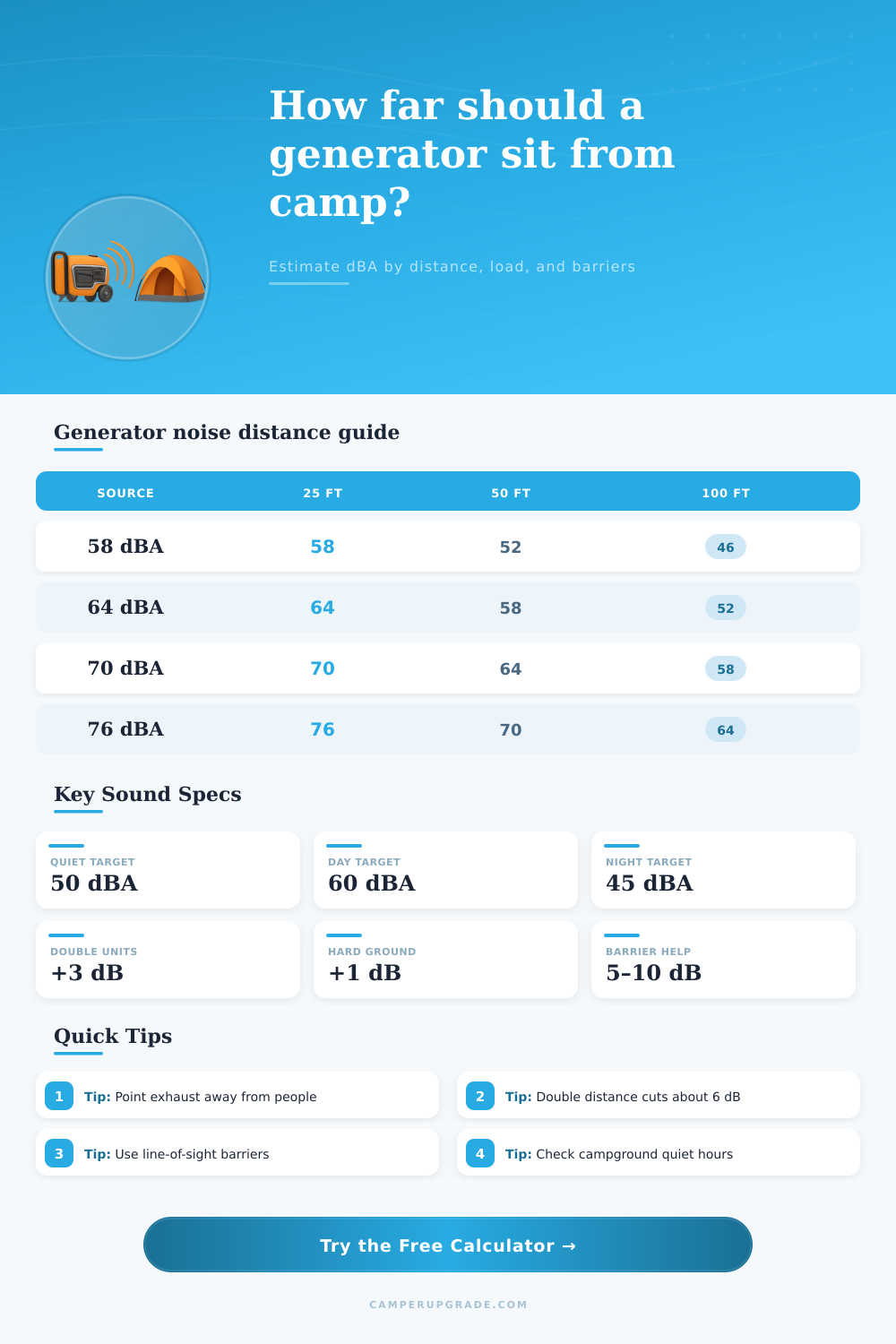
| Published Rating | At 25 ft | At 50 ft | At 100 ft | At 200 ft |
|---|---|---|---|---|
| 54 dBA at 23 ft quiet inverter | 53 dBA | 47 dBA | 41 dBA | 35 dBA |
| 58 dBA at 23 ft common inverter | 57 dBA | 51 dBA | 45 dBA | 39 dBA |
| 64 dBA at 23 ft large inverter | 63 dBA | 57 dBA | 51 dBA | 45 dBA |
| 74 dBA at 23 ft open-frame portable | 73 dBA | 67 dBA | 61 dBA | 55 dBA |
| Sound Change | What It Means | Distance Rule | Camping Use |
|---|---|---|---|
| -3 dB | Small but noticeable drop | Move about 1.4x farther | From 35 ft to 50 ft |
| -6 dB | Clear reduction | Double the distance | From 50 ft to 100 ft |
| -10 dB | Often perceived about half as loud | Move about 3.2x farther | From 30 ft to 95 ft |
| +3 dB | Two equal sources combined | Same distance, double units | Parallel inverter pair |
| Barrier Or Site Feature | Typical Adjustment | Best When | Watch Point |
|---|---|---|---|
| RV body blocks line of sight | -5 dB | Generator is behind the rig | Keep exhaust clear |
| Earth berm or dense fence | -6 to -10 dB | Barrier is close and tall | Gaps leak sound |
| Ventilated quiet box | -3 to -7 dB | Airflow is engineered | Overheating risk |
| Hard pavement or rock wall | +1 to +4 dB | Sound reflects toward camp | Shift angle first |
| Listener Target | Practical Range | Typical Scenario | Calculator Setting |
|---|---|---|---|
| Very quiet sleep | 40-45 dBA | Tent or thin camper wall | 45 dBA target |
| Quiet campground | 45-50 dBA | Neighboring campsite edge | 50 dBA target |
| Daytime comfort | 55-60 dBA | Awning area conversation | 58 dBA target |
| Work zone edge | 65-70 dBA | Brief tool or event power | 65 dBA target |
🧭Calculation Tips
When you wake up to birdsong, you know you are camping. What you don’t want to hear is the low hum of a two-stroke engine coming from the next site over. Campsite noise pollution isn’t visible; it’s when it hits your ears that it ruin everything. It is the fastest way to steal a night’s sleep or ruin an evening.
If most campers move their generator ten feet and think they’ve solved the issue, well, that’s just intuition and it’s wrong. Sound doesn’t drop off linearly as you get further away. It drops off following a geometric rule which means that for every doubling of the distance, the sound drops off significantly. Before you even unpack your tent, most of the trick is understanding how terrain can change things and what you’re really measuring.
How to Reduce Generator Noise When Camping
You can plug some numbers into our dB calculator to see how it works here, but knowing what goes in is more important than knowing what comes out. Begin with the generator’s rated decibel level, which you’ll find somewhere on its label. This is a tested number produced by manufacturers in a controlled environment typically at seven meters (twenty-three feet) away. That’s the starting place; it’s not a promise that life won’t be noisy.
If two generators sits side-by-side, their sound doesn’t get twice as loud. They gets roughly three decibels louder. On paper, that may seem insignificant. In person, it sounds like an audible increase in volume. The tool compensates for this stacking effect. This prevents you from underestimating the combined result of friends who share power or parallel inverters.
Your first line of defense is distance, but there’s another variable lurking here: ground conditions. Sound waves bounce off hard surfaces (think paved roads or gravel driveways) right back at you, while they gets absorbed by soft surfaces (like snow, or the soft forest floor). That can make a difference of several decibels in either direction.
A few decibels doesn’t sound like much. But it’s the difference between a hum you tune out in the background and a drone that won’t let you sleep. Nestled in a bed of deep pine needles? You need less setback. Boondocked on hardpan desert soil? You’re going to have to go farther. This chart below (from the page) explains it all. It shows how a typical class of generator will lose X number of decibels at a given distance (twenty-five, fifty, one hundred feet). So it becomes easy to see quickly that increasing distance from say ten feet to twenty gets you significantly less benefit then doing so from thirty feet to ninety feet.
“Barriers help. But the barrier has to be placed in the right location to prevent them from hearing the generator directly. For example, if you have an RV with the generator mounted behind it, the body of the RV will function as a sound shield. Also, heavy vegetation can help. A simple fence can also work. However, it won’t help at all unless it is solid and tall enough to stop the sound from bending around it. Many of us have put up these fancy-looking contraptions that look awesome, but they don’t work because they block air flow or cause overheating. Generators dies faster due to overheating then they do from noise complaints.
The tool shows the adjustment for barriers starting at three decibels for something with a low screen, up to 10 for an acoustic wall built specifically for the job. Knowing where yours fits in will give you some idea about its effectiveness before you bank on it saving your bacon.
In most established campgrounds (and lots of national parks), quiet hours exist, and if they’re broken, you leave the site. At any given moment, the margin calculation will tell you whether you’re over or under by that margin at this spot. So if it’s three decibels over, then yes, technically you’re breaking the rule. You need to increase the distance or create a better barrier.
Ambient sounds also count. Maybe there’s a ton of road noise and other people around so a fifty-decibel generator doesn’t make a peep in the middle of a bustling campground. But put it out in a quiet valley and it sounds deafening. The tool does both; it combines your generator output and the ambient noise to show the perceived sound at the site. It is not just the machine, but the overall acoustic environment.
Planning for setbacks isn’t really about being precise; it’s about being considerate. Friendships are free, a bit of extra space is cheap. Running the exhaust toward your neighbor? Free. Effective. The most effective thing you can do is to double up on distance. Do that before buying any gadgets, or complaining to the campground host. It’s simple social contract math; not forgiving math, but simple math nonetheless. You should of kept your distance generous. Keep your power quiet. Let everyone else enjoy the birds again.