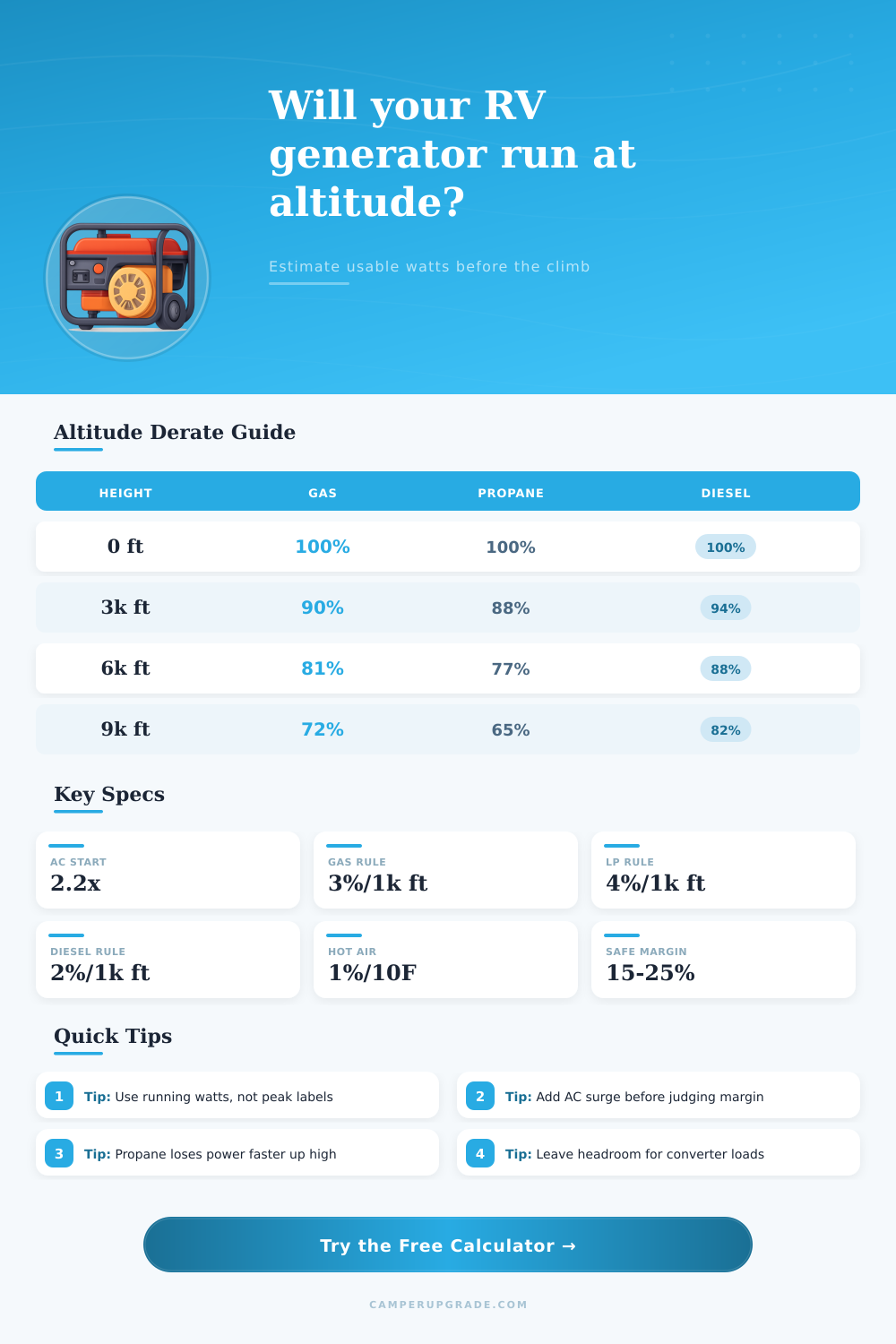
Generator Altitude Derating Calculator
Estimate usable running watts, surge margin, and appliance capacity after elevation, temperature, fuel, and RV load adjustments.
Derating estimates compare load against usable generator output. Always follow the generator manual for jetting, EFI altitude mode, maintenance, and maximum elevation limits.
Altitude Derating Results
| Elevation | Gas Carbureted | Gas EFI Inverter | Propane / LP | Naturally Aspirated Diesel | Turbo Diesel |
|---|---|---|---|---|---|
| Sea level | 100% | 100% | 100% | 100% | 100% |
| 3,000 ft / 914 m | 91% | 94% | 88% | 94% | 98% |
| 5,000 ft / 1,524 m | 85% | 90% | 80% | 90% | 96% |
| 7,000 ft / 2,134 m | 79% | 86% | 72% | 86% | 94% |
| 10,000 ft / 3,048 m | 70% | 80% | 60% | 80% | 90% |
| Ambient Air | Approx. Heat Derate | Reason to Apply | RV Example |
|---|---|---|---|
| 60°F / 16°C | 0% | Cool dense air | Spring forest campsite |
| 77°F / 25°C | 0% | Common rating baseline | Generator spec comparison |
| 90°F / 32°C | 1.3% | Lower air density and hotter windings | Sunny gravel pad |
| 100°F / 38°C | 2.3% | Reduced cooling margin | Desert boondocking |
| 110°F / 43°C | 3.3% | Heavy thermal stress | Hot canyon generator bay |
| RV Load | Typical Running Watts | Starting Surge | Derating Concern |
|---|---|---|---|
| Converter charging batteries | 300-900 W | Low | Often hidden load while AC runs |
| Microwave oven | 1,000-1,600 W | Low to moderate | Can overload small derated units |
| 13.5k BTU rooftop AC with soft start | 1,300-1,700 W | 600-1,600 W | Usually manageable with margin |
| 15k BTU rooftop AC standard start | 1,500-2,000 W | 2,000-3,500 W | Surge is often the failure point |
| Coffee maker or toaster | 900-1,500 W | Low | Resistive load consumes steady capacity |
| Generator Class | Best RV Use | Altitude Sensitivity | Load Planning Note |
|---|---|---|---|
| 2.0-2.5 kW inverter | Battery charging, small microwave, light AC use | High for gas carb models | Watch compressor start and eco mode response |
| 3.0-4.0 kW onboard gas | Single AC travel trailers and Class C rigs | Moderate to high | Usually needs appliance sequencing at 6,000 ft |
| 3.6-4.0 kW LP onboard | Propane-only Class C or truck camper setups | High | LP vapor power drops quickly with elevation |
| 5.5-7.0 kW gasoline | Toy haulers and dual AC fifth wheels | Moderate | Derated capacity may still support staggered loads |
| 8.0-12.5 kW diesel | Class A coaches and large inverters | Low to moderate | Turbo models retain capacity better above passes |
So you buy a generator labeled as three thousand watts and figure it will get job done on a mountain pass. After climbing up to seven thousand feet you turn it on and nothing happens but your lights go dim. No luck with the AC compressor coming online so now you’re in the dark and running on batteries only. Your engine isn’t broken. It just has no fire, and there’s not enough oxygen in the air at high elevation to feed it.
Thinner air mean there is less oxygen. This causes each combustion cycle to generate fewer BTUs then what manufacturer tested for at sea level. That’s called altitude derating and virtually nobody sees it coming until they’re staring at a cold, dead circuit breaker on some dark night.
Why Your Generator Loses Power at High Elevations
It’s all good if you have an idea what is required for your setup… Fuel type, elevation, and your anticipated load, and then it’s simple math. That’s why we included a generator calculator above. You don’t need to guess anymore if your propane tank will support your fridge or only heat the surrounding air with no cooling effect.
Here’s the deal: Your output drops approximately three-percent per thousand-foot increase in elevation. That percentage increases significently, almost four-percent if you’re using liquid propane. That’s because propane acts differently at reduced atmospheric pressure; it vaporize easier. The carburetor recieve a leaner mixture than the engine can handle, and the result is a loss of pulling power.
Even diesel engines (which compress air first before injecting fuel) experience the impact above five-thousand-feet unless they is turbocharged. All of this is laid out nicely in the reference table on the page. And it make short work of seeing how fast those percentages add up against your requirements.
But there’s another factor, the silent one: Temperature matter too. Hot air isn’t as dense as cold air. This means your generator will experience double the effects of a blistering August desert afternoon compared to a chilly desert morning at the same altitude. Enter the ambient temperature, and the tool takes that thermal derating into account, subtracting a slight amount for each degree above the standard test conditions.
Sounds like a little thing. But a two-percent reduction might mean the difference between starting a microwave or tripping breaker while making coffee. You think “it started the engine, it must of have a lot of reserve capacity,” but nope. Each mile climbed and every heatwave reduce the margin.
Up high, maintenance is much more critical than at sea level. Airflow is limited anyway; a plugged up air filter means even less gets through.” Your generator has not been tuned yet? You’re doubling the derating penalty by being mechanically inefficient too. The calculator lets you rate “maintenance condition,” meaning real world degradation from wear and tear.
That’s where a lot of RVers get hurt, they’ll go out and purchase a three kilowatt generator, camp at five thousand feet and complain that their air conditioner won’t work. By itself, the elevation causes the unit to deliver probably just eighty percent of what it was rated for. Now factor in some dirt and dust, heat, and old spark plugs, and you’re lucky to see seventy-five percent.
Don’t obsess over the generator rating… Consider your actual power use. Listeners tend to zero in on the running watts (how much does it pull to keep running) without considering surge watts (what amount will start). Starting something like an AC unit involves a giant gush of electricity to spin up the motor and then it runs at a reduced rate thereafter. You need to have some headroom or the generator will instantly overload when the starting spike exceeds your reduced surge capacity.
That’s where the tool comes into play, it precisely calculates your remaining cushion once all penalties are accounted for. Shoot for 20 percent or better buffer here. It increase the life of engine and also prevents it from having to labor. You’ll soon get good at planning for them.
If needed, sequence your loads (turn off the converter charger then kick on the microwave). And use a soft-start device on the AC so that it cuts its surge requirement. These little tricks will allow you to be running heavy appliances while still breathing thin air without blowing a fuse.
The math doesn’t lie but it also offers options because yes, you do have to live within the envelope of available heat and oxygen. The trick is to accept that constraint; it’s the first step to getting reliable power anywhere. Once you know why the engine is struggling, you stop fighting it and start managing it. That mindset shift is what keeps your lights on when everyone else’s in camp goes dark.