LiFePO4 Charge Current Calculator
Estimate a safe camper battery charge current from capacity, C-rate, temperature, BMS limit, charger source, state of charge, and system voltage.
⚡Camper Battery Presets
🔋Battery And Charger Inputs
Full Calculation Breakdown
⚙LiFePO4 Spec Comparison Grid
📊C-Rate To Amps Reference
| Bank Capacity | 0.10C Recovery | 0.20C Gentle | 0.30C Normal | 0.50C Fast |
|---|---|---|---|---|
| 100 Ah | 10 A | 20 A | 30 A | 50 A |
| 200 Ah | 20 A | 40 A | 60 A | 100 A |
| 300 Ah | 30 A | 60 A | 90 A | 150 A |
| 400 Ah | 40 A | 80 A | 120 A | 200 A |
| 560 Ah | 56 A | 112 A | 168 A | 280 A |
🌡Temperature Derating Reference
| Battery Temp | Charge Current Factor | Meaning | Camper Note |
|---|---|---|---|
| Below 32°F / 0°C | 0% | No charging | Use heated battery mode or wait |
| 32-41°F / 0-5°C | 25% | Very limited | Low solar current only if allowed |
| 42-50°F / 6-10°C | 50% | Reduced | Limit DC-DC or AC charger output |
| 51-113°F / 11-45°C | 100% | Normal range | Use manual or BMS charge limit |
| 114-131°F / 46-55°C | 50% | Heat reduced | Improve ventilation and reduce load |
| Above 131°F / 55°C | 0% | Stop charging | Allow the bank to cool first |
🔌Voltage Setpoint Reference
| Nominal Bank | Absorption Range | Float / Standby | Equalize | Notes |
|---|---|---|---|---|
| 12V LiFePO4 | 14.2-14.6 V | 13.4-13.6 V | Off | 14.4 V is common for RV chargers |
| 24V LiFePO4 | 28.4-29.2 V | 26.8-27.2 V | Off | Double the 12V values |
| 48V LiFePO4 | 56.8-58.4 V | 53.6-54.4 V | Off | Used on larger inverter systems |
| Storage hold | 13.2-13.4 V per 12V | No forced full charge | Off | Useful when parked for long periods |
🛻Camper Charging Source Comparison
| Charging Source | Typical Current | Current Control | Best Use | Important Limit |
|---|---|---|---|---|
| Portable solar controller | 10-40 A | Solar controller | Small trailers and top-off charging | Panel output varies through the day |
| Roof solar MPPT | 30-100 A | MPPT controller | Daily charging while camping | Set LiFePO4 voltage profile |
| DC-DC alternator charger | 20-80 A | Charger rating | Driving charge without alternator stress | Match alternator and wiring capacity |
| AC shore charger | 20-150 A | Charger rating | Fast campsite or driveway recharge | Do not exceed BMS charge current |
| Inverter-charger | 50-200 A | Programmed limit | Large RV battery banks | Confirm generator or shore input capacity |
💡Charge Current Tips
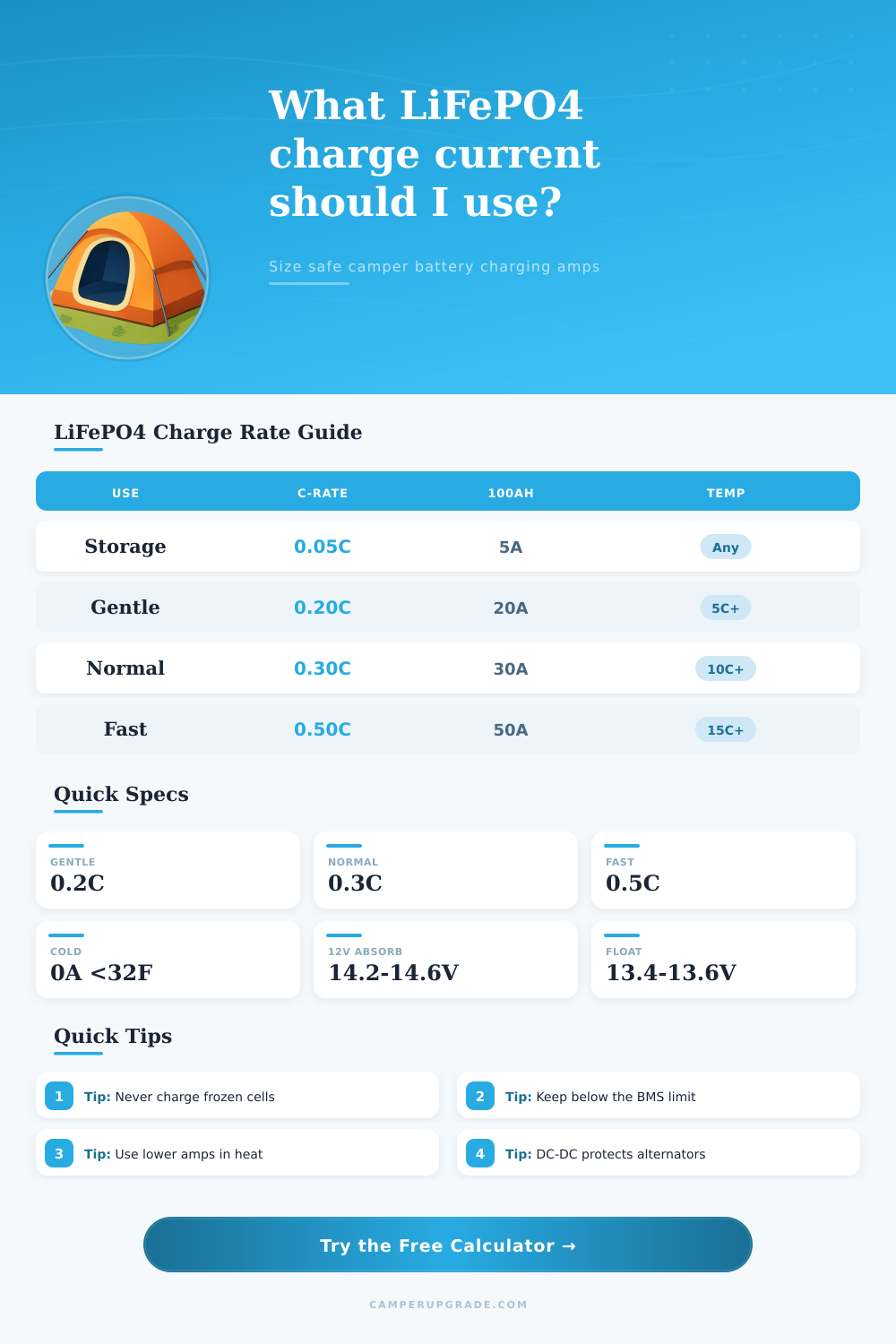
Charging current isn’t necessarily a set value but a rate of consumption to be considered. Say you have a two-hundred-amp-hour battery bank. If you push thirty amps into it the chemistry will take in fifteen percent of its total capacity every hour. It sounds okay until you double it. Now you’re trying to demand twenty-five percent per hour. This creates stress and heat which aren’t always mentioned in manuals.
Once you input your own capacity and desired C-rate, the calculator above do this math for you. In other words, you no longer need to guess if your charger are being too aggressive for your cells.
How to Charge Your Battery Safely
The other variable that destroys batteries more quicklier than overcharge is temperature. Cold weather is bad news for Lithium Iron Phosphate (the battery chemistry used by this tool), and in particular below-freezing temperatures. The sluggish solution doesn’t let the lithium ions move in very well, and the result is that charging process leads to metal plating within the cell, permanently damaging the cell and diminishing its capacity overnight.
If you charge in the cold, the tool adjust expectations accordingly. That’s a good thing; it means you’ll know that your charger should of probably just be turned off until cells are warm again. It is a small step but it is important if you ever camp out in spring or fall.
A second mistake many people make relates to power system’s limitations. They purchase high-wattage solar arrays and a massive inverter but neglect to check their battery management system for its ability to handle incoming power on the input side. Your BMS might cap charging at one hundred amps; even if it’s sunny out, you won’t be able to push two hundred amps in safe. To protect itself, the device opens relays, abruptly cutting off your power source. That ends your session mid-work or mid-cooking, which is frustrating.
Avoiding this means knowing your ceiling before purchasing charger. This is where the reference table on the page comes into play; it lays out how much current is safe (in amps) based off battery capacities for various situations. For example, a fast charge will refill your power more rapid but create some thermal buildup, whereas a gentle charge will preserve life span of your batteries. Normal camping frequently sits somewhere in-between the two extremes. People don’t always require maximum speeds when plugging it in…just consistent ones.
The amount of current also has something to do with the voltage setting. Pushing too many amps into a lithium battery on an absorption charge forces more current through higher internal resistance. This stress the batteries. On the other hand, if you set your absorption voltage too low on lithium chemistry you will not be topping it off sufficiently; instead, you will be cycling it shallowly and accumulating wear in a different way then deep cycling.
In a conventional twelve volt system, absorption typically occurs somewhere between fourteen point two and fourteen point six volts. Within this range the charger will complete its function while not harming cells.
There’s also issue of inefficiencies. The process generates heat. Batteries convert solar energy into stored power with some loss. Wiring itself is inefficient, and so forth. Your estimate for charge time assumes everything is perfectly efficient, which won’t be true. If you assume just a couple percent loss, you get more realistic sense of how long it really takes, enough that cloudy days aren’t a top-off-in-the-afternoon situation but rather an all-day-in-the-sun thing.
Lithium charging isn’t a tech issue, it’s a discipline issue. If you look closely at the specs, you’ve got all the information you need. This tool helps you connect the dots so you can sleep easy knowing your system is protected. Like any battery, it only works well when you respect it.