MPPT vs PWM Efficiency Calculator
Compare real RV solar harvest from panel voltage, battery voltage, sun hours, temperature, wiring loss, controller loss, and battery charge behavior.
⚡RV Solar Presets
🔋Array and Battery Inputs
⚙Controller Spec Comparison Grid
📊Voltage Match Reference
| Array Vmp Setup | Battery Bank | MPPT Behavior | PWM Behavior |
|---|---|---|---|
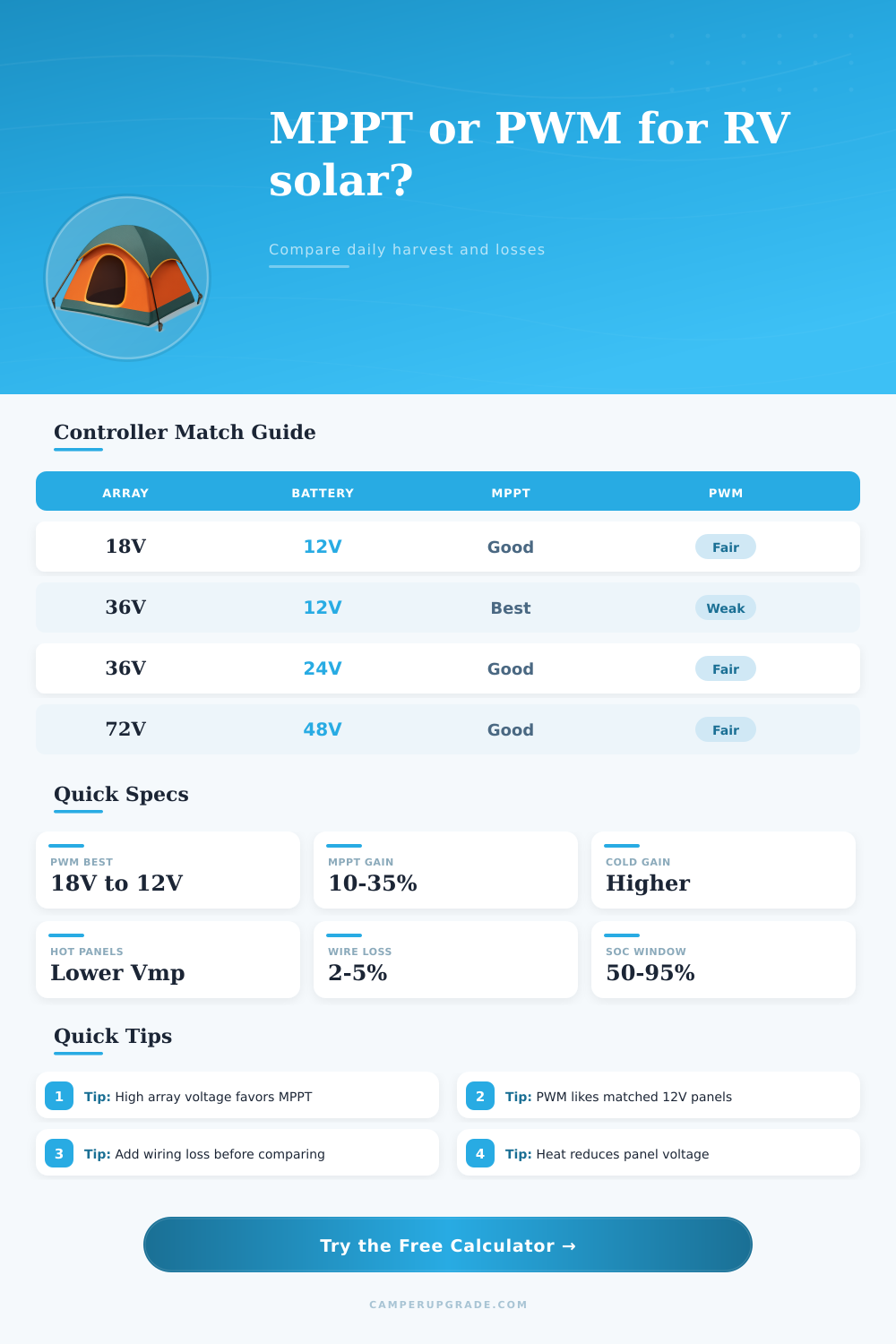
| 18V 12V-nominal panel in parallel | 12V | Modest gain after conversion loss | Good match when batteries are low |
| 36V 24V-nominal panel or two 18V panels in series | 12V | Strong gain from voltage conversion | Large voltage clamp loss |
| 36V 24V-nominal panel in parallel | 24V | Moderate to strong gain | Fair match during bulk charge |
| 54V three 18V panels in series | 12V or 24V | Best suited to MPPT | Usually inappropriate |
| 72V high voltage roof string | 48V | Good conversion margin | Fair only if voltage is close |
☀Temperature and Voltage Table
| Panel Cell Temperature | Typical Vmp Change | MPPT Effect | PWM Effect |
|---|---|---|---|
| 35°F / 2°C cold morning | About +7% vs STC | Can harvest extra voltage | Extra voltage is mostly clipped |
| 77°F / 25°C test condition | Rated Vmp | Baseline conversion | Baseline voltage clamp |
| 115°F / 46°C warm roof | About -6.5% vs STC | Still tracks lower Vmp | May improve match slightly |
| 150°F / 66°C hot desert roof | About -13% vs STC | Power is lower but optimized | Voltage headroom can get tight |
🔧Controller Type Comparison
| Spec / Condition | MPPT Controller | PWM Controller | Calculator Treatment |
|---|---|---|---|
| Voltage conversion | Converts higher array voltage into charging current | Clamps array near battery charging voltage | PWM factor = charge volts divided by adjusted Vmp |
| Best panel match | Series strings and high Vmp modules | 12V-nominal panels on 12V banks | Recommendation changes with voltage ratio |
| Cold weather | Often gains more from higher voltage | Clips more extra voltage | Cell temperature adjusts Vmp first |
| Absorption / nearly full battery | Reduced by battery acceptance | Reduced by battery acceptance | SOC window derates both outputs |
| Wire design | Higher voltage can reduce array current and drop | Lower voltage arrays need heavier wire | Shared wiring loss is applied before controller loss |
🚙Common RV Solar Scenarios
| Scenario | Typical Array | Battery Bank | Expected MPPT Gain |
|---|---|---|---|
| Small travel trailer roof | 200W to 300W, 18V parallel | 12V lithium or AGM | Small to moderate |
| Portable suitcase panel | 160W to 220W, short leads | 12V battery | Small if Vmp is close |
| Series roof pair | Two 200W panels, about 36V Vmp | 12V lithium | Often high |
| Large fifth wheel | 800W to 1,200W, series-parallel | 12V or 24V bank | High with long wire runs |
| 24V inverter build | 600W to 1,200W at 36V to 72V | 24V lithium | Moderate to high |
💡Calculator Notes
If you think it’s dramatic engineering, or that standing on a hot RV roof in July is some sort of thermal issue, then forget it, it’s simply a question of thermal reality. Your battery bank want those electrons pulled down out of the glass above you. The decision on whether to use a PWM or MPPT controller can seem complicated. But it isn’t.
If you understand voltage management instead of guesswork, math becomes simple. People assume an MPPT is better because it’s more expensive. It’s like going out and buying high-performance car because you drive slowly through town. When so many other things slow performance, who needs speed? Solar collection has lots of those limiting factors.
How to Choose Between PWM and MPPT Solar Controllers
After you put in the size of your roof and what temp you expect it to be, then let the calculator do the math. You won’t have to guess conversions or coefficients anymore. It starts out easy, since most folks don’t think about this stuff till they are sitting in dark after sundown with no lights. Put in how many panels you have and what’s the wattage per each one. Also, include operating voltage of those panels.
For example if you have 18 volt panels at max output (peak sun) and a 12 volt battery bank, it will work fine on simple PWM controller. A PWM controller is basically just a switch, it dumps the current whenever the panel voltage gets higher then the battery voltage. There isn’t much extra juice to throw away so loss of efficiency is not great.
If you wire those panels in series, however, things change quickly. Suddenly you have 36 volts from your 18-volt panels feeding the same 12-volt battery. There is no other place for power to go, such as to an inverter or the house. A PWM controller still clamps out the rest (about two-thirds of the available power), while seeing only battery voltage. An MPPT controller will see that high voltage and step it down into more current, which recovers nearly all of it.
This is where a lot of folks miss the boat. When they pay extra for an MPPT, they think they’re buying a smarter brain, but in reality they’re mainly paying for a step-down converter that recovers the lost volts. The calculator demonstrates just how many watt-hours gets thrown away by the PWM clamp, and how much the MPPT rescues.
And then there’s one more key variable: heat. At 77 degrees Fahrenheit, solar panels operate as listed on their spec sheet. On an aluminum roof in August? Not likely. Easily reaching 140 degrees or more, those cell temps causes voltage output to drop a lot. That’s why the calculator takes into account thermal loss and reduces your panel voltage accordingly before it compares the controllers. And in cold weather, when voltages go up, the MPPT units does well, using all that added headroom. In high summer, not so much; there just isn’t enough energy to work with, but MPPT units will still hold their own compared to PWM, since they’re closer to that sweet spot.
One caveat: don’t count on your test results from a single nice spring day. You need to adjust for that daily fluctuation. Other things include wiring loss and sky conditions. Resistance heat accounts for 3 to 5 percent loss on long runs from batteries on a back roof panel to a battery box at the front of the cab. Because MPPT systems tend to permit higher voltage and lower current, they can goes with thinner wire that loses far less energy. Low voltage arrays required thick, expensive wires to prevent voltage drop when using PWM systems. These little percentages adds up over a year of boondocking. They are factored into those tools.
Battery acceptance is another consideration. No amount of controller magic forces energy into a saturated cell. So this puts a lid on both types equally. The bottom line: it stops being a mystery and starts being a calculation…
Try out the presets for common setups such as the fifth wheel roof or the weekend trailer. What’s the difference in daily harvest? If the MPPT adds just 10 watt-hours per day then it is probably not worth the additional complexity or higher cost tag. But if you have long distance/efficiency wiring with high voltage strings, the increase is impossible to ignore.
The goal isn’t the most expensive hardware, the goal is matching the controller to the voltage delta of your batteries versus the panels. When you get that relationship the decision is no longer strange but rather a mathematical one. It is a question of adding up the values. You are no longer fighting the sun but instead working with the sun. Actually, it would of been better to just plan ahead.