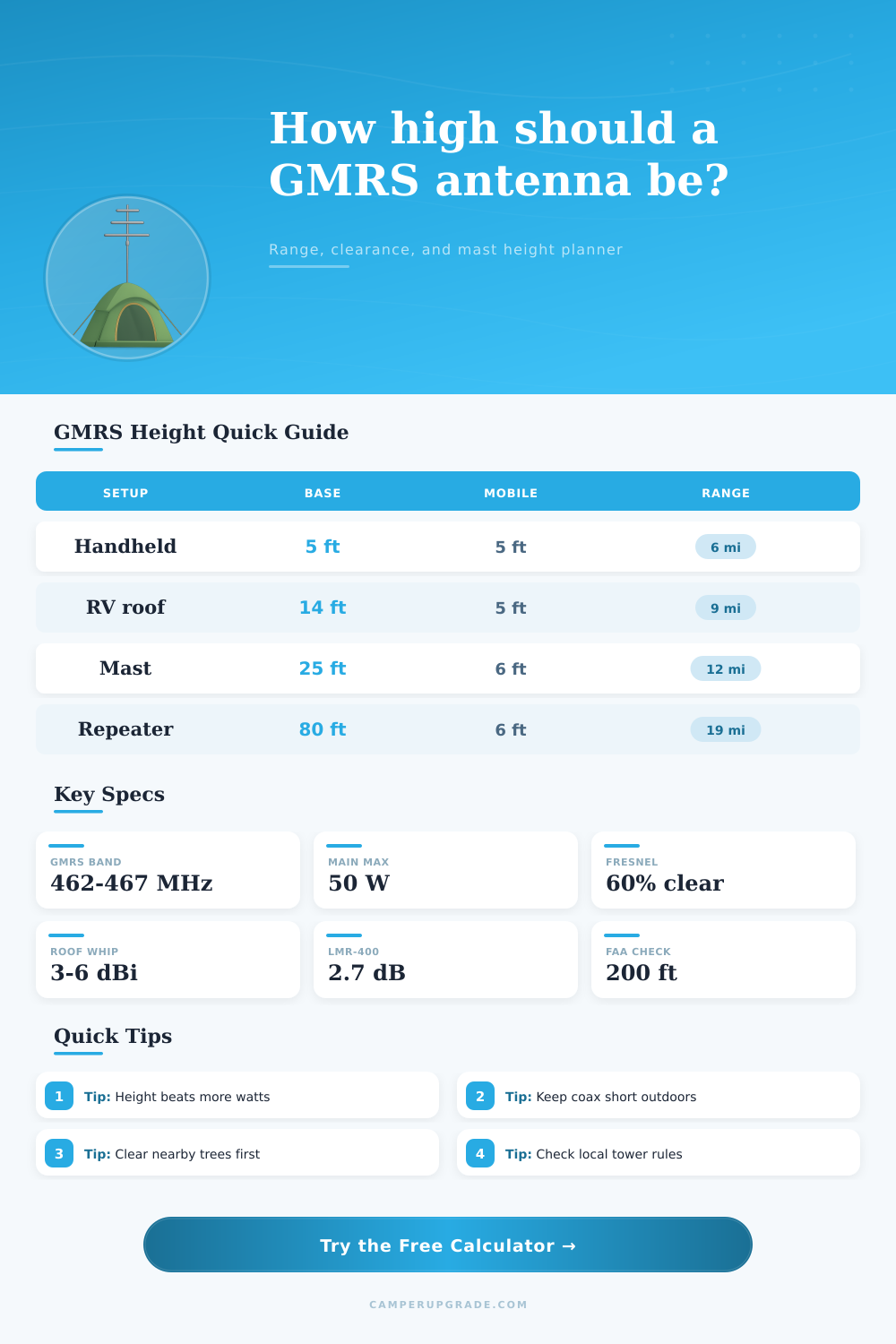
GMRS Antenna Height Calculator
Estimate GMRS line-of-sight range, required mast height, Fresnel clearance, coax loss, and effective radiated power for RV, overland, cabin, and campsite radio setups.
📡Real GMRS Setup Presets
⚙Antenna And Path Inputs
📊GMRS Antenna Type Comparison
📐Reference Formulas Used
📋Radio Horizon By Antenna Height
| Your antenna height | To handheld at 5 ft | To mobile at 7 ft | To base at 30 ft |
|---|---|---|---|
| 5 ft handheld | 6.3 mi | 6.9 mi | 10.9 mi |
| 14 ft RV roof | 8.5 mi | 9.0 mi | 13.1 mi |
| 25 ft portable mast | 10.2 mi | 10.8 mi | 14.8 mi |
| 40 ft cabin mast | 12.1 mi | 12.7 mi | 16.7 mi |
| 80 ft high site | 15.8 mi | 16.4 mi | 20.4 mi |
🔌Coax Loss Near GMRS Frequencies
| Coax type | Loss per 100 ft | 25 ft power kept | Best use |
|---|---|---|---|
| RG-58 | About 6.7 dB | 68% | Short mobile jumpers |
| RG-8X | About 4.6 dB | 77% | Portable mast kits |
| RG-213 / RG-8 | About 3.9 dB | 80% | Moderate base runs |
| LMR-400 | About 2.7 dB | 86% | RV base and cabin masts |
| LMR-600 | About 1.5 dB | 92% | Long low-loss tower runs |
📻GMRS Channel And Power Planning
| Channel group | Common frequency range | Typical limit | Planning note |
|---|---|---|---|
| 462 MHz main channels | 462.550 to 462.725 MHz | Up to 50 W | Common simplex and repeater outputs. |
| 467 MHz main channels | 467.550 to 467.725 MHz | Up to 50 W | GMRS repeater inputs, paired 5 MHz up. |
| 462 MHz interstitial | Between main channels | Lower ERP | Often shared with FRS users. |
| 467 MHz interstitial | Between input channels | Very low power | Generally handheld-only planning territory. |
🏕Common RV And Camping Setups
| Setup | Typical feedpoint | Antenna gain | Practical expectation |
|---|---|---|---|
| Handheld around camp | 4 to 6 ft | 0 to 2 dBi | Best for nearby sites and trail groups. |
| Vehicle convoy whip | 6 to 9 ft | 2 to 5 dBi | Great on roads, weaker behind ridges. |
| RV roof antenna | 11 to 14 ft | 3 to 6 dBi | Good campground base when trees are low. |
| Portable fiberglass mast | 20 to 35 ft | 3 to 8 dBi | Strong campsite upgrade if guyed safely. |
| Cabin or hilltop base | 30 to 80 ft | 6 to 9 dBi | Often limited by terrain, not transmitter watts. |
✅Height Planning Tips
The best way to boost your GMRS range is to focus on better geometry and height. After all, I figure, that five watts is good enough if I can eventualy get to fifty. That’s not quite how UHF behave. It turns out that wattage has little to do with the signal; it’s more about obstructions to the signal. For example, a standard antenna on top of a mast will typically perform better than a super-powerful radio nestled behind some wall inside an RV, or up in some tree.
If you want to get most line of sight range, then height is what matter. And that’s where the geometry comes into play… Which is why planning realy starts here. After plugging in your target distance and then your roof height, the calculator (above) figure out all the math for you. It uses a formula that calculates how far a radio wave travels when accounting for curvature of the Earth, and spits out a reasonable guess at your horizon line.
How to Get Better Range
Because terrain obstructs signals before the planet itself does, think of a bunch of trees or rolling hills. The calculator factors that in as well. This is where it gets important. Just because you can see across to your buddy’s camp site doesn’t mean he’ll be able to talk to you, trees get in the way. Height is actualy your best tool for extending range.
The tool also explains Fresnel clearance, which many people gets wrong. They think radio signals shoot along a straight line. Because of this, they believe all that matters is having a good eye-line-of-sight view with minimal visible obstruction from transmitter. But the truth is, the radio signal expand outward in an oval zone surrounding the straight-line path, with anything touching this zone (even by only a hair) reducing the quality of the signal. The calculator check if your antenna will clear 60% of the ellipsoid zone. That means it makes you consider not just the endpoints but also what’s in the middle. Often, how much you raise your endpoint antennas won’t matter more nearly as much as making sure you have some kind of clearance in the middle.
And finally, there is feedline losses. It might seem like raising your antenna would of been a good thing, but that typically means running more coax cable between your radio and a mast. Cheap coax has terrible loss at GMRS frequencies. Thin RG-58 will lose signal fast. If you run 50 feet of this cheap coax with your antenna mounted 25 feet off the ground, most of that transmit power become heat before it even gets out of the house. The power retention charts in the reference tables shows what happens with various types of cable over distances. This is not a big issue but it is important when considering effective radiated power.
It’s asking for some basic information about the environment… Terrain profiles, target frequency; so it can fine-tune those estimations. Four-hundred sixty-two megahertz is the operating space for GMRS. Its wavelength doesn’t change greatly throughout that spectrum, but different frequencies will move the size of the Fresnel zone somewhat. You’ll notice that range predictions changes a lot when you switch from open lake view to the dense forest profile. It uses a decay factor to account for branch-and-leaf absorption in the real world; don’t expect highway-range results while camping out in a thick pine grove.
The math is pretty straightforward. To get a good signal, you want the lowest-loss cable. You also need the least obstructed path, meaning a clear line of sight. Finally, use highest antenna that is both legal and safe. With the calculator, you can plug in a few numbers and see which trade-offs you’re making before you pull out the drill bits or spend money on components.
Now you know that doubling your power isn’t going to help, but a ten-foot mast will add about this much. Clear enough?