Signal Mirror Distance Calculator
Estimate how far a rescue flash may be seen by aircraft, boats, hikers, vehicles, or lookout teams using mirror size, elevation, sun angle, visibility, and aiming accuracy.
🪞Field Presets
⚙Signal Conditions
📊Mirror Spec Comparison
📐Reference Tables
| Mirror face | Area | Clear-air planning range | Typical use |
|---|---|---|---|
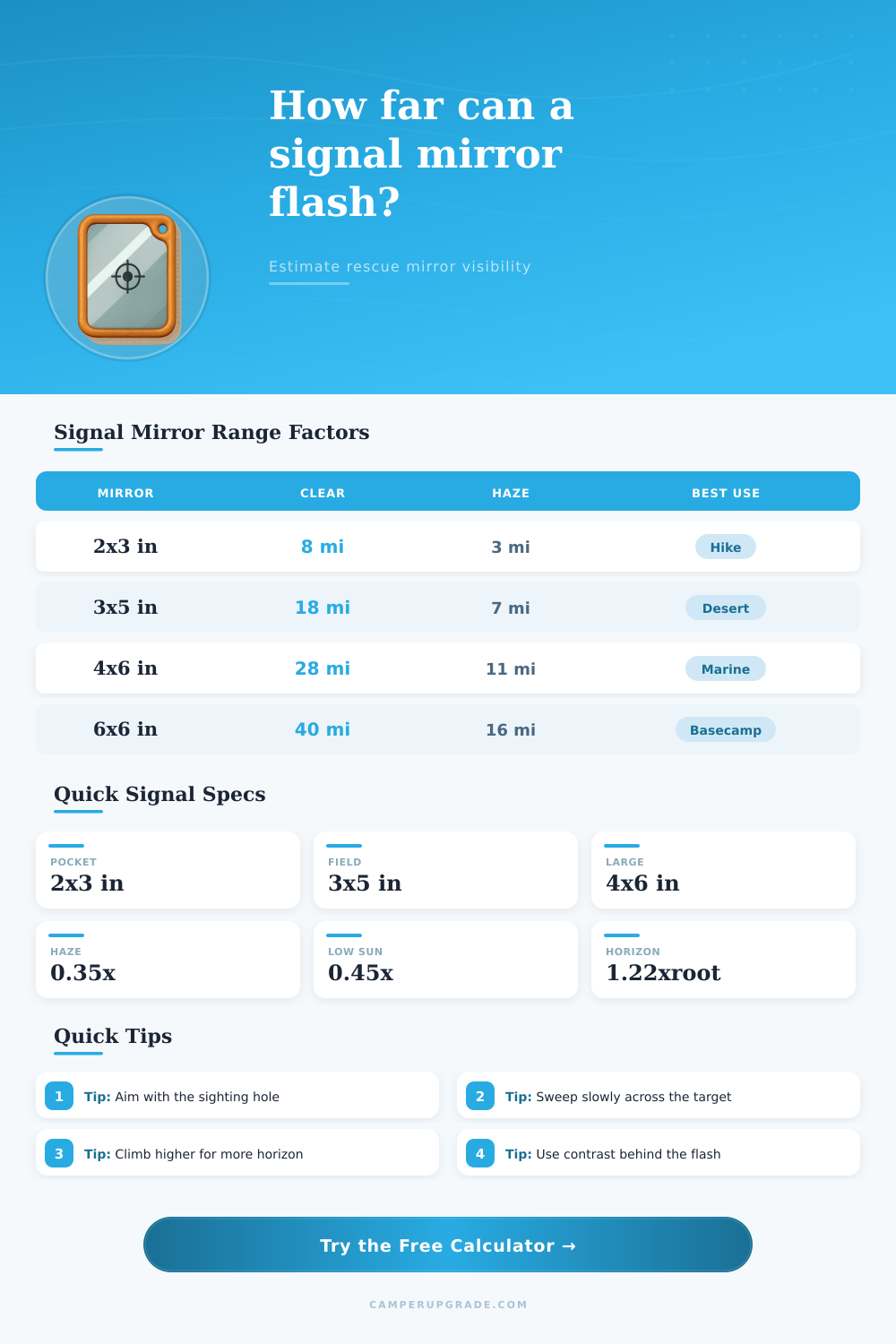
| 2 x 3 in pocket mirror | 6 sq in | 6 to 10 mi | Day hiking, small survival kit, short valley signals |
| 3 x 5 in field mirror | 15 sq in | 14 to 22 mi | Desert travel, kayak, backpacking, roadside distress |
| 4 x 6 in marine mirror | 24 sq in | 22 to 32 mi | Open water, beaches, exposed ridges, aircraft signaling |
| 6 x 6 in panel mirror | 36 sq in | 32 to 45 mi | Basecamp, liferaft kit, snowfield, fixed lookout signal |
| Condition | Range factor | What it means | Field adjustment |
|---|---|---|---|
| Excellent dry air | 1.15x | Deep blue sky, low haze, strong sun | Use normal sweep intervals |
| Clear daylight | 1.00x | Normal outdoor visibility | Signal every few seconds |
| Light haze or glare | 0.72x | Sea sparkle, humidity, light dust | Use longer holds on target |
| Dust, smoke, humid haze | 0.45x | Flash still works, but contrast drops | Move higher and seek darker backdrop |
| Heavy haze or cloud edge | 0.25x | Marginal daylight signaling | Use every backup signal available |
| Observer height pair | Approx horizon | Metric horizon | Common example |
|---|---|---|---|
| 6 ft to 6 ft | 6 mi | 10 km | Two people on flat shoreline |
| 20 ft to 60 ft | 15 mi | 24 km | Kayak to small boat bridge |
| 100 ft to 1000 ft | 51 mi | 82 km | Ridge to low search aircraft |
| 1000 ft to 3000 ft | 104 mi | 167 km | Mountain slope to helicopter or aircraft |
| Target type | Detection factor | Why it changes | Signal method |
|---|---|---|---|
| Search aircraft | 1.30x | Crew may be scanning for signals | Flash across cockpit repeatedly |
| Boat crew | 1.10x | Open horizon, but sea glare competes | Sweep over bridge and bow |
| Lookout or ridge team | 1.00x | Good sight line if contrast is clean | Hold flashes near skyline |
| Ground hiker | 0.72x | Lower vantage and narrower view | Use repeated slow sweeps |
| Road vehicle | 0.62x | Short attention window and windshield glare | Flash early, then wave visibly |
💡Field Tips
A signal mirror: to most folks, this is nothing more than a shiny piece of glass that glares in the sun until someone notices it. Half credit for that instinct. The glare? Yes. But the getting-noticed bit, well, that’s up to geometry and physics… There’s no voodoo here.
When you’re floating out on open water, or stuck on a ridge somewhere, understanding how far that flash realy reaches could be the difference between waiting ’til morning or somebody finding you by lunchtime. It won’t save your ass, exactly, but it sure as hell helps. Once you know what size mirror (or other device) you are working with, you input those numbers into the calculator at the top of this post. It spit out your answer without making you do any of the geometry calculations of atmosphere coefficient or line-of-sight stuff yourself.
How to Use a Signal Mirror for Rescue
You begin with the object being reflected: not all mirrors is made equal. While an average 3×5 inch hiker’s mirror will get you out of most jams, it has much less surface area than a big panel used on a boat. To adjust for this, it requires knowing the size of the reflecting surface, width and length (height), excluding the plastic housing around the thing. And it wants to know the type of mirror too. Glass will throw a sharper beam then crinkled up foil or scratched-up polycarb. Not only does a bigger and clearer one throw a brighter beam, but the brighter beam punches through haze better. That is your coinage when you’re trying to save someone’s life.
“It makes all the difference… Much more so than most folks realize.” The “horizon limit” doesn’t only refer to being able to see the other person, it’s also about them seeing you. Because when you’re below the ridgeline and the helo flies low along the opposite ridge, there’s no way they can see you flashing away. They know you’re down in that hole. Regardless of what you flash at ’em, nothing does any good, not until their line of sight is clear, meaning over the hill. The calculator takes into account both your highness above the ground (or water) as well as the probable boat/aircraft crew height and calculates an optical horizon accordingly. It might of been worth burning a few extra calories by climbing up a bit to signal, since you’ll get miles of additional visibility that a larger mirror won’t provide.
Oh and then we have the environment. Light travels further on clear air than it does on moist sea mist or dusty desert air. You can also see that the flash gets dulled by a lot of haze, smoke, or heavy glare. The tool has reduction factors for those. Failing that, if you’re trying to signal out through fog or dust, your effective range drops. And that’s the bit most folks don’t get. They think their mirror will be equally effective under all conditions. Not true.
A weak reflection means low sun (unless you’re set up with ideal angles). Sun high in the sky is typically better for newbies. Theory meets practice here, in the aiming. On paper, the range may be perfect; but if you don’t sweep the beam slowly enough, any single place in the sky recieve a flash lasting just a fraction of a second. Most observers miss it. The calculator takes into account how steady you are and how good you are at sweeping the beam. If you have shaky hands or you’re on a boat that rock, the window gets smaller. A sighting hole will help pin the target. However, even with perfect aim, you must hold the beam on bridge or cockpit long enough for the eye to see it as a signal rather than a random glint.
This is where contrast comes in, and it’s not always obvious but important. Against a snowy field or a gleaming white beach, that flash melds with the ambient noise. On a shadowy cliff or a dark wood, it stands out. The tool includes this in the detection probability calculation. This is also why sometimes you’ll shift your position just enough to change your perspective. That way, the surrounding landscape isn’t so glaringly bright.
But ultimately, signaling isn’t as much about gear as it is about position and patience. You need a solid platform, an unobstructed line of sight, and slow, deliberate aiming. Your own persistence will fill in the gaps between the math and a rescue team zeroing in on that beacon of hope. Crawl up high if possible, keep the mirror handy and let the light do the talking.