Candle Burn Time Calculator
Estimate candle runtime, wax use, overnight coverage, and session limits for camping lanterns, RV kits, and backup light planning.
⚡Real candle presets
🕯Candle and burn settings
📊Wax and candle spec comparison
📘Reference tables
| Format | Typical wax | Baseline draw | Planning note |
|---|---|---|---|
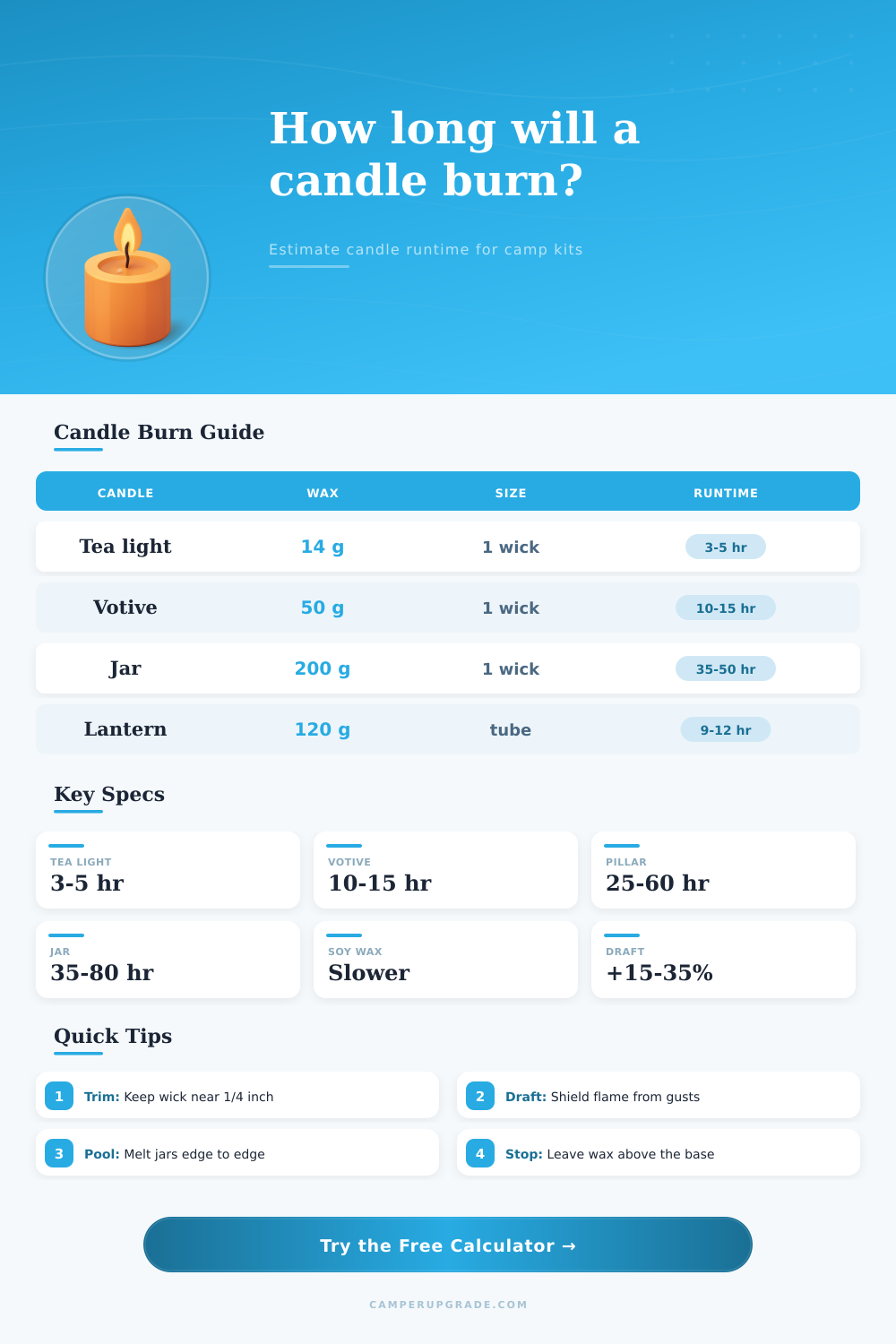
| Tea light cup | 12-16 g | 3.4 g/hr | Short, broad pool with thin metal cup |
| Votive or small glass | 45-60 g | 4.0 g/hr | Needs a snug holder to avoid side loss |
| Jar candle | 150-500 g | 4.6 g/hr | Runtime depends strongly on diameter |
| Pillar candle | 100-700 g | 3.8 g/hr | Slow if tunnel is controlled, faster in drafts |
| Taper candle | 25-80 g | 6.5 g/hr | Long exposed flame, little container buffering |
| Lantern insert | 100-150 g | 9.5 g/hr | Designed for brighter output over fewer hours |
| Diameter | Metric width | Area factor | Use case |
|---|---|---|---|
| 1.5 in | 3.8 cm | 0.78x | Tea lights, slim votives, inserts |
| 2.25 in | 5.7 cm | 0.92x | Small jar or compact pillar |
| 3.0 in | 7.6 cm | 1.00x | Standard jar or pillar baseline |
| 4.0 in | 10.2 cm | 1.23x | Large jar, bucket, or multi-wick candle |
| 5.0 in | 12.7 cm | 1.42x | Outdoor bucket or wide decorative jar |
| Condition | Multiplier | Runtime effect | Field signal |
|---|---|---|---|
| Fresh trimmed wick | 0.95x | Slightly longer | Small steady flame |
| Long wick | 1.14x | Shorter runtime | Flicker, soot, tall flame |
| Light breeze | 1.15x | More wax per hour | Flame leans often |
| Drafty table | 1.32x | Much faster burn | Uneven pool or guttering |
| Tight chimney | 0.88x | May slow but dim | Small flame, check ventilation |
| Planning target | Example candle | Session length | Useful check |
|---|---|---|---|
| One dinner setup | Tea lights or votive | 2-4 hr | Bring extras for wind loss |
| Weekend RV light | 200 g jar | 3-5 hr | Confirm remaining wax above base |
| Emergency outage kit | Tin or pillar | 4-6 hr | Split burn blocks across nights |
| Lantern warmth cue | Insert candle | 6-10 hr | Match insert to lantern vent design |
| Outdoor bug candle | Bucket blend | 2-5 hr | Expect faster burn in breeze |
🛠Calculation tips
You’re in an RV park and flip on the lights in your rig, but they don’t come on at night; all you see is the glow from your neighbor’s lantern. You panic. It’s happened more times than you care to think about. Camping infrastructure can be spotty, and power grids is fragile. An emergency outage isn’t a question of if; it’s a question of when.
Planning based off how long a candle will burn doesn’t feel like hoarding supplies as much as practicing basic survival strategy. Most folks just snatch up what looks cheapest at the gas station, crossing their fingers that it’ll last through to next day. But air drafts, wick length, and wax density all conspire to drastically reduce that run time. Know these variables and you turn a flickering glimmer of hope into dependable light for navigating or eating dinner.
How to Make Your Candle Last Longer
So what’s the magic number? It’s the wax weight. Not the whole package weight. That includes things like the glass or tin. These can be half the weight of your big good-looking glass jar candle. In that case, you’re paying extra for decoration, not light. Take out the tare weight (the package minus the wax) and use that as your estimate for hours per candle.
Why does this matter so much? Because when you see these candles at store, they show you the full product weight on the label, making the value look more attractive then it really is. Enter the net wax weight into the calculator above and it’ll do the math for you. It takes the packaging illusion out of play to give you a real-world guess for how many hours it will burn based only on the fuel you’re paying for.
Neglecting wick management can reduces your runtime by twenty percent without you even realizing it. Having a trimmed wick maintains a consistent, small flame which draws the wax in at a controlled pace for best run-time. An unchecked wick will grow up high, getting hot enough to consume wax quicker and leaving a layer of soot all around walls of your container. It’s not just a matter of hygiene; it’s also a matter of efficiency.
Instead of a precise burner, your mushroomed wick cap becomes an unregulated torch. By keeping the wick capped within roughly a quarter inch you guarantee that the fuel draw correspond with the oxygen being pulled into the flame. It’s a little bit of work, but it would of saved you up to a full twenty percent (or more) of your expected run-time each night.
Finally there’s the added wrinkle of environment (something labels don’t account for). Because drafts feed excess oxygen to the flame, they’ll speed up combustion, widening the melt pool and drastically increasing your wax consumption. An indoor candle that lasts 15 hours will be gone in only ten on a gusty picnic table outdoors. Likewise, overly coddling a candle, such as with a tight shield around its flame, will either choke it out or make it burn erratically. Get that ventilation/protection balance right, and you have yourself a consistently performing candle. Considering all these airflow situations, the tool lets you match your output expectation depending on if you’re burning it under a gazebo or in a tent.
Also, various types of wax respond different than heat. Traditional paraffin burns cooler and more slowly, so a given weight may last longer. Soy blends will typically do this as well. Outdoor candles like those made with citronella blend formulas are specifically designed for higher exposure and thus burn quicker with wider wicks. And then there’s beeswax: dense and consistent. The correct type of wax for your situation avoids fighting the candle’s own properties. For extended periods of indoor lighting, beeswax or soy pillars is generally better options than basic utility paraffin.
Any serious plan includes safety reserves. Don’t burn a container candle all the way down to nothing. If the glass base gets too hot, it may crack or even shatter. Reserve at least ten to fifteen percent to protect the container itself and let you know when it’s time to blow out the flame safely. The remaining wax isn’t wasted but is instead insurance: it guarantees a clean end to the candle and keeps accidents from happening. Two hours of light you don’t need is far better than an hour you do that finishes with a pile of broken glass on your camp table.
And at the end of the day, that’s what candle planning is all about: not so much getting it right as managing expectations. Because there’s nothing you can do about unpredictable shifts in temperature and gusts of wind out here in the wild, but you can plan for them. Respect their boundaries. Keep your wicks trimmed. Focus on net weight. Turn a humble candle. A novelty piece, from a “maybe” into something reliable and trustworthy. Make it an extension of yourself, a tool to keep your evenings calm, even when everything around you goes dark. You won’t need to guess how long you’ve got left. You’ll know when to reach for another and when to pack it up.