Tip Up Spacing Calculator
Plan an ice fishing spread by target species, visibility, pattern, structure width, line limits, and walking distance between flags.
Enter the limit you have verified for that waterbody.
Breakline, weed edge, flat, bay arm, or search lane width.
Tip Up Layout Results
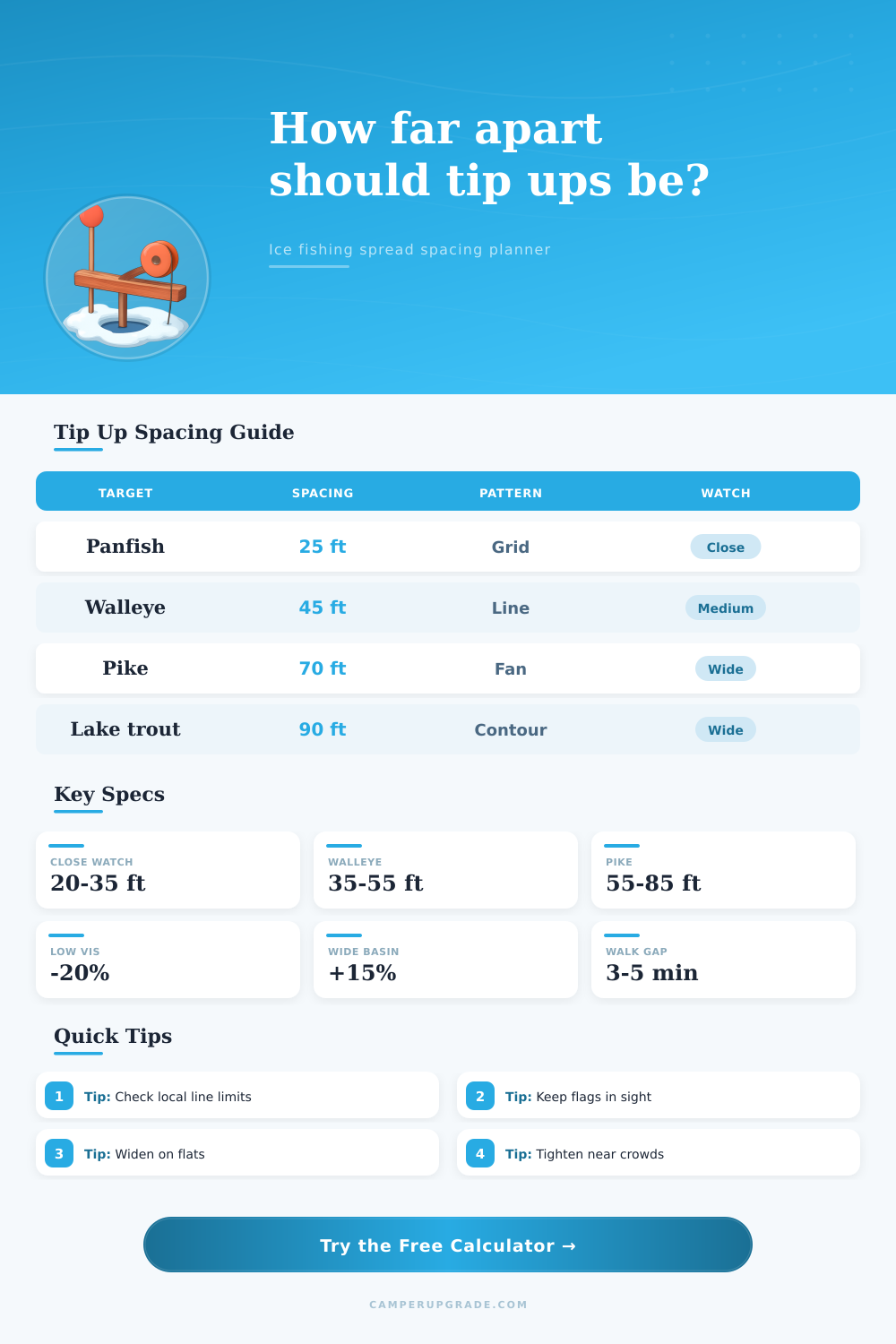
| Target or style | Starting spacing | Best pattern | Why it works |
|---|---|---|---|
| Panfish, crappie, close bites | 25 to 35 ft | Cluster or grid | Keeps light flags visible and holes easy to reset |
| Walleye breakline | 40 to 55 ft | Line or contour | Covers depth changes without losing flag sight lines |
| Perch flat search | 35 to 50 ft | Grid | Samples a roaming school path while staying movable |
| Northern pike weed edge | 55 to 85 ft | Contour or fan | Spreads bait along ambush lanes and weed openings |
| Lake trout basin | 75 to 100 ft | Fan or contour | Searches open water where fish travel wider routes |
| Condition | Spacing change | Visibility cue | Layout adjustment |
|---|---|---|---|
| Clear, calm, daylight | Add up to 10% | Flags easy to see | Widen search lanes or fan points |
| Normal winter light | No change | Flags visible from base | Use standard target spacing |
| Snow glare or drift | Reduce 10% | Flag color blends in | Keep holes closer and mark route |
| Wind or blowing snow | Reduce 20% | False flags possible | Shorten spread and face flags consistently |
| Dusk, night, low light | Reduce 15% | Harder to judge distance | Use lights, reflective tape, or close cluster |
| Pattern | Footprint formula | Best for | Spacing caution |
|---|---|---|---|
| Straight line | (lines - 1) x spacing | Breaks, weed edges, current seams | Do not block travel lanes or nearby anglers |
| Grid | Rows and columns x spacing | Flats, bays, perch schools | Needs more walking turns than a line |
| Fan | Radius equals spacing x tiers | Point, island, base camp search | Outer holes can drift out of sight |
| Contour | Edge length divided by line gaps | Drop-offs and weed lines | Match holes to depth, not just distance |
| Close cluster | Compact circle around base | Kids, night, cold wind | Risk of tangles if fish run across holes |
| Rig component | Light duty | All-around | Heavy predator |
|---|---|---|---|
| Main tip up line | 20 to 30 lb braid | 30 to 50 lb coated braid | 50 lb plus coated braid |
| Leader | 4 to 8 lb mono | 8 to 15 lb fluoro | Wire or 30 lb fluoro |
| Hole diameter | 6 inch | 8 inch | 10 inch |
| Flag visibility | Close watch | Normal height flag | Tall flag or reflector |
| Best spacing | 25 to 40 ft | 40 to 65 ft | 65 to 100 ft |
| Common layout | Lines | Typical spacing | Approx span |
|---|---|---|---|
| Two anglers on walleye break | 4 | 45 ft | 135 ft line |
| Family panfish base | 5 | 30 ft | 60 ft grid |
| Pike weed edge scout | 6 | 70 ft | 350 ft contour |
| Perch flat move | 4 | 40 ft | 80 ft grid |
| Lake trout basin fan | 6 | 90 ft | 180 ft radius |
You drill and set for hours then step out onto the ice, only to find that your line of tip ups appears as one big smeared red dot on the white background of your horizons. Your carefully planned-out holes has become an unruly jumble and panic strikes. The fish are on the bite. Now’s the time to figure out what is flagged up, but how? Before you lose your mind, there’s no way of knowing unless you can differentiate between your flags.
Spacing isn’t a theory at this stage; it’s a survival tactic based off your catch-rate. Hole placement is something most angler do as an afterthought, casting their baits where they feel comfortabley with the auger, thinking it’ll work…until the wind blows, glare makes fishing difficult, or your flags look like a single blurry red smudge.
How to Space Your Fishing Holes
Simply input your visibility conditions and target species into the calculator above and let it do the math for you. No more guesswork about how many feet separate those pesky red triangles. While fifty feet may sound sufficient for walleye, it fails to account for the impact of a crowded ice house in the vicinity or blowing snow. By accounting for walking effort and sight lines, the tool ensure an accurate calculation. Before punching a single hole, it forces you to take physical exertion of your plan into consideration.
One thing is certain: An appealing-looking layout on paper doesn’t necessarily equate to an effective one out on the ice while you’re shaking your teeth off in the dark. The baseline is dictated by target species, but adjustment depend on visibility. Panfish cluster and hold tight, making them quick bites for fast fishing that demands close watching. Their holes may only be spaced twenty-five feet apart. That keeps the bait inside striking range of curious bluegill or perch.
Large predators such as lake trout or pike patrol far greater areas, demanding long contour lines or broad fan patterns spanning seventy to ninety feet between points. Crowding pike holes run the risk of tangling leaders when two fish both go in the same direction at once. It is not a big deal, but it becomes enormous when you’re after a trophy. The calculator balances these biological behaviors and your legal line limits.
But there’s a hard constraint, legal limits, which also influence the geometry of your spread. Let’s say you have four lines and your partners has four apiece. Covering just enough water to catch fish while not forming a tangled mess of braided line becomes part of the equation. A grid pattern works well for flats where schools roam randomly, but it requires more turning radius when walking the check route. Running a straight line along a break is efficient for walleyes following depth changes. These are laid out in the table on the page with explanations of why they work with what structure. Getting this wrong means missing bites and wasting time taking extra steps.
In ice fishing planning, visibility is the great equalizer. On clear days, when you can see a flagged hole from fifty yards away, you can push those holes further apart. You need closer spacing on days with blowing snow, dusk, or fog when it becomes harder to see things clearly. Distance is the enemy of contrast. The calculator use a reduction factor to decrease your recommended spacing in low-visibility conditions, which keeps the flags distinct. It also takes into account weight of the gear and your walking speed.
Having fewer gaps but placing flags closer together works best if you’re moving slowly and have a lot of furnitures on your sled. Widening the search area is possible at a faster pace on a trail. A lot of people get so caught up in fishing with rigs and baits that they don’t think about the logistical side of their footprint. Missing flags and tripping over lines is what happens when you fail to consider flag height and wind direction. You can tighten your spread down when it’s windy to avoid getting false alarms from flapping fabric. Holes should be kept within clear sight lines so there are no missed bites due to confusion.
Your lines should be outside the recommended buffer zone provided by the tool to avoid frustration and liability to yourself and other angler. At its core, good spacing is a matter of control. A disorganized hodge-podge of holes becomes a manageable system. Where is each line? No guessing required.
Begin with the behavior of the species. Adjust for weather. Observe the legal limits. Use the numbers as guides for your first set up. Trust your eyes when on the ice. If the flags rise you should of been ready.