Ice Hole Diameter Calculator
Size an ice fishing hole from fish girth, auger bit, ice thickness, electronics clearance, and fishing layout.
This calculator sizes fishing access holes only. Confirm local regulations, conditions, and safe ice thickness before travel.
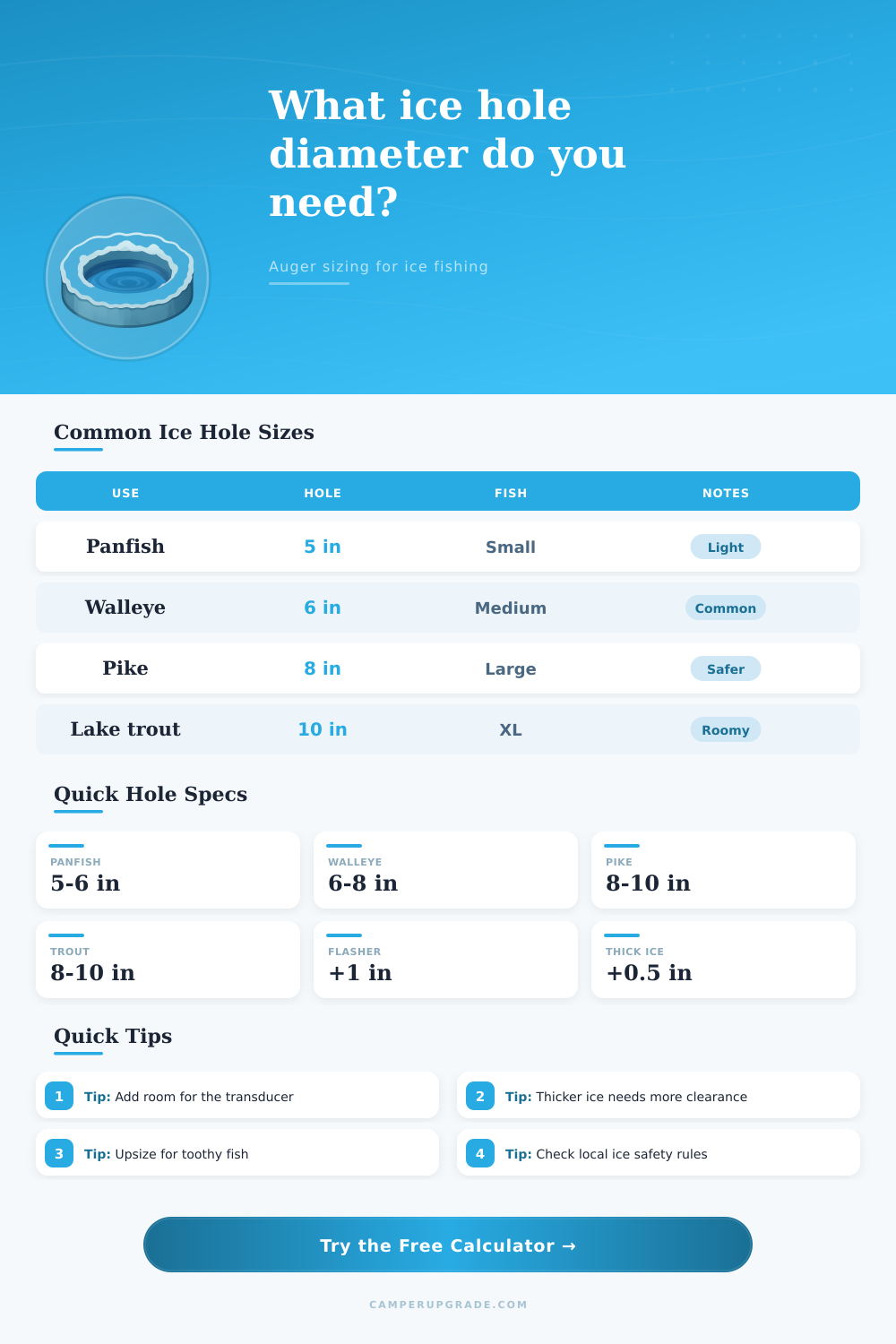
| Fish class | Typical girth | Minimum geometry | Practical hole |
|---|---|---|---|
| Panfish and perch | 4 to 7 in | 1.3 to 2.2 in | 5 to 6 in |
| Crappie and eater walleye | 8 to 12 in | 2.6 to 3.8 in | 6 to 7 in |
| Large walleye or bass | 12 to 15 in | 3.8 to 4.8 in | 7 to 8 in |
| Northern pike | 15 to 20 in | 4.8 to 6.4 in | 8 to 10 in |
| Lake trout | 17 to 23 in | 5.4 to 7.3 in | 9 to 10 in |
| Muskie or trophy pike | 22 to 30 in | 7.0 to 9.6 in | 10 to 12 in |
| Ice thickness | Added lift difficulty | Suggested extra clearance | Why it matters |
|---|---|---|---|
| 4 to 8 in | Low | 0 to 0.25 in | Short sleeve through the ice |
| 9 to 16 in | Moderate | 0.25 to 0.50 in | Fish can roll under the lower edge |
| 17 to 24 in | High | 0.50 to 0.75 in | More angle while hand landing |
| 25 to 36 in | Very high | 0.75 to 1.25 in | Thick tube narrows the working path |
| 37 in or more | Extreme | 1.25 in or more | Use conservative hole sizing |
| Bit diameter | Round area | Ice removed at 18 in | Best use |
|---|---|---|---|
| 5 in | 19.6 in² | 0.20 ft³ | Fast drilling, small fish |
| 6 in | 28.3 in² | 0.29 ft³ | Panfish and light walleye |
| 7 in | 38.5 in² | 0.40 ft³ | Portable mixed-species setup |
| 8 in | 50.3 in² | 0.52 ft³ | Common shelter and walleye size |
| 9 in | 63.6 in² | 0.66 ft³ | Large pike and big trout buffer |
| 10 in | 78.5 in² | 0.82 ft³ | Trophy fish and heavy electronics |
| 12 in | 113.1 in² | 1.18 ft³ | Sight fishing and spear openings |
| Pattern | Drill holes | Estimated clear opening | Typical use |
|---|---|---|---|
| Single round | 1 | 1.0× bit width | Normal jigging and deadstick use |
| Two overlapping | 2 | 1.6× bit width | Large fish with a compact auger |
| Three-hole triangle | 3 | 1.8× bit width | Camera plus lure or trophy landing |
| Four-hole slot | 4 | 2.2× bit width | Sight fishing or spear opening |
Nothing sums up ice fishing like the panic of setting into a walleye that just turned under the ice. You’re feeling weight. Then, the next thing you know, your gloved hand hits the cold rim of hole, and now the fish feels heavier then before. Ice fishing is all about those moments where any depth reading or lure pattern won’t cut it. You are just one break-off away from losing a trophy or catching dinner.
And when pressure gets high that’s exactly why you need a calculator like this one, because the ice conditions and target species are variables that can saves you from guessing on numbers that matter. So I think most guys just think “well as long as it can go through sideways it’ll go through.” The thing guys don’t understand is the girth. Most guys just think that if it can go through sideways, it will go through. But rarely does a big lake trout or a northern pike come up straight out of water. They come up rolling, bending and quite often trying to dive back down again once hitting light. And all this turning and bending takes much more room than what your mind can figure using simple shapes.
Why You Need the Right Hole Size
The landing angle you use in the tool accounts for that wild world we live in. Sometimes a straight lift will squeak through on a narrower margin, but if it’s thick ice and fish has farther to swim up before busting out, you want enough space to fit the fish’s curved body and your rod tip’s arc. The physics is counterintuitive until you’ve done it enough times. When there’s thin ice, it behaves more like a shallow tray and you can easily reach down into water column beneath it. With thick ice, you’re working from one end of a long narrow tunnel with limited leverage.
The table on the page breaks it down nicely… Depth to added difficulty. But practically speaking, the lesson is simpler. The bigger your hole, the smaller actual diameter of it becomes as the ice thickens, thanks to how much you’ll have to lift the fish upward. Not only do you require clearance for the fish itself, but also your own hands and whatever electronics might be dangling beside you.
And then there’s electronics; something most guides won’t even consider until much later. In today’s world of ice fishing, very few fishers go out without some sort of sonar unit or flasher dangling below surface. When you have a transducer dangling off your hole, just waiting to cut through a piece of line as you’re trying to hoist a fish up, that’s what we call a tripwire. So the tool does have an option to increase gear allowance, allowing a bit more room for you and your gear while still getting a recommended size. It’s simply an additional entry in the input fields. It helps avoid that painful moment when your sonar dome gets clipped with a gaff or your line gets tangled on a lift at the worst possible time.
The Slush Factor shrinks the hole A clean new hole cut in ice is precise and crisp. Ice fishing, however, occurs outside. Weather like wind and snow, along with changing temperatures, can cause tidy holes to become ragged and half-frozen. This turns them into semi-blocked up obstacles. Figure your hole will be reduced in diameter once you’re realy ready to use it. The slush factor is sort of like an insurance policy against reality. It assumes that your hole won’t stay perfectly round for very long. If you anticipate that you’ll leave the hole open for a lengthy period or you’re on a day when snowfall is heavy, actual diameter will be reduced as water refreezes to the sides.
When deciding between regular sized bits, it’s usually a trade-off between how easily they land versus how quickly they drill. The bigger the hole, more ice you’re removing and the more tired you’ll be after a long day on lake. But if it’s too snug of a fit in the hole, you may not even get her into it at all. Whenever in doubt, round up. You’d rather make one slightly bigger hole than drill two holes that partially overlap but feel cramped anyway. If you’ve got a nine-inch bit handy but your pike setup says it should of been an eight-inch, go ahead and grab the nine. That extra minute or two you spend drilling will pay off when you need that extra inch of wiggle room to get a big fish sliding safely through.
At the end of the day, ice fishing is all about variables. You have little control over these variables. The fish chooses where it will go. You can control where you set up, what bait you use, and which auger you use. When opportunity arises, knowing you’re prepared for whatever comes out of the hole gives you the comfort of having done everything right. Taking time to size those holes properly eliminates one more variable. This makes most thrilling moment of the day easier and frees you from the same panic you felt hours ago. And then a cool, calm lift carries the fish into the boat and leaves the rest of the story for telling for years ahead.