Sled Harness Length Calculator
Size the towline, bridle legs, gangline spacing, and pull angle for pulks, skijor rigs, cargo sleds, and small dog-sled setups.
🛷Real Sled Rig Presets
⚙Harness And Sled Inputs
🧵Material And Stretch Comparison
📊Reference Tables
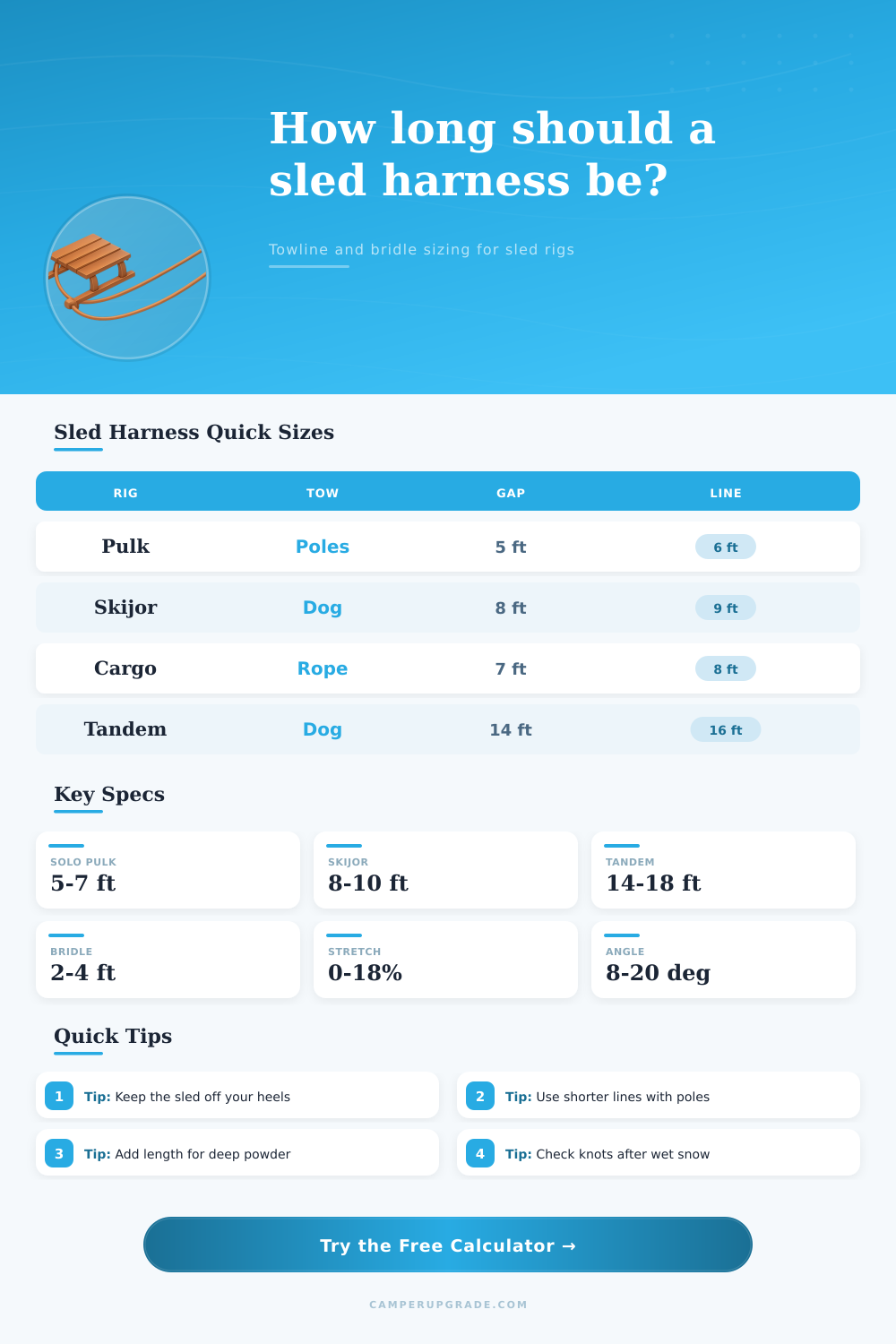
| Rig or preset | Typical clear gap | Common towline | Best use |
|---|---|---|---|
| Rigid pole pulk | 4.5-6.5 ft | 5-7 ft poles | Backcountry skiing and stable downhill control |
| Rope-towed cargo sled | 6-9 ft | 7-10 ft rope | Snowshoe hauling where turns are moderate |
| One-dog skijor | 8-10 ft | 8.5-10.5 ft tug | Keeping ski tips away from dog paws |
| Two-dog fan hitch | 9-12 ft | 10-13 ft main line | Open areas with dogs side-by-side |
| Tandem dog team | 12-18 ft | 14-20 ft gangline | Lead and wheel dog spacing |
| Tow style | Geometry rule | Line behavior | Adjustment |
|---|---|---|---|
| Rigid pulk poles | Short gap plus stride clearance | Controls sled on descents | Use less turn buffer |
| Single rope tow | Gap plus terrain buffer | Sled can surge forward | Add downhill clearance |
| Shock dog towline | Loaded length matters most | Elastic section smooths starts | Cut shorter if bungee stretches far |
| Two-leg bridle | Each leg uses spread and setback | Centers pull on sled nose | Equalize both sides carefully |
| Gangline | Add station spacing per dog | Keeps dogs separated | Use necklines only for alignment |
| Material | Loaded stretch | Cold-weather notes | Best sled use |
|---|---|---|---|
| Dyneema or UHMWPE | About 1% | Low water uptake, needs secure splices | Precise pulk towlines |
| Polyester webbing | About 3% | Stable when wet, easy to sew | Harness traces and belt links |
| Nylon rope | About 8% | More bounce, absorbs moisture | Hand towlines and light cargo |
| Bungee shock section | About 18% | Protect from abrasion and UV | Short shock absorber in dog tow |
| Polypropylene rope | About 6% | Floats, can stiffen and abrade | Utility sleds and temporary rigs |
| Leather tug section | About 5% | Needs drying and inspection | Traditional dog-sled tugs |
| Coated steel cable | About 0% | Stiff, cold to handle, little give | Fixed bridle or rescue hardware |
| Hollow-braid sled line | About 4% | Easy splicing, inspect for fuzzing | Ganglines and bridle legs |
| Condition | Buffer to add | Why it matters | Watch point |
|---|---|---|---|
| Packed trail | 0-0.5 ft | Sled tracks predictably behind the puller | Line sag on slow climbs |
| Rolling terrain | 0.5-1 ft | Crests shorten the effective gap | Sled nose bumping heels |
| Deep powder | 1-2 ft | Sled wanders and plows in soft snow | High pull angle and drag |
| Downhill turns | 1.5-3 ft | Sled can overrun or swing wide | Use poles or a brake line |
| Tight trees | Shorten 0.5-1 ft | Long rigs snag and cut corners | Keep enough heel clearance |
| Training speed | 0.5-1.5 ft | Extra space reduces contact with dogs | Avoid loose, dragging line |
| Common project | Inputs used | Calculated target | Field check |
|---|---|---|---|
| Solo pulk ski tour | 5.5 ft gap, 2 ft spread, 34 in belt | 6.8 ft cut towline | Ski tails clear sled nose |
| One-dog skijor | 9 ft gap, shock line, 22 in dog harness | 9.7 ft loaded tug | No slack under steady trot |
| Fan hitch sled | 10 ft gap, 3 ft spread, 2 dogs | 12.2 ft main line | Dogs avoid crossing traces |
| Camp cargo sled | 7 ft gap, rope tow, 24 in belt | 8.6 ft cut rope | Sled does not hit snowshoes |
| Rescue litter practice | 8 ft gap, bridle, 4 ft spread | 3.3 ft bridle legs | Both legs share load evenly |
🔧Spec Comparison Grid
💡Calculation Tips
The towline length is one you want to get exact because it will ruin your day if wrong. If the towline are two inches too short, the sled digs in on uphill sections. If it is six inches too long, the ski tails slams into the sled nose on a traverse.
It’s geometry, not equipment; the way the pull pin engages the bridle and how high the hole sits in relation to the ski determines how clear of the nose it run. Guessing by feeling how much slack there is in your hand doesn’t matter. Physics is about clearance and leverage. So how do you know?
How to Choose the Right Towline Length
Plug in your rig type and desired gap into calculator above. Then select your preferred gap and it will calculate for you. There is no more memorizing coefficients.
The basic idea is finding a horizontal distance from the center point of your harness belt to the front of your sled. That’s your clear gap. Add length if you are wearing snowshoes or have ski tails so you don’t catch them. Also add length for vertical difference between the anchor points of your sled and your hip height. This vertical difference make a triangle and the actualy towline length is the hypotenuse of that triangle. When stretched out, the same towline look longer than when laid on the ground in flat snow.
Material choice changes how that triangle behave when pulled. Dyneema has minimal stretch on a static line, and so the cut length equals the working length nearly identically. Nylon rope stretches 8% or more when pulled hard or descending steeply. That’s great for absorbing shock, good on your back but bad on tracking precision. When you pull with nylon, if you don’t account for its stretch, effective gap decreases. Your sled gets closer to you under load. The tool requests what material you’re using so that it can adjust the cut length accordingly. So the rig will be where you want it to be under load, not just when hanging loose.
The amount of space required also depends off terrain. Tighter spacing and shorter lines work on packed trail where the sled travels in a predictable track. Extra length is required for deep snow as the sled plows and wanders sideways. Longer lines create enough room to accommodate lateral drift without your towline snapping tight. Even more respect for space is needed downhill. Longer lines helps keep the sled settled behind your center of mass rather than swinging out on turns. In trees, ski tight where shortening your buffer are necessary. Long lines catch branches. Always balance clearance with control.
In bridle geometry, we focus more on lateral stability versus longitudinal distance. If you have two legs attached to the sides of a sled, the felt pull will be centered or off-center, depending on length of each leg. One longer than the other and the sled will yaw over toward that side. To make it go straight would of requires fighting with the handle.
The calculator takes in your sled width and setback from anchor and splits up required total distance into separate leg lengths. This results in symmetrical pulling. A symmetrical pull mean lateral forces are canceled and towing becomes easy. Just pull forward.
This is where it gets tricky with this system: there’s no one exact line length. There’s a spectrum of ideal lengths. For techy, downhill stuff, shorter lines is better because they give you greater control. If a dog pulls, or if you are walking on flat areas, longer lines make things easier and more comfortabley. No two trips are the same. The chart gives you some typical settings to start with.
However, you should expect to tune and tweak them based off your own particular equipment and step size. Take measurements in your shoes with your ski boots on (on flat land). Then test the lift while moving. A static measurement is rarely the same than what occurs in real life when you’re actualy moving.
The goal is invisible geometry. If you get the length right, you don’t think about the sled anymore. It follows you naturaly. You feel its pull through your core, not your wrists or knees. There’s a slight tension on the towline, but not so much as to pull your nose out of the sled. Getting there requires upfront planning, and maybe a few feet of extra rope to experiment with.
The reward: Easy travel over countless miles. It is worth the effort to get it right before the first snowfall.