Igloo Block Count Calculator
Estimate the snow block count, dome courses, doorway allowance, wall volume, cap blocks, and packed snow weight for small camp igloos and winter practice shelters.
| Average block face | Face area | Best igloo size | Field note |
|---|---|---|---|
| 18 x 9 in | 1.13 ft² | Kids dome, small practice wall | Easy to lift but needs many joints |
| 20 x 10 in | 1.39 ft² | Emergency low dome | Good for fast solo cutting |
| 24 x 12 in | 2.00 ft² | Two-person camp igloo | Balanced lift weight and coverage |
| 28 x 12 in | 2.33 ft² | Family backyard dome | Fewer joints, harder trimming |
| 30 x 14 in | 2.92 ft² | Large crew warming hut | Needs firm snow and two-person handling |
| 32 x 16 in | 3.56 ft² | Training spiral dome | Fast coverage with heavy blocks |
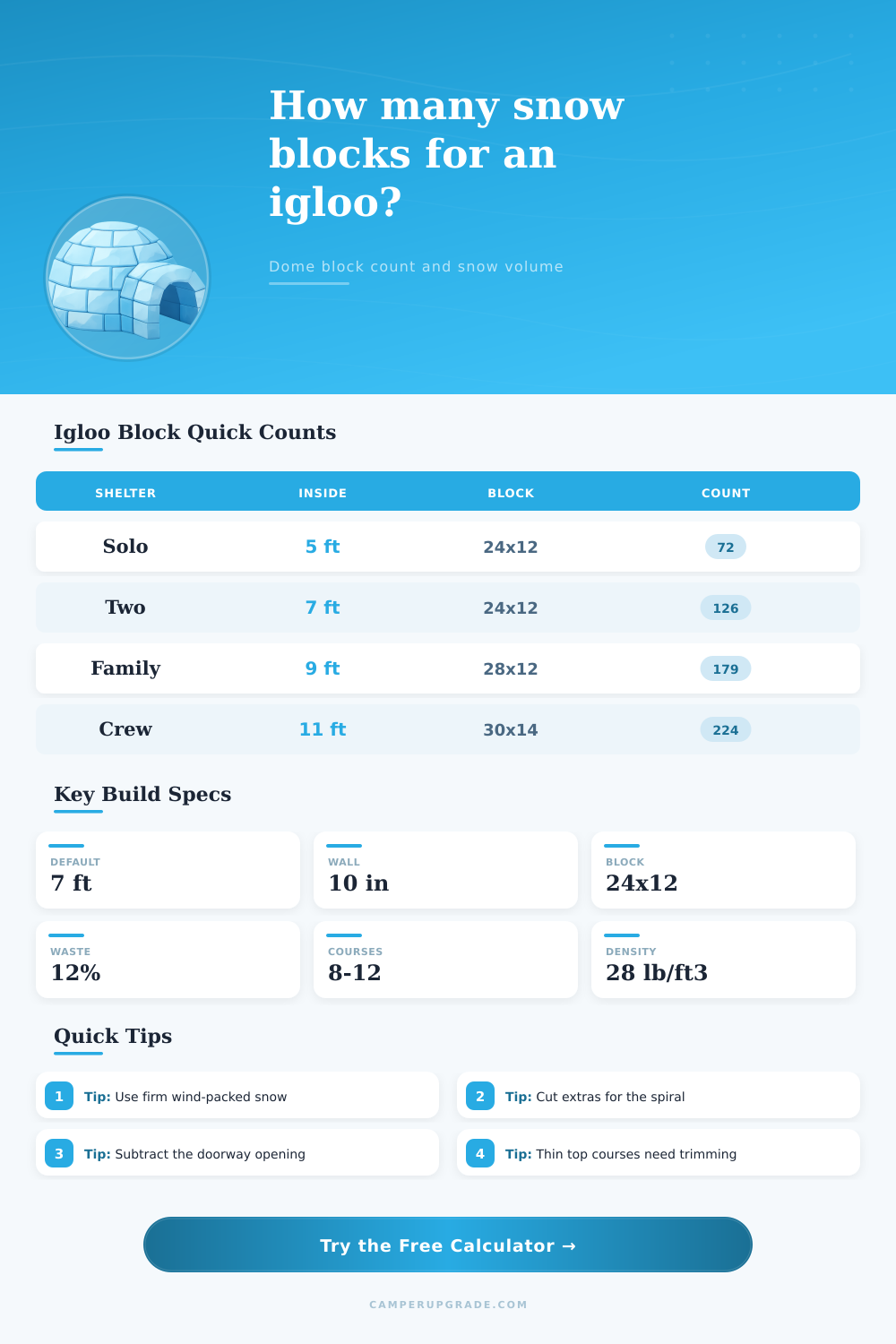
| Inside diameter | 24 x 12 in blocks | 28 x 12 in blocks | Approx courses |
|---|---|---|---|
| 5 ft solo dome | 72 blocks | 62 blocks | 6 to 7 |
| 6 ft compact dome | 97 blocks | 83 blocks | 7 to 8 |
| 7 ft two-person dome | 126 blocks | 108 blocks | 8 to 9 |
| 8 ft patrol dome | 159 blocks | 137 blocks | 9 to 10 |
| 9 ft family dome | 196 blocks | 168 blocks | 9 to 11 |
| 11 ft crew dome | 283 blocks | 242 blocks | 11 to 13 |
Reference counts assume a hemisphere, 10 in wall, doorway subtraction, and about 12% trim allowance. Actual cutting style can shift count.
| Snow condition | Density | 10 x 12 x 24 in block | Best use |
|---|---|---|---|
| Light settled snow | 18 lb/ft³ | 30 lb | Only for small or practice blocks |
| Cuttable camp snow | 24 lb/ft³ | 40 lb | Manageable for most small builds |
| Firm wind-packed snow | 28 lb/ft³ | 47 lb | Good balance of strength and handling |
| Dense hardpack | 34 lb/ft³ | 57 lb | Strong blocks with higher lifting effort |
| Ice crust blocks | 40 lb/ft³ | 67 lb | Heavy blocks, use smaller face sizes |
| Build scenario | Inside diameter | Common block face | Planning count |
|---|---|---|---|
| Emergency low dome | 4.5 ft | 20 x 10 in | 75 to 95 blocks |
| Solo field shelter | 5.5 ft | 22 x 11 in | 80 to 105 blocks |
| Two-person camp igloo | 7 ft | 24 x 12 in | 115 to 140 blocks |
| Scout patrol build | 8 ft | 26 x 12 in | 145 to 175 blocks |
| Family backyard dome | 9 ft | 28 x 12 in | 160 to 200 blocks |
| Large crew warming hut | 11 ft | 30 x 14 in | 210 to 260 blocks |
Typically when someone thinks about making an igloo they envision themselves huddled in a blizzard with a blade in their hand and pray it doesn’t collapse. Truth is, it’s actualy a lot more math and less “just make it stick.” You need to consider geometry, the density of materials, and exactly how many rectangular prism are used to allow for an arch that supports itself. While this doesn’t mean you have to BE an engineer to get it right, it does mean stop assuming about how many blocks you’ll need, don’t just guess based off gut feeling. Use a calculator and take the guesswork out of creating a spiral arch design so you can spend more time ensuring your cuts are clean instead of worrying about running out of material.
The exposed face size of your blocks is the most important variable. Beginners often make mistake of measuring the block before trimming it. This messes up all subsequent calculations. After you cut a spiral shape into wedge, you’ll have an exposed block with a specific flat side that faces outward. The app assumes you know the dimensions of the flat side facing outward.
The Math Behind Building an Igloo
Are you using standard 24 by 12 inch blocks? That’s going to change everything when you compare it to a much bigger 30-inch block for a shelter sized to fit crew. Big blocks require heavier snow to avoid cracks, more muscle in your shoulder to lift them, and fewer seams, but less time building overall. Small blocks takes longer, but compensate because there’s not as much stress on your shoulder or as many opportunities for cracks in the snow. Reference tables explains the balance between size of a shelter and the number of blocks needed. This explains why a family shelter feels so different then a solo one.
Thickness is another area where our gut isn’t reliable. Most camps gets built at 10 inches. This is thick enough to offer good insulation with minimal loss of interior volume, yet not so thick that it feels like the walls is holding up your sleeping bag. To save time, folks want to make it six inches thick, but then you’ll have less structural strength and also less thermal mass. By inputting different wall thicknesses, the calculator can account for this, and instantly show you the impact on weight and overall volume. Keep in mind that thicker walls mean moving and cutting more snow.
A cubic foot of packed snow is no joke, it’s roughly 28 pounds. And that figure doesn’t even consider the fact that wind-packed snow is firm! On average, firm wind-packed snow weigh nearly twenty-eight pounds per cubic foot. This means that most impromptu igloos will fall inwards long before they reach the summit. If the base isn’t level, or the blocks are too large for the person to carry safely, the structure just won’t be able to hold itself up.
Remember: Every doorway you make takes away some of the strength. When you cut out a hole to create a tunnel inside the sphere, you’re taking away some material that would of shared the load, and this tool will subtract that volume from your block calculation.
Next, there’s waste. Snow isn’t made of steel. Blocks will break while being carried. Corners will get knocked off as they’re tapped snugly into position. The uppermost courses will need careful cutting to match final cap stone. Seasoned builders allow about 12% for waste, but novices might want to add a few more blocks on top of that just in case. Better a pile of excess blocks than a cold night outdoors waiting for your dome to close up.
In the end, building an igloo is about learning patience and planning. The math are done by the tools, and all you’ve got to do is determine which size block to use given your own physical capabilities and the physics of an arch. The art is in reading the snow, understanding your body’s limits, and letting the numbers guide your decisions. After that, it’s just grunt work in the cold, putting down one block at a time. Before you know it, the circle are complete. That first question of “will I run out” is long forgotten, replaced by the comforting beat of stacking up block upon block.