Snow Cave Volume Calculator
Estimate interior chamber volume, excavation spoil, snow weight, wall thickness, sleeping bench space, and vent sizing for winter camping snow shelters.
❄Snow Cave Presets
📏Chamber Geometry And Snow Inputs
Measure finished living space after smoothing ceiling and walls.
Use probed thickness above and beside the chamber, not drift depth.
Snow Cave Estimate
🧊Material And Snow Spec Comparison
📊Reference Tables
| Interior layout | Typical dimensions | Volume range | Best use |
|---|---|---|---|
| Solo emergency trench cave | 6 ft x 3 ft x 3 ft | 25 to 35 cu ft | Short bivy shelter |
| Solo overnight arched cave | 7 ft x 4 ft x 3.5 ft | 40 to 55 cu ft | One sleeping pad and small gear |
| Two-person side-bench cave | 7.5 ft x 5 ft x 4 ft | 65 to 85 cu ft | Two pads with shared entry trench |
| Three-person storm cave | 8.5 ft x 6 ft x 4.8 ft | 110 to 135 cu ft | Extra sitting and boot space |
| Lunch cave / wind pocket | 6 ft x 4 ft x 3 ft | 35 to 50 cu ft | Seated ski-tour shelter |
| Gear cache alcove | 5 ft x 4 ft x 3 ft | 25 to 45 cu ft | Packs, sleds, and food bags |
| Snow condition | Density used | Digging feel | Planning note |
|---|---|---|---|
| Settled new snow, light | 18 lb / cu ft | Fast shovel, low strength | Needs extra thickness checks |
| Packed wind slab snow | 35 lb / cu ft | Good block cutting | Common target for caves |
| Sintered consolidated snow | 45 lb / cu ft | Firm saw-and-shovel work | Strong but slower to hollow |
| Heavy coastal snow | 55 lb / cu ft | Wet, sticky, heavy spoil | Plan shorter digging shifts |
| Icy refrozen snow | 62 lb / cu ft | Hard chopping required | Volume is costly to remove |
| Wall / roof thickness | Use case | Visual probe cue | Calculator impact |
|---|---|---|---|
| Under 12 in | Not preferred for sleeping | Probe reaches daylight quickly | Flags thin-wall warning |
| 12 to 17 in | Small fair-weather cave | Short probe depth remains | Marginal for storm loads |
| 18 to 23 in | Normal overnight shelter | Probe has solid reserve | Passes typical target |
| 24 to 35 in | Storm or group shelter | Deep roof and side buffer | Good reserve, more digging |
| Over 36 in | Large drift or cornice-free bank | Thick enough to shape slowly | Heavy entry excavation |
| Vent setup | Opening area | Occupants served | Maintenance note |
|---|---|---|---|
| One 1 in hole | 0.79 sq in | 1 emergency | Check often in falling snow |
| One 1.5 in hole | 1.77 sq in | 1 to 2 people | Common small-cave starter |
| Two 1.5 in holes | 3.53 sq in | 2 to 3 people | Better if cooking outside entry |
| One 2 in hole | 3.14 sq in | 2 to 3 people | Less likely to plug quickly |
| Two 2 in holes | 6.28 sq in | 3 to 5 people | Useful for larger chambers |
⚡Snow Cave Calculation Notes
Building your snow cave is more about understanding geometry than brute force. You’re digging a chamber in a deep drift of snow; you want a warm place to sleep away from cold weather. Managing volume can make the difference between sleeping well and shivering. It’s a technical-sounding concept, but just think: how much room do you need to breathe? Where are you going to put all the snow you dig out? Once you type in the sizes you’re planning on, the calculator will figure out the rest. There’s no guessing whether your walls is too thin and your shelter is too small.
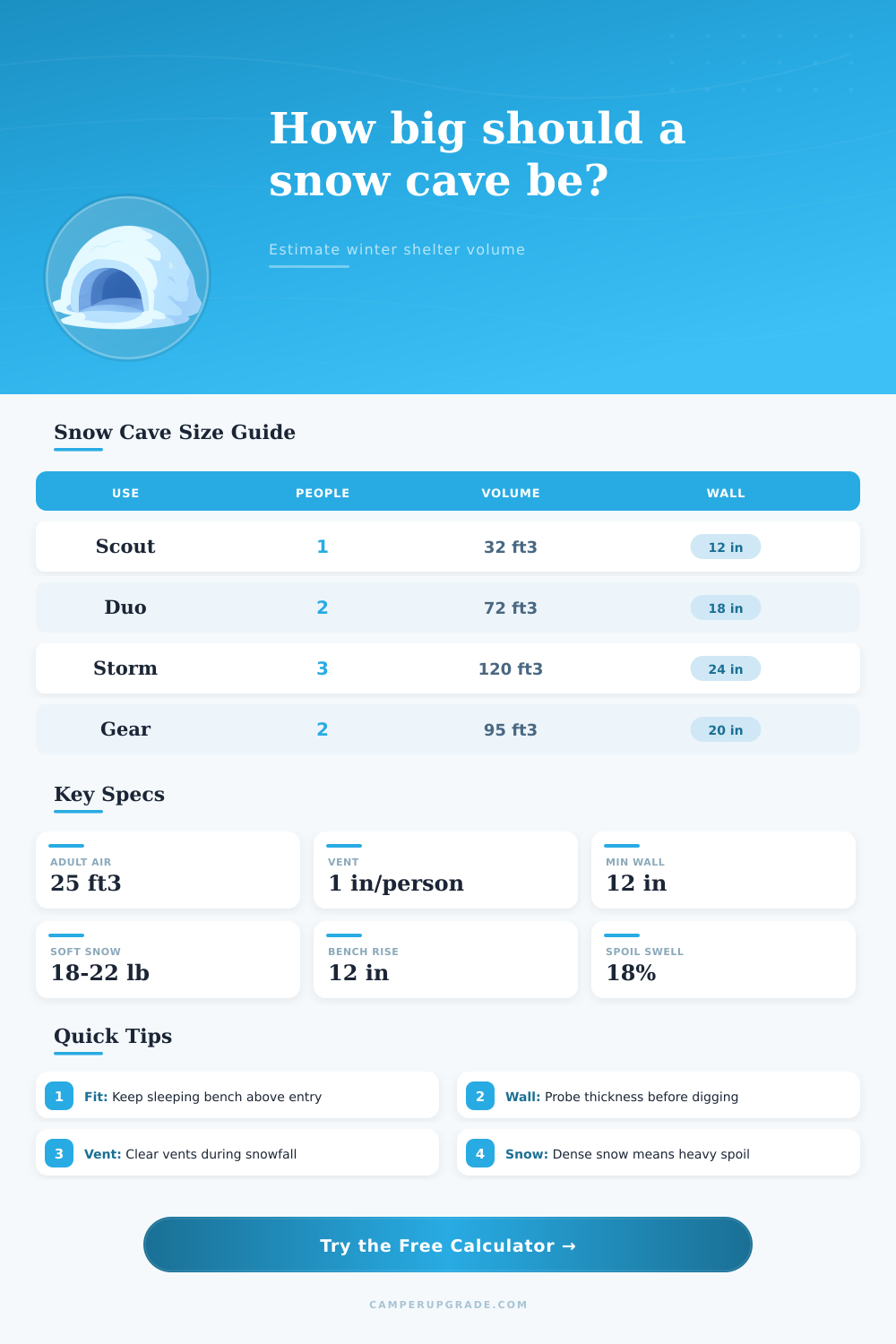
The spoil factor: most folks think they’ll move less then they do. A lot of times when you cut into a drift with dense snow, you break it up into smaller chunks which get realy big. You may end up having to move 75 cubic feet of snow for every 50 you dig out of a chamber. That twenty five percent swell makes all the difference, and you should of consider where the spoil pile will go prior to cutting into anything. Otherwise you’ll just be wasting energy shoveling snow around until your tunnel is clogged.
How to Build a Safe Snow Cave
Another variable that will confuse newcomers are wall thickness. On one hand, you have insulation, on the other hand, you have structure. If it’s fair weather and you’re only sleeping in it solo, then a minimum of twelve inches of roof is fine. Eighteen is a better target if you expect to spend the night in there. Dry, still snow is an insulator; thicker walls means retaining more heat. But, digging through heavy snow is tiresome business. Here, fatigue and warmth are traded off against each other. Digging too long means you burn body heat faster then you’ll save under a heavy roof.
Fresh air’s important indoors. If more than one person is sleeping inside a tight space, the carbon-dioxide concentration will rise fast. According to the chart above, the volume of air needed for comfort by any adult are about 25 cubic feet. That figure includes breathing room. It also includes space to stand. These are two different thing. You’ll want some kind of air circulation. One good guideline is one one-inch-diameter vent per individual. However, if there’s a storm, you’ll need to monitor it frequently because blowing snow can fills the vent before you know it.
It also depends on cave shape. A rectangular box with a flat ceiling is less stable than an arched half-cylinder tunnel, which spreads snow-weight down its curve to minimize mid-tunnel collapse. With the tool you can try various shapes and visualize what an arch do to your volume versus a flat roof. If space is limited but stability matters, a rounded dome gets you more headroom for the same excavation effort.
Storing gear is a real-world problem. You can’t just throw your backpacks on the floor and expect comfort. Wet boots drip water, which melts snow below and makes your feet wet and cold. For this reason, it’s standard practice to have raised sleeping benches. This keeps you out of condensation zone, while using the bottom part of the drift as insulation and storage space. The calculator takes this into account too. It lets you choose between bench types, which changes available living space.
Creating a snow cave is an art form: do I work hard digging or will I be warm enough because my walls are so thick? Do I want to block out wind chill or do I need some fresh air circulating? If you get the math down beforehand, guesswork is minimized. This means more time livig around on the mountain! You also won’t exhaust yourself trying to build something that’s livable. This way, by the time you slide inside, your abode will be homey and not a grueling undertaking.