Condensation Dew Point Tent Calculator
Estimate dew point, inner fly margin, moisture load, and ventilation target for a tent, tarp shelter, bivy, or canvas camp setup.
1.Choose a tent-night preset
2.Enter air, shelter, and moisture details
Tent condensation result
3.Material and shelter comparison grid
4.Reference tables
| Inside air | Relative humidity | Approx dew point | Condensation meaning |
|---|---|---|---|
| 40 F / 4.4 C | 70% | 31 F / -1 C | Frost possible on cold fly |
| 45 F / 7.2 C | 85% | 41 F / 5 C | Very small fabric margin |
| 55 F / 12.8 C | 65% | 43 F / 6 C | Usually manageable if vented |
| 65 F / 18.3 C | 80% | 58 F / 14 C | Humid air can wet cool walls |
| 75 F / 23.9 C | 90% | 72 F / 22 C | Muggy coastal or lake risk |
| Shelter material | Typical behavior | Surface offset guide | Best input use |
|---|---|---|---|
| Coated nylon double-wall | Cold fly, protected inner | +2 to +4 F | Backpacking tents |
| Polyester double-wall | Less sag, similar dew risk | +2 to +4 F | Family domes |
| Silnylon single-wall | Moisture touches sleeper space | 0 to +2 F | Pyramid tents |
| Dyneema single-wall | Low absorption, visible droplets | 0 to +2 F | Ultralight shelters |
| Canvas wall tent | Breathable but can chill slowly | +4 to +8 F | Base camp tents |
| Waterproof bivy | Very small air volume | -1 to +1 F | Alpine bivy sacks |
| Moisture source | Typical rate | 8-hour load | Calculator input |
|---|---|---|---|
| Sleeping adult breath | 35-45 g/hr | 280-360 g | Occupants |
| Hard evening activity | 60-90 g/hr | Short spike | Add higher RH |
| Damp rain jacket | 20-40 g/hr | 160-320 g | Damp gear |
| Wet pack and boots | 70-120 g/hr | 560-960 g | Wet gear |
| Cooking residue | 100-250 g/hr | After-cook spike | Residual preset |
| Vent setting | ACH estimate | Typical setup | Tradeoff |
|---|---|---|---|
| Mostly sealed | 0.5 ACH | Storm flaps shut | Warmest, wettest |
| Small roof vent | 1.2 ACH | One high vent open | Often not enough |
| Low plus high cracked | 2.5 ACH | Door base and roof vent | Good baseline |
| Cross-vented | 4.0 ACH | Opposing vents or fly gap | Cooler but drier |
| Open tarp | 6.0 ACH | Large open sides | Weather exposure |
5.Field notes
Dew point is calculated with the Magnus formula. Ventilation target uses absolute humidity difference between inside and outside air, so saturated outside air may require source control instead of more airflow.
The tent appears to have been rained on from within, as you awaken to a squishy pillow and a damp sleeping bag. It was not because anything was leaking, but because you faced one of those annoying problems with physics. Your body heat and breath had saturated the air within your shelter, which then cool enough to cause the water vapor to condense onto the nylon walls. Despite following all the rules of waterproofing, you find yourself wet nonetheless…because the dew point isn’t a tent problem, it’s a dew point problem.
This all boils down to dew point, which sounds like a mysterious term for a secret society or something, but it’s actualy easy to grasp: Dew point is the temperature where air reaches maximum capacity for holding water vapor; and then what? Condensation happen immediately when that moist air comes in contact with a surface that is below that dew-point temp. Your tent walls is often colder than the air inside because they are thin and exposed to the night sky. So there you sit, shivering under a cold wet tarp.
How to Stop Condensation in Your Tent
That dew point is a number we can plug into a handy-dandy calculator that calculates whether or not the fly will drip given your outside temperature and estimated humidity. You don’t even need to guess anymore! It will compute how much water you’re generating vs. It calculates how much airflow you have through your system. People spend a lot of time trying to keep the rain from getting in… But fail to realize that each of us breathes out a continuous stream of water vapor during sleep, amounting to dozens of gram of moisture per hour for one person. Two people in close quarters inside a waterproof shelter create a humid little microclimate.
What’s interesting about this is that the inputs to the tool appear minor, yet they have a major impact on output. Fabric is important because silnylon shelters (single wall) has very little thermal insulation between the outside layer of tent material and the inside where your hot breath touches. Unless you’re aggressive with air flow you’ll see condensation forming right in your face. If you use a double wall shelter, like most tents these days, condensation builds up closer to the mesh inner walls. This has two effects: first, the fly stays warmer and slows the onset of condensation; second, the warmer air hold more moisture. If you close off the vents, all that moisture gets trapped in the tent itself, making you either warm and wet or cold and dry, but never both.
The chart references help show how various materials perform under similar scenarios. Note that a dome-shaped nylon tent “breathes” differently than a canvas one. A canvas tent lets air through passively but cools down rapidly after dark. The lever to pull is ventilation. How many air changes per hour do you need? That’s what the calculator is estimating, based off how much moisture are your source of. You might have been cooking in the vestibule, or brought wet boots into your tent. Those will really jack up the number.
Lots of people seal their tents closed when it’s storming out there. They believe they’re sealing off wind-driven rain. More often they’re just making a sauna for themselves. A tiny high vent will allow the warm damp air to exit, but it works better with a low intake on the other side to create a chimney effect. Mild wind will blow better if you crack both ends as opposed to just cracking open one roof vent. That way, air moves through the entire space instead of getting stuck at the ceiling.
The other variable that gets folks: fabric temperature. On clear nights, a rainfly will be several degrees colder than the ambient air temperature due to radiative cooling. Also, condensation collects on the coldest surfaces first. That means your fabric may reach the dew point before the thermometer indicate the air is okay. The calculator takes into account radiant heat loss and wind chill, which are not reflected by a simple weather report. Because of this, there’s an offset to account for surface temperature.
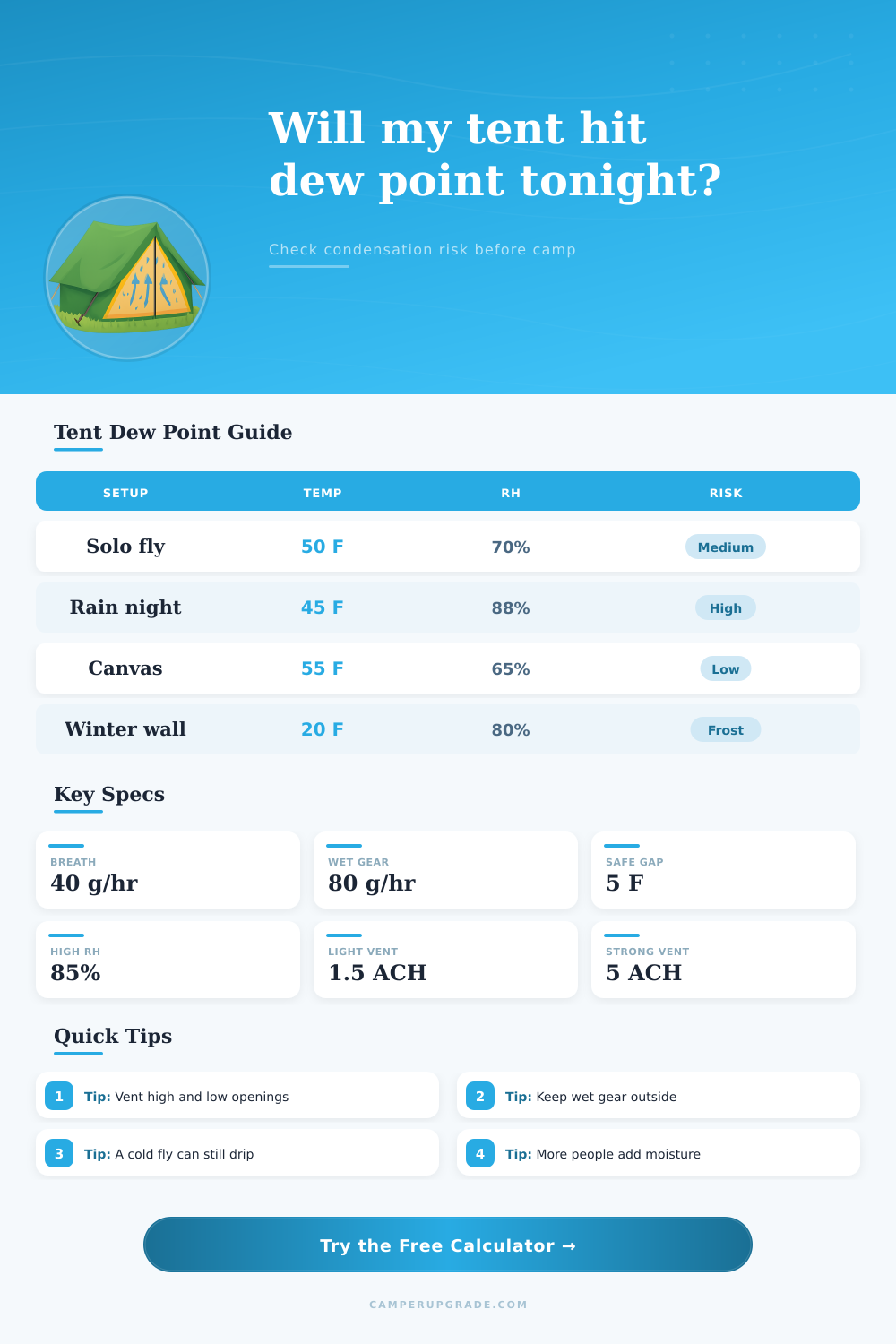
While you have no control over the night sky, you do have some control over the air inside. Keep wet gear out of your sleeping area or hang it away from the space to reduce initial humidity. This decreases the work your ventilation system should of do to catch up by dawn. Achieving this requires a little humility, and some practice. There are going to be times when you get it wrong. Condensation can’t always be avoided, so you want to manage it. Your goal should be to have a fabric margin that maintains at least a five degree temperature buffer between the wall and the dew point.
This creates the space needed to keep your sleeping gear dry and yourself comfortabley. It makes the morning crisp rather than soggy. It’s the difference between a good night’s sleep and a miserable trip. It’s what moves you from fighting the weather to working within the limits of physics. By doing this, you leave those vents cracked just right to let the moist air out before it settles onto your head.