Canvas Waterproofing Coverage Calculator
Estimate waterproofing volume, container count, coating load, seam allowance, and drying window for camper canvas, tents, tarps, awnings, and pop-top fabric.
⛺Real Canvas Presets
📏Canvas Area and Product Inputs
Waterproofing Estimate
🧪Material and Product Spec Comparison
📊Coverage Reference Tables
| Canvas condition | Baseline coverage | Metric coverage | Best input use |
|---|---|---|---|
| Light acrylic canvas, already coated | 220 sq ft / gal | 5.4 sq m / L | Awning refresh |
| Solution-dyed awning fabric | 205 sq ft / gal | 5.0 sq m / L | RV awnings |
| Synthetic tent canvas | 190 sq ft / gal | 4.7 sq m / L | Tent fly panels |
| Medium cotton canvas, weathered | 160 sq ft / gal | 3.9 sq m / L | Camper canvas |
| Seam-heavy camper canvas | 145 sq ft / gal | 3.6 sq m / L | Pop-top walls |
| Heavy cotton duck, dry | 115 sq ft / gal | 2.8 sq m / L | Wall tents |
| Chalky old canvas after cleaning | 105 sq ft / gal | 2.6 sq m / L | Restoration |
| Waxed canvas refresh | 90 sq ft / gal equivalent | 2.2 sq m / L | Wax dressing |
| Product type | Coverage modifier | Touch dry | Full cure estimate |
|---|---|---|---|
| Pump spray fluoropolymer | 1.00 baseline | 4 to 6 hr | 18 to 24 hr |
| Silicone canvas spray | 0.92 of baseline | 6 to 8 hr | 24 to 36 hr |
| Brush-on canvas proofer | 0.88 of baseline | 6 to 10 hr | 24 to 48 hr |
| Wax dressing / paste | 0.55 of baseline | 8 to 12 hr | 36 to 72 hr |
| Acrylic water repellent | 1.08 of baseline | 3 to 5 hr | 12 to 24 hr |
| Seam sealer blend | 0.70 of baseline | 8 to 12 hr | 24 to 48 hr |
| Container | Fluid ounces | Liters | Coverage at 160 sq ft / gal |
|---|---|---|---|
| 16 fl oz bottle | 16 fl oz | 0.47 L | 20 sq ft, one coat |
| 22 fl oz spray bottle | 22 fl oz | 0.65 L | 28 sq ft, one coat |
| 1 quart | 32 fl oz | 0.95 L | 40 sq ft, one coat |
| Half gallon | 64 fl oz | 1.89 L | 80 sq ft, one coat |
| 1 gallon | 128 fl oz | 3.79 L | 160 sq ft, one coat |
| 5 liter can | 169 fl oz | 5.00 L | 211 sq ft, one coat |
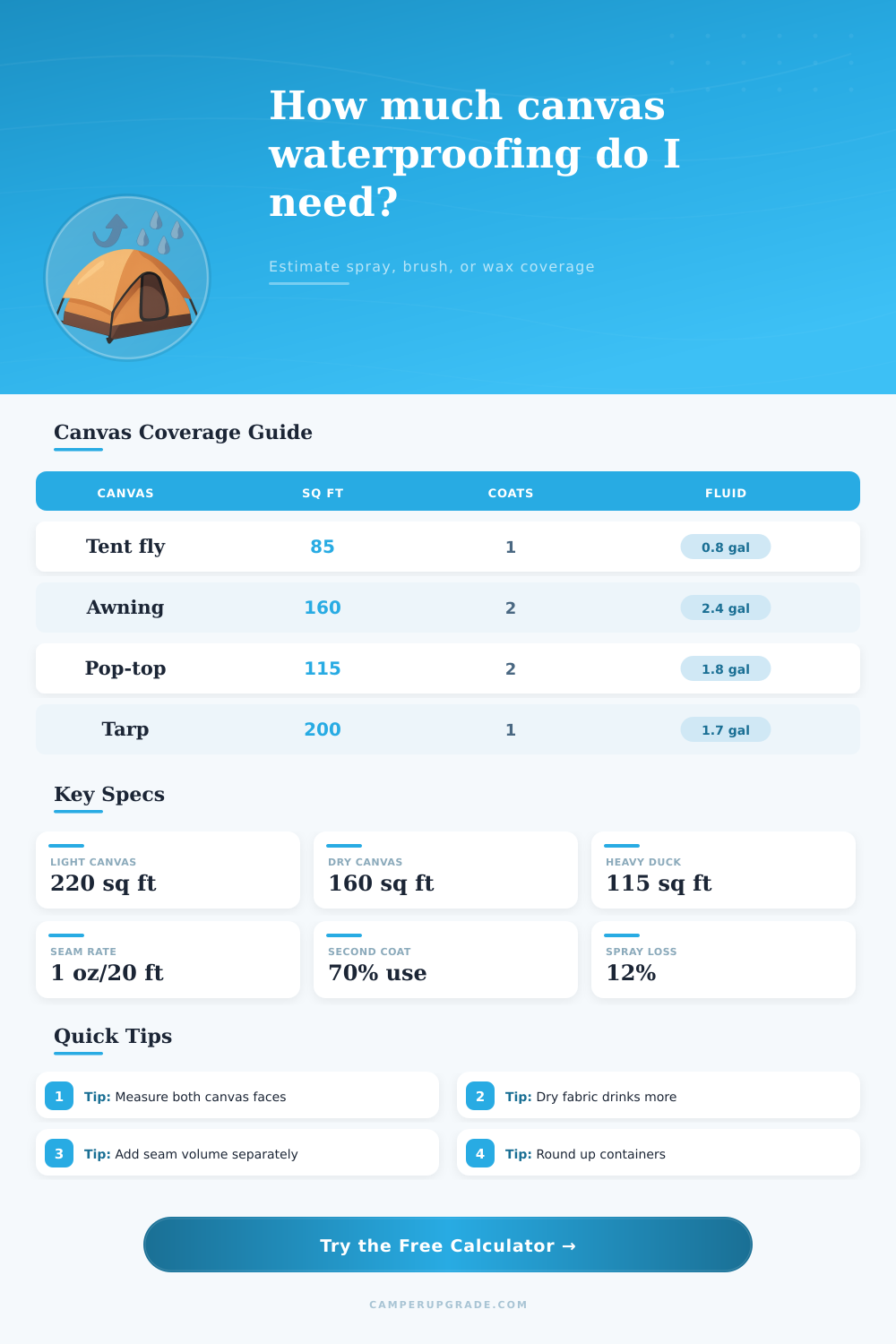
| Common canvas item | Typical treated area | Normal coats | Approx product at medium canvas |
|---|---|---|---|
| Pop-up camper bunk end | 120 sq ft | 2 coats | 1.3 gal with reserve |
| 8 ft by 10 ft awning top | 80 sq ft | 1 to 2 coats | 0.8 gal with reserve |
| 13 ft bell tent wall and roof | 300 sq ft | 2 coats | 3.2 gal with reserve |
| Camper pop-top side canvas | 155 sq ft | 2 coats | 1.7 gal with reserve |
| 12 ft by 16 ft tarp, one face | 192 sq ft | 1 coat | 1.5 gal with reserve |
| Wall tent roof and sides | 420 sq ft | 2 to 3 coats | 5.7 gal with reserve |
💡Canvas Calculation Notes
If you own an old camper shell or a canvas tent, you know what I’m talking about. You’re out for the night on a humid evening. You go to crack the door open and expect dry air inside, only to find your sleeping bag all wet against the canvas. First comes the smell. That musty mildewed smell of cotton that used to be soft just hangs there.
Call it cheap equipment or poor luck. More often than not, they doesn’t realize how much product will stick to old fibers until it runs off. Most people just guess. They pick up a quart cuz the bottle says “covers a thousand square feet” under optimal lab conditions. There are no such condition in your back yard.
Why This Calculator Is Useful for You
The calculator on this page deals with applying waste and actualy absorbency so you don’t have to lug half full bottles in a storm. But one of the most variable things which can throws you off is the condition of the canvas itself. Factory coated, fresh and light acrylic take very little product. It beads water beautifuly because of its factory coating. Weathered, heavy cotton duck left sitting in someone’s garage for five years are like a sponge.
This is why the calculator specifically wants you to know what kind of fabric you are using…it makes over half the difference in how much volume you need. A lightly refreshed awning won’t take nearly as much sealant than a dry weathered tent. If you don’t pick the right option, you’ll either use too much product and waste money…or you’ll have sticky spots that aren’t protected that go right through when it rains hard. It is a little thing, but it is hugely important to the outcome.
There’s also a bit of inefficiency buried in how you apply it… And this is what most guides overlook. Sure spraying appears to be quick work…until you notice that half the fluoropolymer are settling on patio pavers or drifting overhead as overspray. To account for this, the tool includes a loss percentage depending on if you’re using a pump sprayer, a roller or a brush. While faster, spray application require a large volume buffer to make up for the mist that will never touch the canvas. And while slower, brushing deposits more product directly into the fibers with little waste. Plug in your application method into the calculator above and let it handle the math for you. You won’t need to guess whether that extra quart was necessary or just a mistake.
Don’t neglect the seams. Water first enters through folded hems, zipper tracks, and stitching holes. You should of treat these surfaces with the overall coating, but you also need to pay special attention to them. There’s another field in the tool dedicated to seam length, so there is a little bit of additional volume accounted for to make sure those important seams will become fully saturated. It is an easy one to overlook, but also a simple place to fail. You can have a perfectly treated roof, but if your side seam are porous, it doesn’t matter.
The second coat is not like the first. After the primer seals the fibers, the canvas can’t drink as much. And the calculator account for that. Because you don’t need to use as much to create another layer atop the first, it cuts down on its estimate for each additional coat. About seventy percent seems to be what happens in reality. Which makes sense. You’re painting a shield, not feeding a hungry cotton plant.
Last but not least is the drying window. Moddern acrylics will set within hours whereas some waxes can take several days to fully cure. It will show you how long you’ll need to wait before you’re ready to pack away your tarp or roll up that tent. You’ll want to avoid rushing through this process; it traps moisture in your fabric which means guaranteed mold growth… sooner rather than later. Go with what the calculator tells you and take your time.
You’ll have gear that lasts longer and you won’t be carrying around that mildew stench that screams “it’s going to be a rainy night and I’ll be shivering in wet clothing.” Proper preparation beat expensive furnitures every time.