Grommet Spacing Calculator
Lay out grommets for RV skirting, tarps, awnings, privacy screens, canvas covers, and campground banners with even spacing, corner offsets, and load-aware recommendations.
Calculated Grommet Layout
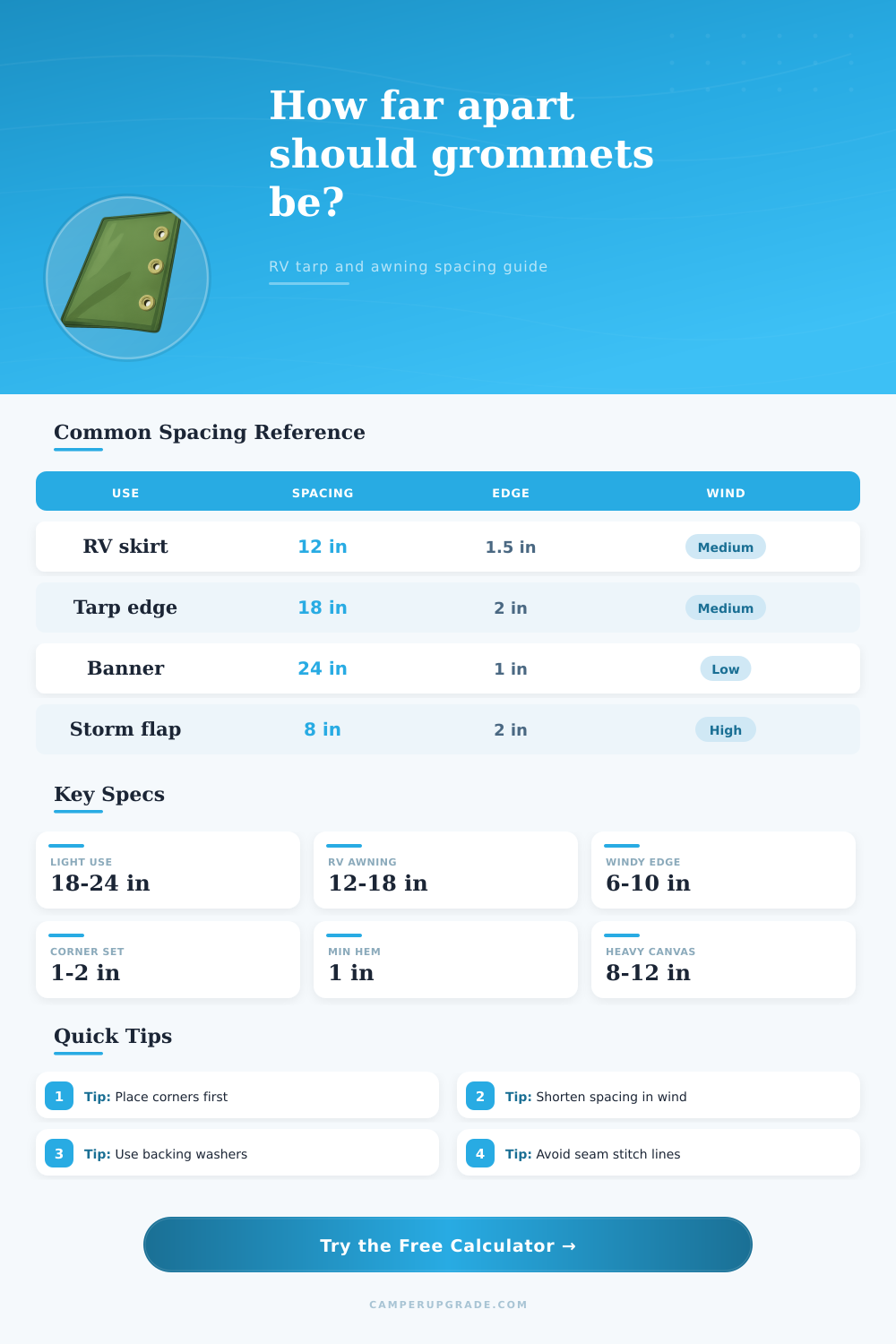
| Project use | Typical spacing | Corner offset | Best grommet size |
|---|---|---|---|
| RV skirting or wind skirt | 10 to 14 in | 1.5 to 2 in | #2 or #3 brass |
| Awning shade panel | 12 to 18 in | 1.5 in | #2 stainless or brass |
| Light campground banner | 18 to 24 in | 1 to 1.5 in | #1 or #2 brass |
| Mesh privacy screen | 12 to 16 in | 1.5 in | #2 with washer |
| Storm flap or tight lashing | 6 to 10 in | 2 in | #3 or #4 with patch |
| Heavy canvas equipment cover | 8 to 12 in | 2 in | #3 or #4 spur |
| Grommet size | Hole diameter | Common cord | Typical use |
|---|---|---|---|
| #0 | 1/4 in / 6 mm | 1/8 in shock cord | Small snaps, light covers |
| #1 | 9/32 in / 7 mm | 1/8 to 3/16 in cord | Banners, small screens |
| #2 | 3/8 in / 10 mm | 3/16 to 1/4 in cord | Tarps, RV skirting, shade |
| #3 | 7/16 in / 11 mm | 1/4 in rope | Canvas covers, high load |
| #4 | 1/2 in / 13 mm | 1/4 to 5/16 in rope | Large covers, lashing |
| #5 | 5/8 in / 16 mm | 3/8 in rope | Heavy industrial panels |
| Material | Reinforcement need | Suggested max spacing | Notes for layout |
|---|---|---|---|
| Poly tarp with rope hem | Medium | 18 in calm, 12 in wind | Stay centered in the heat-sealed hem |
| Vinyl-coated polyester | Medium-high | 12 to 16 in | Use washers or a backing patch |
| Cotton canvas | High | 8 to 12 in | Prefer spur grommets on thick layers |
| Open mesh shade cloth | High | 10 to 14 in | Add webbing tape along grommet edge |
| Banner vinyl | Low-medium | 18 to 24 in | Use shorter spacing outdoors |
| Clear vinyl panel | Medium | 10 to 14 in | Keep holes away from cold-stress cracks |
| Panel size | Edges used | 12 in spacing | 18 in spacing |
|---|---|---|---|
| 3 ft x 8 ft banner | All four | 22 grommets | 16 grommets |
| 6 ft x 14 ft screen | All four | 40 grommets | 28 grommets |
| 7 ft x 16 ft awning wall | Top and bottom | 34 grommets | 24 grommets |
| 8 ft x 18 ft RV skirt | Top only | 19 grommets | 13 grommets |
| 10 ft x 12 ft tarp | All four | 44 grommets | 32 grommets |
| 4 ft x 20 ft storm flap | All four | 48 grommets | 34 grommets |
Grommets are one of those thing most RV’ers learn about by experience, the bad kind. One night in the wind, a corner give way. You struggle to pull the torn corner back up but have no luck as you drag fabric behind the rig. The wind pulls the ripped corner out from around hole and now you have a tear in the canvas from the hole to where the corner used to be. So many assume the stitch or metal was sub-standard (but that’s rarely the case).
The culprit is simply misaligned grommet spacing that doesn’t account for force that come from wind pressure across an exposed surface. After plugging in your panels’ size the calculator above do all the work. No need to guess whether twelve inches is too wide for a storm flap!
How to Space Your Grommets Correctly
Define what’s at the edge of the interface. An RV skirt may be eight feet long and eighteen high; a banner might be hung on a fence as a horizontal line. Specify type of material used, as a poly tarp will behave very differently than heavy cotton duck material. Canvas wants to hold its form but requires more regular tie-off anchors to avoid bagging out inbetween ties; vinyl stretches when placed under tension. The input fields holds the key as much as pushing the button marked “calculate”.
The offsets on corners are very important. A corner takes most of the stress so when you put your grommet smack dab in the middle of 90 degree turn, it puts all the strain where it is weakest and tears through fast. By shifting the offset by an inch and a half you remove the force from near raw edge and spread it into reinforced body of the fabric. That little tweak prevents tearing out the hem and keeps the fabric piece together.
Then there’s wind. On a calm day in the campground, you can space out wide with no problems. However, when it blows, the closer together your anchors, the less concentration of force they has to withstand if you’re spaced out too much. That’s where the tool comes into play. Based off these settings, it calculates how many pounds of load will be applied to each grommet. It’ll tell you approximately how many pounds each ring should of be able to withstand in normal pulling conditions. If that seems like too much, it’ll advise you to tighten up the interval.
More grommets aren’t about looks; it’s so that one doesn’t fail under load. Your starting point will be determined by material. Rope hems on poly tarps hold up fine for a reasonable gap when it’s calm out there. Toss the same tarp into the wind and the ropes stretches or rip out of thin plastic edge. For canvas, the fabric is so heavy that you have to place it tighter than for other materials. The material itself sags where the tie ins are, forming pockets that act as sails to catch the wind. With mesh screen, the holes must be reinforced behind each one as the open weave provide no structure by itself.
A few sanity checks is made from the reference tables, which include ranges for usual applications such as privacy screens or awnings. They are not hard and fast, just informed guesses based on years of fixes and failures out in the field. Notice how much less space storm flaps require compared to a banner in a campground? One displays a logo at ground level in relatively sheltered conditions. The other one dangles down in the teeth of gale force wind blowing directly across it. The physics are quite different.
Add a waste percentage to the number. You’ll make mistakes, setting your punch tool or making a hole. You might start again on a section because your alignment is off. Having an additional ten percent will guarantee you won’t need to stop halfway through the project, searching at 2 am for replacements.
Corner treatments are different too. Double corners has redundancy. If one falls out during extreme weather, it is OK. Single points save on metal. This is because good spacing prevents the tear from starting. Keeping equal tension on all attachment points is a balance between form and function. By letting each grommet shares the load, no single one feels the strain. You stay in there and your cover stays put.
Peace of mind does not come from reacting when the wind picks up and things go wrong like they have before; it comes from planning ahead.