Tent Pole Diameter Strength Calculator
Estimate tube bending stress, deflection, buckling margin, and recommended diameter for tent, tarp, awning, and canopy poles.
Strength Estimate
| Material | Elastic modulus | Yield / working strength | Typical use |
|---|---|---|---|
| 7001-T6 aluminum | 69 GPa / 10.0 Msi | Strong tent-pole alloy range | Backpacking and dome poles |
| 7075-T6 aluminum | 71.7 GPa / 10.4 Msi | High aluminum strength | Premium lightweight pole sets |
| 6061-T6 aluminum | 68.9 GPa / 10.0 Msi | Moderate aluminum strength | Awning braces and utility tubes |
| Pultruded fiberglass | 17 GPa / 2.5 Msi | Flexible, lower stiffness | Budget family tents |
| Carbon fiber tube | 90 GPa / 13.1 Msi | High stiffness, brittle overload | Specialty ultralight poles |
| Mild steel tube | 200 GPa / 29.0 Msi | High stiffness, heavy | Canopy legs and ridge tubes |
| Outside diameter | Common wall | Best fit | Design note |
|---|---|---|---|
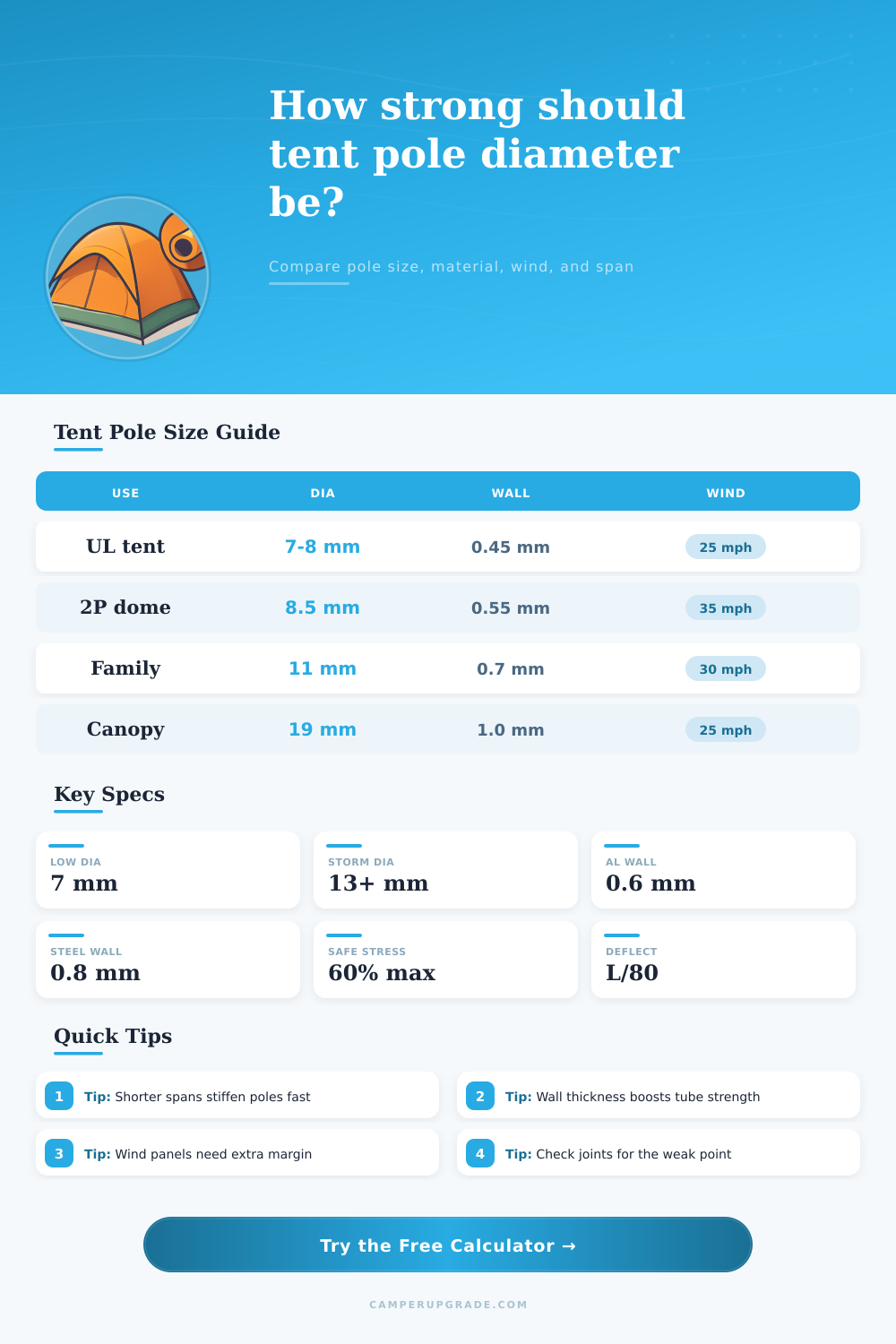
| 7 to 8 mm | 0.45 to 0.55 mm | Solo ultralight tents | Keep spans short and panels small |
| 8.5 to 9.6 mm | 0.55 to 0.70 mm | Two-person dome tents | Good balance for packed size |
| 10 to 11 mm | 0.65 to 0.80 mm | Family or taller tents | Better for long unsupported arcs |
| 13 to 16 mm | 0.80 to 1.20 mm | Awning braces and tarp poles | Watch ferrules and guy-line angles |
| 19 to 25 mm | 0.90 to 1.50 mm | Canopies and steel ridge poles | Check buckling as well as bending |
| Wind speed | Pressure estimate | Camping meaning | Pole response |
|---|---|---|---|
| 20 mph | 1.0 psf / 49 Pa | Noticeable steady breeze | Most tents remain lightly loaded |
| 30 mph | 2.3 psf / 110 Pa | Strong campground gusts | Guy lines begin to matter |
| 40 mph | 4.1 psf / 196 Pa | Hard exposed gusts | Stress rises sharply with speed |
| 50 mph | 6.4 psf / 306 Pa | Storm-level loading | Use storm pitch and high margin |
| Support style | Moment model | Deflection model | Calculator use |
|---|---|---|---|
| Curved tent arch or hoop | wL² / 12 equivalent | 0.65 times simple beam | Dome arches with fabric support |
| Sleeved dome span | wL² / 10 equivalent | 0.85 times simple beam | Pole in continuous tent sleeve |
| Straight ridge, both ends held | wL² / 8 simple beam | 5wL⁴ / 384EI | Ridge bar or supported cross pole |
| Awning brace or cantilever | wL² / 2 cantilever | wL⁴ / 8EI | One end fixed, one end loaded |
| Vertical canopy upright | wL² / 16 sway estimate | Compression plus side load | Canopy leg or upright pole |
Tent poles buckle under wind pressure more frequent than they tear out, causing most tent failure. That may sound like something that only engineers worry about, but the physics of keeping nylon fabric aloft against wind is easy to understand, if you know which variables matter. Enter your expected wind speed and tube dimensions into the calculator, and it’ll run the math for you.
No guesswork: Is your ultralight design up to surviving a sudden squall? Or wind on an exposed ridge? Most of the structural strength come from the outside diameter. For example, a 9 mm pole will be much stiffer than an eight mm pole, even with equal wall thickness. This is because bending strength is proportional to the fourth power of radius. A very slight increase in outside diameter results in a huge jump in stiffness.
How to Choose the Right Tent Pole for Wind
Wall thickness matter too, primarily for preventing local crushing at joint points and adding shear strength, but diameter does most of the heavy lifting in bending strength. But wall thickness adds to weight linearly whereas diameter add to strength exponentially. Here you are trading off pack volume for structural integrity.
The material selection also complicates things since poles don’t necessarily require equal amounts of strength and stiffness to pack well. A good compromise is found in aluminum alloys such as DAC TH72M or 7001 series. They possess sufficient elasticity and yield strength that the pole will bend slightly when hit with gusts while remaining stiff enough to stay strong.
Carbon fibers are more rigid per weight, a property that appeals to ultralight folks, but they is less ductile than metals. This means that although a carbon pole retains its shape better at sustained winds, it can fail catastrophically if impacted or overstressed. Fiberglass bends readily and isn’t prone to breaking, but too much flex can pull stakes out of the ground causing the tent to collapse from bottom-up.
These stiffness differences are taken into account so that you can compare apples-to-apples without having to manually convert units between a titanium trekking pole attachment and a steel canopy leg. People often make mistakes when estimating wind load by assuming wind speed equals pressure. Wind pressure actualy goes up at the square of the velocity: twice the wind speed means four times the pressure pushing on your tent walls. It’s doable to feel comfortable in a 20 mile per hour breeze, but when you get a 40 mile per hour gust it’ll be four times the load.
The calculator factors in projected area (as opposed to just floor space) and that’s more realistic since wind impacts aren’t against the actual floor; they’re against the side profile of your dome/tunnel shape. So if you have a big vestibule facing into the prevailing wind, that surface area contributes to the bending moment on your front poles beyond what interior floor dimensions would indicate.
How you configure your support makes a huge difference in how stresses are distributed. For example, a straight ridge pole and a curved arch distribute loads quite differently because arches has built-in backup support. A cantilevered awning will see the most bending where it’s attached; therefore, it will need either larger diameter or thicker walls to withstand bending forces. The tool has preset buttons to get an approximation of some common configurations so that you’re less likely to choose a simple beam model for something more complicated like a hub and sleeve system.
If you have a combination of joint types, always lean toward the cautious side, theory models tend to smooth out areas of stress concentration from things like ferrules and swaged sections. It is not just fail-thresholds, but also deflection limits. For durability and comfort, deflection is more important than pure threshold. If there is too much deflection under load, it puts too much stress where the fabric meets the guy line. That can cause them to come out too early or all at once when stakes pull out suddenly.
Deflection should of been kept low enough to prevent sags where the tent collapses into a puddle of water or loses its aerodynamic form. By keeping it a fraction of the span, you will have a tight tent not one that sags and pools water. The output shows whether the sag will fall within a reasonable range if you select a diameter.
Gear redundancy is cheap compared to cost of a busted tent. Whether you’re pitching a family campsite or a weeklong thru-hike, it helps to know exactly what your poles can handle. Knowing their limits gives you a peace of mind that no warranty can provide. It’s also a way to break past the marketing language about pole strength and really grasp their mechanical limit.
You don’t want the strongest pole out there; you just want the lightest one that will help you stay dry if the weather turns bad.