Awning Tie Down Angle Calculator
Estimate RV awning strap angle, anchor distance, wind uplift load, tie-down tension, and anchor safety margin from your campsite geometry.
| Strap angle from ground | Vertical hold per 100 lb tension | Anchor pull per 100 lb tension | Setup meaning |
|---|---|---|---|
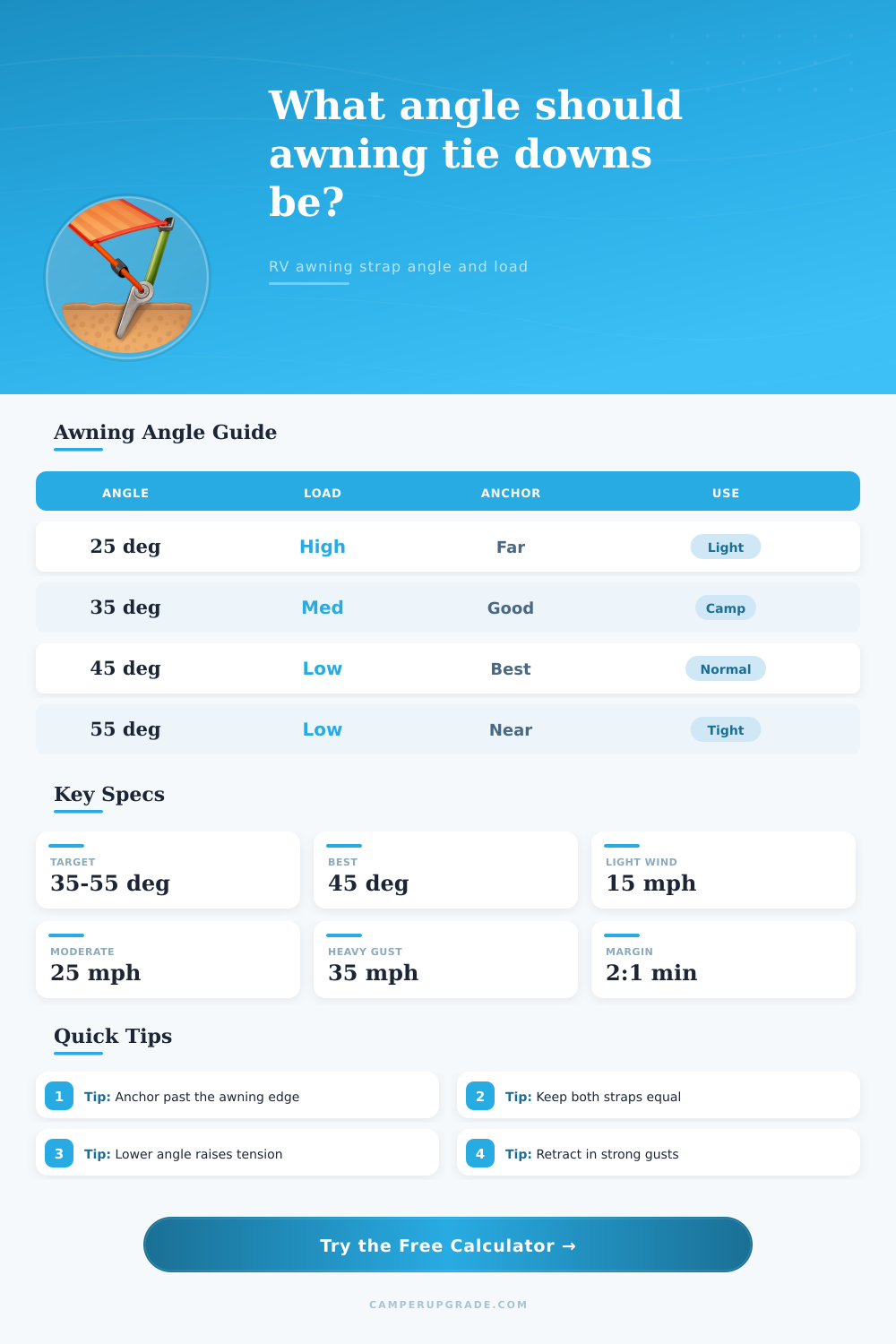
| 25° | 42 lb | 91 lb horizontal | Long reach, high strap tension |
| 35° | 57 lb | 82 lb horizontal | Usable campsite angle |
| 45° | 71 lb | 71 lb horizontal | Balanced strap and anchor loading |
| 55° | 82 lb | 57 lb horizontal | Steeper, shorter anchor distance |
| 60° | 87 lb | 50 lb horizontal | Compact but more downward pull |
| Gust speed | Velocity pressure | Approx uplift on 16 ft x 8 ft | Planning note |
|---|---|---|---|
| 15 mph | 0.58 psf | 56 lb at open-site factor | Light breeze |
| 20 mph | 1.02 psf | 98 lb at open-site factor | Watch fabric movement |
| 25 mph | 1.60 psf | 154 lb at open-site factor | Many awnings should come in |
| 30 mph | 2.30 psf | 221 lb at open-site factor | Retract before exposure worsens |
| 35 mph | 3.14 psf | 301 lb at open-site factor | Do not rely on tie-downs alone |
| Anchor condition | Planning hold per anchor | Best strap angle range | Field check |
|---|---|---|---|
| 10 in smooth stake, firm soil | About 80 lb | 45° to 60° | Twists or wiggles easily if overloaded |
| 12 in spiral stake, firm soil | About 150 lb | 35° to 55° | Good for typical corner straps |
| 15 in screw anchor, packed soil | About 220 lb | 30° to 55° | Best when aligned with strap pull |
| Sand stake or buried deadman | About 90 lb | 35° to 50° | Needs wide surface area in soft sand |
| Water or weight anchor pair | About 250 lb | 45° to 60° | Check sliding as well as lifting |
| Awning setup | Common fabric area | Usual straps | Typical anchor offset |
|---|---|---|---|
| 8 ft van bag awning | 48 sq ft | 2 straps | 5 to 7 ft beyond edge |
| 10 ft pop-up camper awning | 70 sq ft | 2 straps | 6 to 8 ft beyond edge |
| 12 ft cassette awning | 96 sq ft | 2 straps | 6 to 9 ft beyond edge |
| 16 ft RV patio awning | 128 sq ft | 2 or 3 straps | 7 to 10 ft beyond edge |
| 18 ft fifth-wheel awning | 144 sq ft | 3 or 4 straps | 8 to 11 ft beyond edge |
Gusts break the calm of an otherwise nice evening under your extended awning. Beer in one hand, wind in your face; you want nothing more then a few peaceful moments. Except that sound isn’t just annoyance, it’s a warning that your tie-downs is failing. Physics be damned; you ignored it.
Staking your corners down and hoping for the best is fine, most people do this. They don’t think about geometry of pull, however. Premium stakes and heavy-duty straps won’t make any difference unless you get angle right. You’re asking anchor to do two things at once, and force will rip it all out.
Why Awning Tie-Downs Fail
Horizontal pull vs. Vertical hold: Consider it like a tug-of-war between wind (trying to pick up your roof) and gravity (keeping the stake anchored on the ground). A shallow angle causes most of your strap tension to drag on the stake sideways instead of pulling downward. And that’s where people screw up. Instead of adjusting their anchor location, they purchase a beefier strap.
Once you input your approximate wind gusts and awning dimensions, the calculator above will crunch numbers for you. You don’t have to wonder whether or not your set-up will survive a twenty-five-mile-per-hour breeze. Forty-five degrees seems like a good general sweet spot for most campsites. That’s where two forces of holding the post down vs holding it back get pretty evenly split.
Tilt it steeper because you are up against something and cannot be as far out. This gets you some of lift you were looking for, but it adds some pull down on the stakes. That adds drag to the front of stake. Go flatter and you have to add a bunch more tension to get equal amount of lift. This means you are putting way more stress on the strap connection points (shear stress) and loading straps more heavily. The tool’s visuals shows you exactly how much load each piece carries based off your specific setup, letting you see the trade-offs clearly.
The other thing to remember is that force equals square of velocity; it goes up four times, not double. A fifteen-mile-per-hour breeze doesn’t double its force when it becomes a thirty-mile-per-hour gust; it go up by a factor of four. So it’s not just for comfort’s sake that you want to check the forecast: you also want to ensure structure is safe. You may be OK in light air, but if margin between comfortable and uncomfortably is too small, the same set-up can blow out in moderate gusts.
Your anchor hardware won’t do anything except hold in certain soil types: In firm ground, a spiral stake is great; in sandy or rockier soil, it’s a pointless stick. You can’t just count on hardware. You also have to has the cooperation of the ground. On loose gravel, for example, you want to use something that has more surface area (like an anchor with flatter sides) or add weight so it doesn’t slide. The table at the bottom of the page matches strap angles and hold strength, giving you a quick way to see if you can trust your shade to the elements.
Tie-downs are no replacement for commonsense: By keeping flutter low and slight arm-stress at bay, they’re a good deal… But never mistake them for making an awning storm-rated. Retract the awning if you feel the dirt underfoot is a bit loose or the wind gets up past comfort level. Better to forfeit an hour of shade than the whole extension mechanism. You should of keep that fabric flat and snug till packing-up time by keeping a little math handy.