Groundsheet Weight Per Square Meter Calculator
Estimate fabric GSM, cut area, seams, pegs, guylines, stuff sack, and packed weight for tent footprints, awning mats, tarp floors, and RV camp layouts.
| Material | Typical GSM | Approx oz/yd² | Best Fit |
|---|---|---|---|
| Polycryo window film | 30 to 45 g/m² | 0.9 to 1.3 | Ultralight fair-weather groundcloths |
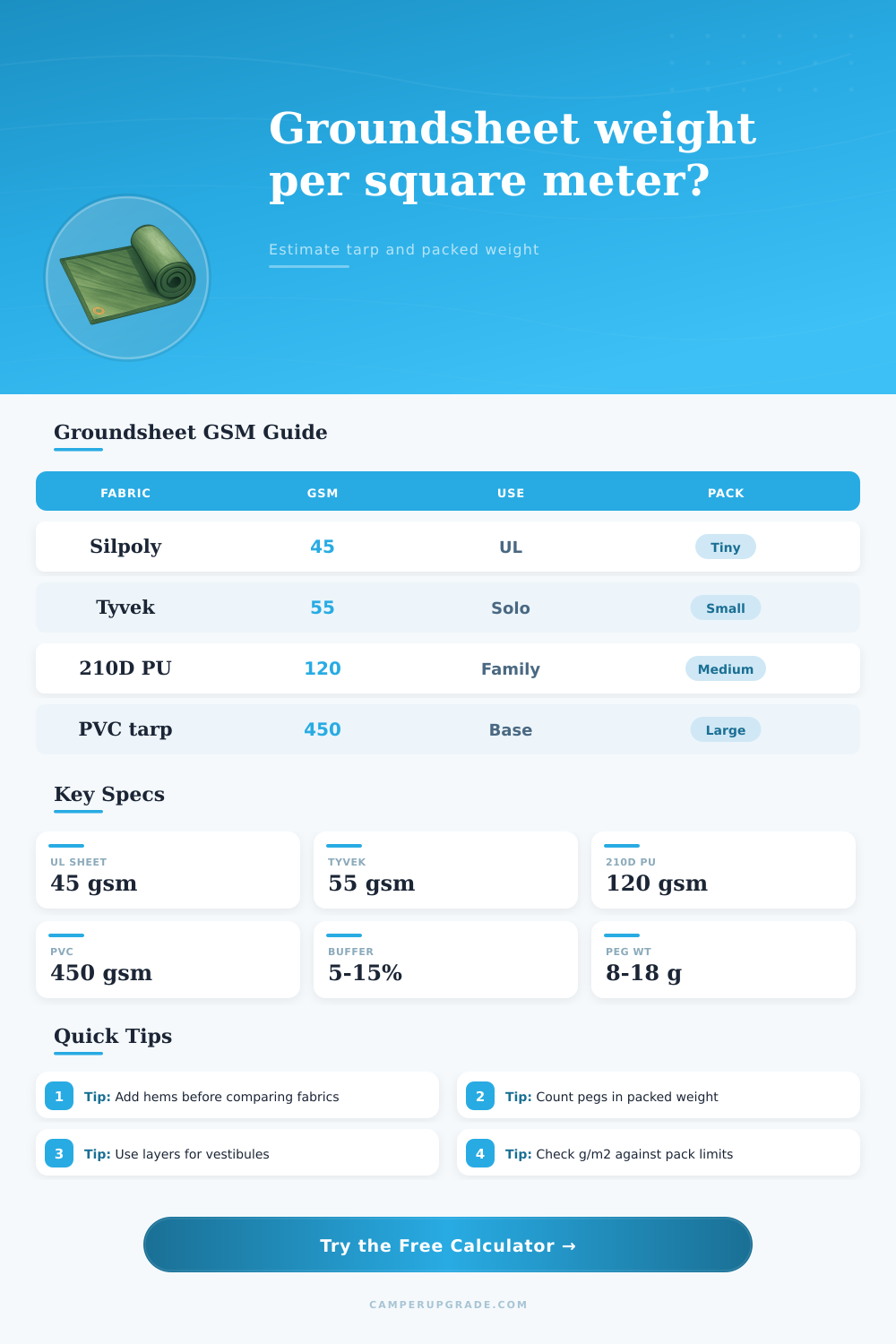
| 20D silpoly footprint | 40 to 55 g/m² | 1.2 to 1.6 | Backpacking footprints and vestibules |
| Tyvek housewrap | 50 to 65 g/m² | 1.5 to 1.9 | Durable solo and 2-person sheets |
| 40D silnylon floor | 65 to 90 g/m² | 1.9 to 2.7 | Tent floors needing better abrasion resistance |
| 210D PU oxford | 110 to 150 g/m² | 3.2 to 4.4 | Family tents and camp kitchen sheets |
| Woven polyethylene tarp | 160 to 220 g/m² | 4.7 to 6.5 | Utility tarps and truck bed covers |
| RV patio mat polypropylene | 230 to 320 g/m² | 6.8 to 9.4 | Awning mats and campsite living areas |
| PVC vinyl tarp | 400 to 650 g/m² | 11.8 to 19.2 | Heavy base sheets and wet ground protection |
| Use Case | Typical Size | Area | Weight at 120 GSM |
|---|---|---|---|
| Bivy groundcloth | 0.8 m × 2.2 m | 1.76 m² | 211 g before hardware |
| Solo tent footprint | 1.2 m × 2.2 m | 2.64 m² | 317 g before hardware |
| 2-person footprint | 1.4 m × 2.2 m | 3.08 m² | 370 g before hardware |
| Family tent floor | 3.0 m × 4.0 m | 12.00 m² | 1,440 g before hardware |
| RV awning mat | 2.4 m × 4.9 m | 11.76 m² | 1,411 g before hardware |
| Camp kitchen sheet | 2.0 m × 3.0 m | 6.00 m² | 720 g before hardware |
| Component | Typical Value | Weight Formula | When To Use |
|---|---|---|---|
| Normal hem allowance | 5% | Finished area × 1.05 | Most sewn or taped footprint edges |
| Reinforced corners | 8% | Finished area × 1.08 | Repeated pegging and rocky campsites |
| Bathtub edge overlap | 12% | Finished area × 1.12 | Raised edges, deep hems, or wall overlap |
| Aluminum mini peg | 8 to 12 g | Count × peg weight | Backpacking footprints and small tarps |
| Steel utility stake | 20 to 35 g | Count × stake weight | RV mats, awnings, and windy sites |
| Light shock cord | 2 to 4 g/m | Length × grams per meter | Corner tensioners or elastic loops |
| Result | Formula | Metric Output | Imperial Output |
|---|---|---|---|
| Rectangle area | length × width | m² | ft² converted to m² |
| Circle area | 3.1416 × radius² | m² | ft² converted to m² |
| Triangle area | 0.5 × base × height | m² | ft² converted to m² |
| Fabric weight | cut area × GSM × layers | grams | ounces and pounds |
| Packed weight | fabric + wet gain + hardware | grams and kilograms | ounces and pounds |
Why does your pack feel heavier then it was when you left home? And then you’re standing there staring at the strap on your backpack. You weighed your tent. You weighed your food. You swapped that heavy book for a lighter guidebook. Somehow in all of this math, a hidden variable has consumed fifty grams from your budget.
More than likely, it’s the groundsheet. Or rather, the cost of carrying the groundsheet, what you THINK the groundsheet weighs versus what it actualy COSTS you to carry because of things like hems, stakes, dampness, and the stuff sack itself. That number on the tag is rarely the truth.
The Real Weight of Your Groundsheet
Most folks just buy a footprint based off nothing more than the fabric specification. They see a number on a tag and believe it. It rarely are. You will also need to input some numbers into this calculator, specifically the materials and sizes. The beauty of this calculator is that it does all the math for you, no more guessing at conversions and coefficients.
You’ll have to stop thinking about fabric only in terms of denier. Sure, a 20d silpoly is going to be very lightweight as far as a base goes. But forty-five grams per square meter doesn’t sound like much. But you has to remember that those numbers don’t include any kind of hem allowance. Each time you tape or sew another edge, you’re adding width. Each time you reinforce a corner, you’re adding area. Five percent cut and hem allowance may not sound like much on paper. In real life? An extra strip of fabric running around the entire perimeter. That add up fast if you want to lose ounces from your solo pack.
Oh, and then there’s the hardware trap. That’s the one where folks lose track of the fact that the dang sheet has to be kept down. And to do that, you need pegs. And pegs weighs something. Sure, aluminum stakes don’t weigh much, but if your site is going to get windy and you want six of them, those dozen or so grams apiece add up fast. Steel stakes will hold better on hard ground, but they double or triple that weight at once. With this thing, you can fiddle with both the number and the weight-per-peg until you hit the actual cost to keep it secure. It also factors in loops and grommets. Small as heck as individual bits of metal, they’re dead weight you tote around all day long even when not in use.
The other quiet assassin here is moisture. A wet sheet weighs something different than a dry one does. So if there’s been a little bit of rain overnight or maybe just a morning dew, when you go to break down your camp site, that stuff will have been sucked up into the fabric. Worse yet, it’ll pick up some dirt and grit off the ground. This add mass. There is an allowance in the calculator for moisture pickup to account for this penalty of reality. In most cases 10% is a good guess, but if it’s a wet time of year or perhaps you’re camping near a marshy area, 20% might be more appropriate. Failure to account for this will always cause your actual weight to be more than your planned weight.
The page does lay it all out, though. If you look at the reference table, they have side-by-side comparisons of various fabric types. Solo camper will notice that Tyvek fits right there into that sweet spot between weight vs. It is durable. And if you’re wondering why PVC tarps may be cheap but they suck for backpacking: A simple 2 person PVC tarp has a fabric density of over four hundred fifty grams per square meter. That’s heavier than many whole tents. While it is waterproof and durable, you’ll carry that cost everywhere up your mountain trails. Doing the math makes it clear what you’re paying for that tradeoff.
Ultimately picking the correct groundsheet boils down to two things: know your conditions and know yourself. Do you carry more weight? Are you ultralight? Are you going car camping around an RV site? Go heavy with the Oxford Cloth / Patio Mats, you’re going to need something abrasion resistant in case you put it down over some gravel and concrete pad. Backpacking? Go light with the Tyvek / Silpoly and know that you’ll have to pick your spots carefully. It’s about finding not only a sheet that fits underneath your tent but a system that keeps your gear protected while not punishing your back. And once you start measuring every gram of moisture, stakes, and fabric, everything gets a lot clearer. Guesswork goes out the window and you start making decisions from real data. That’s what helps make packing day less stressful.