Tent Repair Tape Length Calculator
Estimate patch length, roll count, overlap allowance, and spare tape for tent fly, floor, mesh, window, and seam repairs.
Full repair breakdown
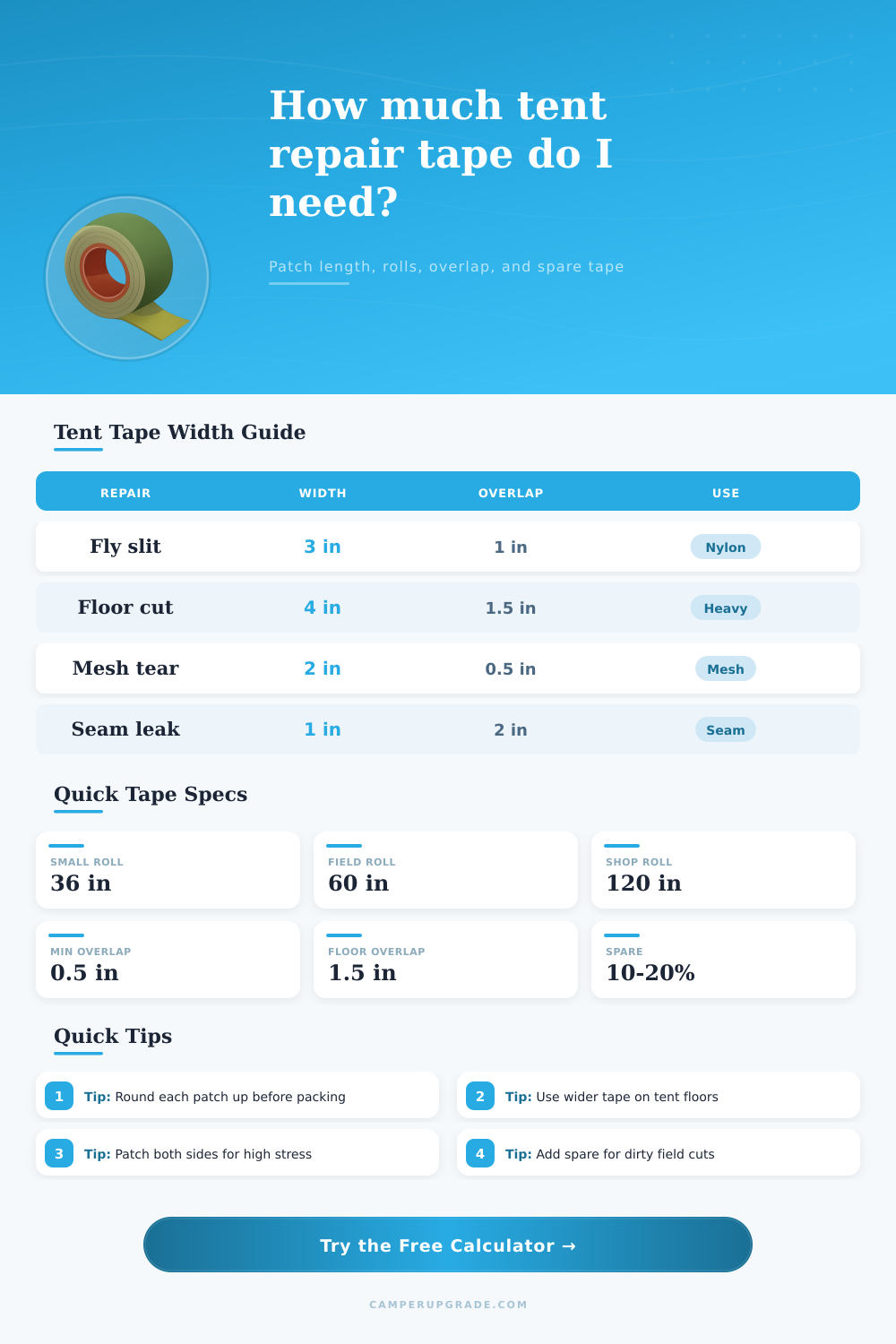
| Repair type | Typical tape width | Overlap per edge | Patch approach |
|---|---|---|---|
| Rainfly slit or puncture | 2 to 3 in | 1 in beyond damage | Single side for light loads, double side when the fabric is tensioned. |
| Tent floor cut | 3 to 4 in | 1.5 in beyond damage | Inside and outside patches reduce peeling from foot traffic. |
| Mesh door tear | 1.5 to 2 in | 0.5 to 1 in beyond damage | Use mesh-compatible tape and avoid covering more screen than needed. |
| Pole sleeve abrasion | 1 to 2 in | 1 in beyond rub area | Long strip with rounded ends follows the sleeve load path. |
| Clear window crack | 2 to 3 in | 1 in beyond crack | Transparent flexible tape keeps the window visible and sealed. |
| Canvas panel rip | 4 to 6 in | 1.5 to 2 in beyond damage | Wide patches spread load across heavier woven fabric. |
| Damage length | With 0.5 in overlap | With 1 in overlap | With 1.5 in overlap |
|---|---|---|---|
| 2 in tear | 3 in cut | 4 in cut | 5 in cut |
| 6 in tear | 7 in cut | 8 in cut | 9 in cut |
| 12 in tear | 13 in cut | 14 in cut | 15 in cut |
| 24 in seam strip | 25 in cut | 26 in cut | 27 in cut |
| Roll length | Equivalent | Example 8 in cuts | Best use |
|---|---|---|---|
| 20 in | 50.8 cm | 2 cuts plus spare | Emergency pocket strip for one small tear. |
| 36 in | 91.4 cm | 4 cuts plus trim | Weekend kit for minor fly and mesh repairs. |
| 60 in | 152.4 cm | 7 cuts plus trim | Common field roll for several tent repairs. |
| 120 in | 304.8 cm | 15 cuts plus trim | Workshop roll for family tents or canopies. |
| 180 in | 457.2 cm | 22 cuts plus trim | Expedition repair kit with generous reserve. |
| Patch style | Length formula | Width formula | When it fits |
|---|---|---|---|
| Single side | tear length + 2 overlap | max damage width + 2 overlap | Small rainfly punctures and low-stress wall tears. |
| Inside and outside | single patch length x 2 | same roll width | Floors, corners, and fabric under repeated tension. |
| Long strip | repair length + 2 overlap | selected tape width | Seams, sleeves, and straight abrasion lines. |
| Cross patch | two strips per repair | selected tape width | L-shaped tears and stress points near grommets. |
So you’ve got an ugly tear in your rain fly and the prediction calls for bad weather? That’s no good. The little tear, caused by a rock or a branch, become bigger as time goes on. And then it’s not only the hole you have to contend with anymore but also if your patch job is going to hold up at all. Many campers walk around with tape in their packs and don’t realize what they’re walking around with until it’s too late. If you has too much or not enough, you waste more or your patch ends up being too short.
With this calculator (above), you input the size of your rips and it calculates how much fabric you’ll need. No more guessing whether a three-inch tear needs a six-inch patch or an eight-inch one. It also factors in the overlap, which is critical to a repair. If you don’t have enough material overlapping the tear to provide clean fabric on each side, the adhesive tape won’t adhere well because it can’t just stick to itself across gap. If the tear is two inches but has only one-quarter inch overlap, then the tent will move in the wind and peel back.
How to Fix Your Tent Tears
Tent repairs are not one-size-fits-all. Replacing a nylon rainfly isn’t the same as repairing a heavy canvas floor. Materials matters so the calculator accounts for this by recommending bigger overlap and wider strips of tape in high-stress spots. Floor cuts is like bathtub floors: They need to handle ground debris and foot traffic. Their surfaces also has to spread the stress across a greater area.
Don’t think of it as a mesh tear repair. Too much force and stiff tape will rip through mesh. Because mesh is delicate, precision are important rather than force. You’re looking for a skinny strip that spans the hole without obstructing airflow.
Plan out the patch layout. Another feature is that the tool will also help you in planning the layout of the patch. Do you want to patch one side (apply from inside)? Or do you need two sided? That impacts your material usage. If two sided, then adhesive goes on each side of fabric. It involves more time. You use twice as much tape. But it prevents peeling on corners or floors which are often high friction areas.
For something like a puncture on a wall, one side is fine. For high stress areas, such as around pole sleeves or grommets, having more surface area to share the load with make sense. Two sides work because they spread the force more effectiveley.
Many people forget about one thing until it’s too late: waste. Contamination and trim add up. There is also room in the calculator to account for waste. In the field, no cut is going to be perfect. Your scissors might slip or perhaps you dropped the tape on a dirty section of ground. Giving yourself a bit more room with ten to twenty percent in excess length will make sure you’re covered even under bad conditions. It’s a little buffer but it won’t let you run out mid-repair.
For long trips, consider how much roll you need. For an emergency patch in your gear closet, a short pocket roll will do. To re-tape several seam section on an old tent, that little roll won’t go far. Knowing how many cut lengths are on a typical sixty-inch roll can help determine whether to carry several smaller rolls or one large one. Look at the reference tables to see what effect overlap has on the number of repairs from a package.
The best patch job is one you don’t notice… Until it stops working. Cutting is easy; measuring are not. But it’s worth it. Tape corner edges round a bit to prevent peeling at sharp angles. The patch will last longer. To ensure a strong seal, consider how much material is wasted, what type of material is used, and how much the layers overlap. You should of thought about this earlier.
When it rains, knowing you have a solid repair gives peace of mind. It keeps the rain out where it belongs: outside.