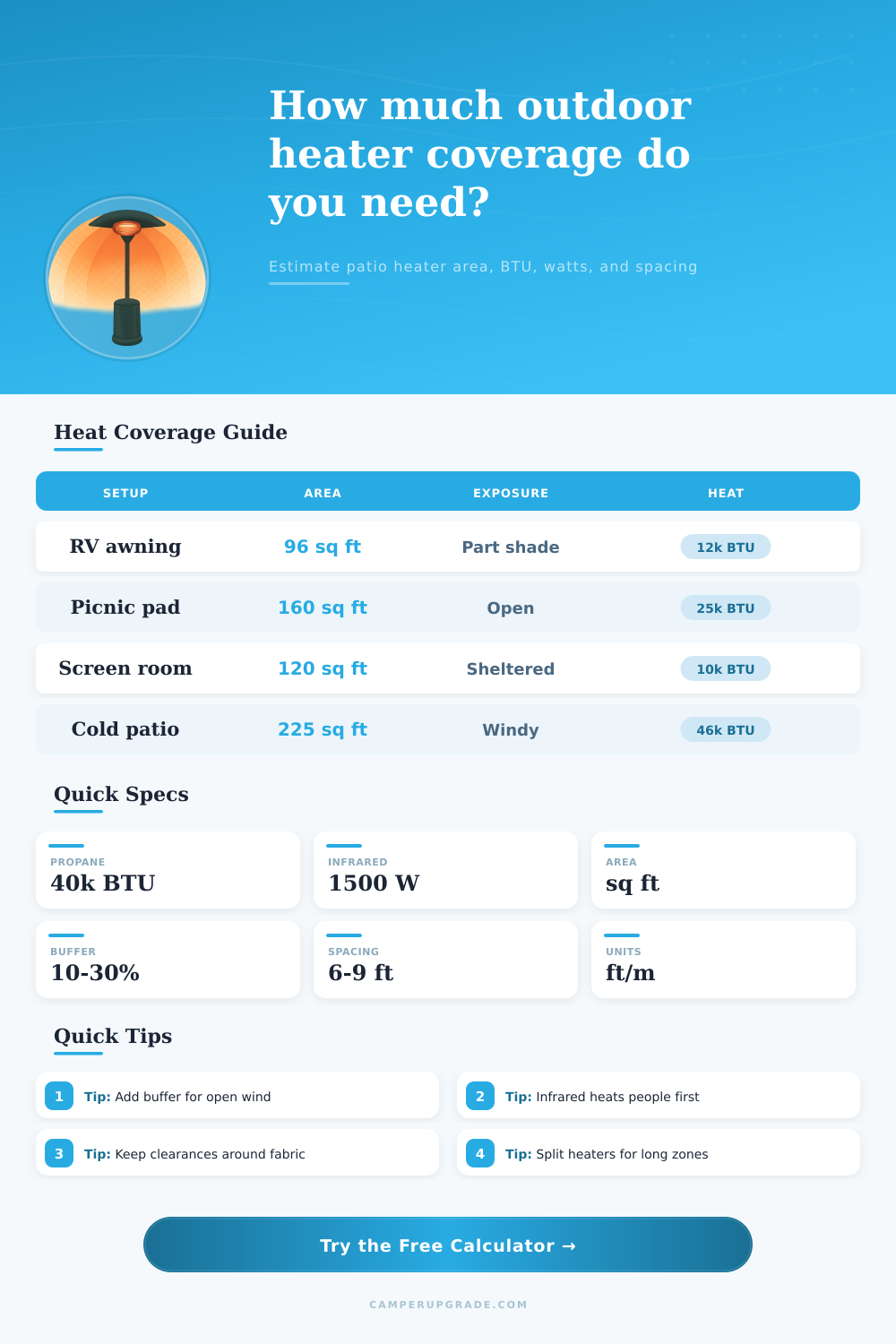
Outdoor Heater Coverage Area Calculator
Estimate patio heater coverage, total BTU per hour, electric watt equivalent, heater count, spacing, and comfort margin for RV awnings, campsite shelters, picnic pads, decks, and open outdoor seating zones.
🏷Topic Labels
🔥Outdoor Heater Presets
Heater Coverage And Output Snapshot
⚙Calculator Inputs
Safety note: Use outdoor heaters only as the manufacturer allows, keep required clearances from awnings and tent fabric, and do not use unvented combustion heaters in enclosed spaces.
📊Heater Material And Spec Comparison
📋Reference Tables
| Heater profile | Nominal output | Typical useful pattern | Best fit |
|---|---|---|---|
| Propane mushroom | 40,000 BTU/h | 10-16 ft diameter | Open patios and picnic pads |
| Propane pyramid | 42,000 BTU/h | 8-14 ft diameter | Visual center heat and small groups |
| Portable radiant propane | 18,000 BTU/h | 6-10 ft directional zone | Camp chairs and tailgate canopies |
| Electric infrared panel | 1,500 W / 5,118 BTU/h | 5-8 ft directional zone | Covered awnings with shore power |
| Dual electric infrared | 3,000 W / 10,236 BTU/h | 7-11 ft directional zone | Long benches and covered decks |
| Catalytic camp heater | 8,000 BTU/h | 4-7 ft close zone | Small, ventilated, attended spots |
| Exposure band | Base BTU per sq ft | Wind adjustment | Planning note |
|---|---|---|---|
| Mostly sheltered | 50-70 | Low | Screen rooms and covered corners hold radiant heat better. |
| Partial cover | 70-95 | Moderate | Most RV awnings and two-sided patios land here. |
| Open patio | 95-125 | High | Plan for more output or smaller comfort zones. |
| Wind-exposed | 125-170 | Very high | Split heaters and wind breaks usually matter more than one huge unit. |
| Area size | Sheltered output | Open output | Electric equivalent |
|---|---|---|---|
| 64 sq ft | 3,800-4,500 BTU/h | 7,000-8,500 BTU/h | 1,100-2,500 W |
| 100 sq ft | 6,000-7,000 BTU/h | 11,000-13,000 BTU/h | 1,800-3,800 W |
| 150 sq ft | 9,000-10,500 BTU/h | 16,500-20,000 BTU/h | 2,650-5,900 W |
| 225 sq ft | 13,500-15,750 BTU/h | 24,750-30,000 BTU/h | 3,950-8,800 W |
| 400 sq ft | 24,000-28,000 BTU/h | 44,000-52,000 BTU/h | 7,050-15,250 W |
| Common setup | Typical area | Likely heater count | Spacing cue |
|---|---|---|---|
| Small bistro table | 36-64 sq ft | 1 compact radiant unit | Point heat toward seats, not open air. |
| RV awning mat | 80-140 sq ft | 1 large propane or 2 electric panels | Keep heat clear of fabric edges. |
| Canopy tailgate | 100-160 sq ft | 1-2 portable radiant units | Place units outside traffic paths. |
| Covered deck lounge | 160-250 sq ft | 2-3 directional heaters | Use overlapping zones instead of one hot spot. |
| Open patio group | 250-400 sq ft | 2-4 large propane heaters | Set heaters around the perimeter, facing inward. |
💡Practical Tips
The problem with trying to warm an open patio with one of those mushroom propane heaters is that it’s a real lesson in thermodynamics. On the package, they rate them for some number of BTUs, like forty thousand. And that sounds pretty good. But in practice, the heat only go as far as a few feet from the burner, while everything else around it (the part where you’re sitting) was firmly in “bring-your-parka” territory.
Because there are no walls to hold the energy you expend, heating the outdoors is nothing like heating your living room. Instead, you’re battling an infinite amount of cold air, plus convection currents and wind drafts. So BTU ratings aren’t always sufficient to predict how comfortable something will be; you have to look beyond that.
How to Choose the Right Outdoor Heater
By merging area measurements with exposure factors, the calculator does the math for you and spares you from guessing whether you need one big unit or multiple small units. Wind on the seating zone can dramatically speed up heat loss. While a sheltered corner beneath an awning or fence may be comfortable at just fifty BTUs per square foot, a windy ridge could call for close to twice as many. That’s where adjusting for exposure comes in. By entering how exposed the space is, the tool turns abstract weather conditions into real heating requirements.
When most folks use outdoor heaters they hold them up like spotlights, aim them vaguely in the general direction of the party, and hope for the best. Unlike those types of heaters, infrared technology does not attempt to warm surrounding air, but rather the people and other solid objects sitting below. That’s why this tech is so good under awnings on RVs or decks without a lot of airflow.
Mounting an IR panel too far away means energy is wasted as it warms the space between you and the heater. Instead we’re looking for it to intersect the seat(s). That’s what the calculator will help you do: get the right height and spacing so the radiant heat actualy hits your seats, not the empty air above you.
Sometimes what makes it more comfortable isn’t a heater with an additional thousand BTU’s, but a windbreaker. Sometimes simply placing things in the right spots so that you get a lot less wind through your room makes a small heater work better than its specs might indicate. Those exposure bands are spelled out clearly in the tool’s reference tables. These tables show you that a “mostly sheltered” screen room needs much less power than an “open patio,” even if they have the same square footage. It’s not always about the space it warms, but rather how much of that heat gets stolen before you can use it.
For larger areas (and really, in general), it’s typically best practice to divide up the heat source into smaller loads instead of just stacking a huge unit in there. That’s why two medium-sized heaters, one at each end of a long deck… Create a warm zone with greater overlap than one large heater in the middle where everything is chilly.
This means less guessing about what to buy: The tool figures out how many units you’ll need to reach the target temp increase… In watts or in BTUs so you can easily compare to what you know. Propane vs. Electric? No problem; just flip between modes, and the app will show you the equivalent wattage.
Intuition is also no match for safety clearance. Even non-combustion infrared heaters create lots of radiant heat. This heat can cook any surface it touches if the heater is set too close. Tenting fabrics and fabric awnings catch fire easily. That’s why the calculator asks you to consider what’s around, what the clearance is, and reminds you to measure how far away things like tables, walls and other overhead covering are before you install anything. Better coolish than burned.
So it’s all about setting expectations with outdoor heaters, really. There’s no way to make it as cozy or efficient as an insulated space: It just doesn’t work like that outdoors. However, if you’re tuned-in to the relationship between your heater type, exposure and area, you can create little pockets of actual warmth and comfortabley extend your season.
It’s less about completely beating the cold, and more about cutting out enough coziness so people may momentarily forget where they are. That dance between atmosphere and output is where a chilly night becomes a memorable one, as long as you’ve laid things out well going in.