Utility Trailer Load Balance Calculator
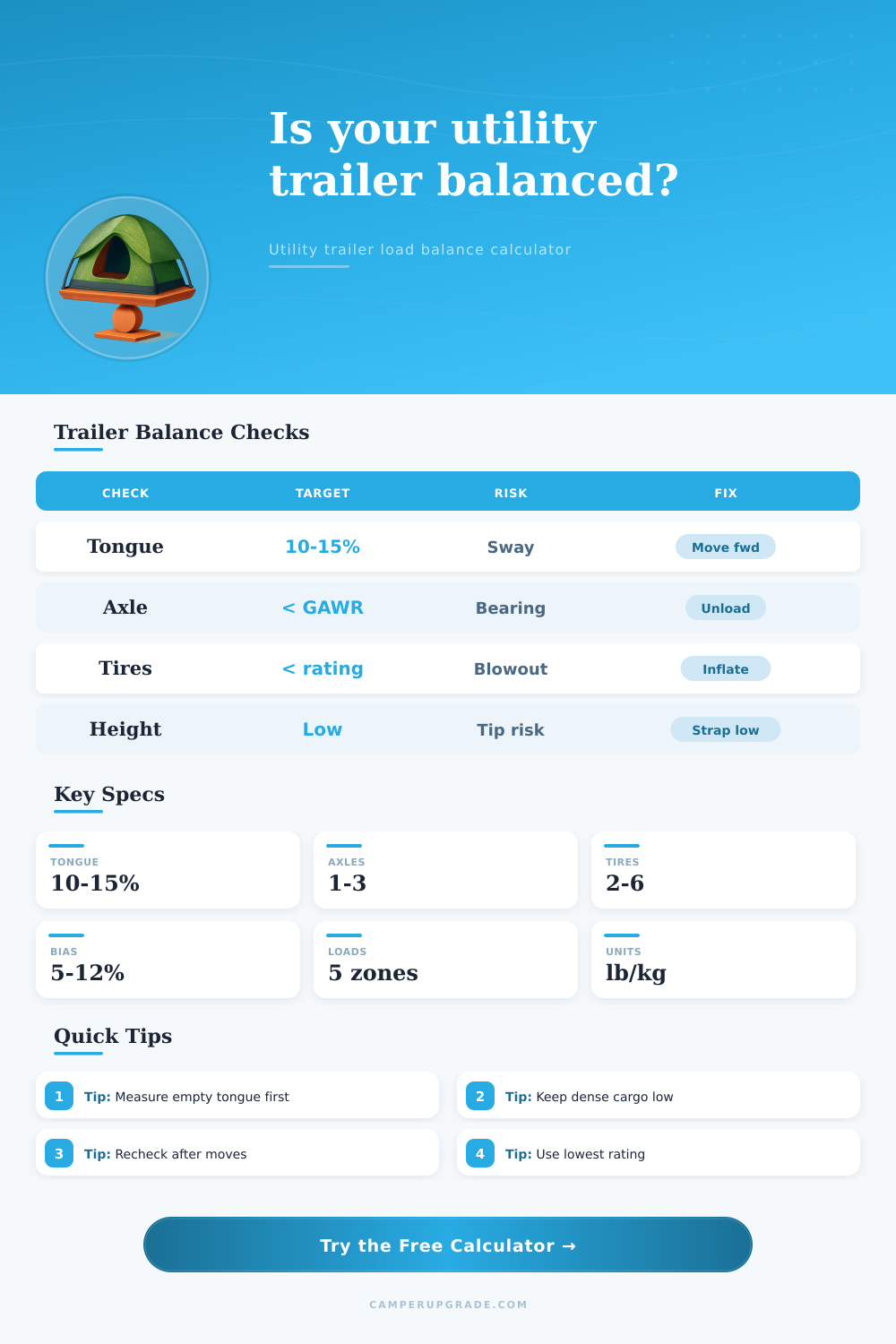
Estimate gross trailer weight, tongue percentage, axle group load, per tire load, rating usage, cargo height risk, and how far movable cargo should shift before towing.
🚚Utility Trailer Presets
Utility Trailer Balance Snapshot
⚖Trailer Ratings And Geometry
📦Cargo Stations And Load Depth
🔧Utility Trailer Material And Spec Comparison
📊Reference Tables
| Trailer profile | Typical tongue target | Low tongue signal | High tongue signal |
|---|---|---|---|
| Light lawn and garden trailer | 8% to 12% | Sway, bounce, rattling coupler | Rear tow vehicle squat |
| Standard open utility trailer | 10% to 15% | Trailer wanders at speed | Steering feels light |
| Enclosed cargo trailer | 12% to 16% | Wind pushes the trailer around | Hitch or receiver limit nears max |
| Equipment or mower trailer | 12% to 15% | Machine sits too far rearward | Front tool box is overloaded |
| Low car or vehicle hauler | 10% to 12% | Rear axle of vehicle too far back | Vehicle nose too far forward |
| Off-road or camping utility trailer | 10% to 14% | Rear water or fuel dominates | Front storage box too dense |
| Common cargo | Typical weight | Balance behavior | Station hint |
|---|---|---|---|
| Zero-turn mower | 700 to 1,500 lb | Heavy and compact, changes tongue fast | Center engine near axle group |
| ATV | 500 to 900 lb | Usually balanced if centered | Keep front wheels slightly ahead of axle |
| Side by side | 1,200 to 2,000 lb | Often needs tandem trailer ratings | Check tongue before tying down |
| Appliance or toolbox | 150 to 500 lb | Small footprint creates point load | Put dense items low and forward |
| Lumber bundle | 300 to 1,200 lb | Long load can shift center easily | Center the bundle, then fine tune |
| Brush or dump run | 300 to 1,800 lb | High stack can be light but tippy | Compress and strap low |
| Rating check | Calculator formula | Pass target | Correction |
|---|---|---|---|
| GVWR use | Gross trailer weight divided by GVWR | Below 100% | Unload cargo or use a higher rated trailer |
| GAWR use | Axle group load divided by total axle rating | Below 100% | Reduce rear cargo or overall payload |
| Worst tire use | Biased per-axle load divided by tire rating | Below 100% | Verify tire load range and pressure |
| Hitch tongue use | Estimated tongue weight divided by hitch rating | Below 100% | Move cargo rearward or reduce load |
| Target tongue fit | Tongue weight divided by gross trailer weight | Within selected range | Move movable cargo toward the recommended direction |
| Cargo stack height/depth | Stability read | Best practice | Load check |
|---|---|---|---|
| Below 25% of deck width | Low height concern | Use normal tie-down spacing | Weight balance is the main check |
| 25% to 50% of deck width | Moderate height concern | Cross strap tall items | Check side-to-side placement too |
| 50% to 75% of deck width | High height concern | Keep dense cargo on the floor | Drive slower and recheck straps |
| Above 75% of deck width | Very high height concern | Break the load down if possible | Balance, tie-downs, and route matter |
📘Preset Benchmarks
| Preset | Typical trailer | Main balance issue | Useful check |
|---|---|---|---|
| Landscape Trailer | 6x12 single axle | Mower and front tool weight | Hitch rating and tire load |
| ATV Hauler | 5x10 utility | Machine station relative to axle | Tongue percent before highway speed |
| Dump Run | 5x8 or 6x10 utility | Loose cargo slides rearward | Recheck after loading and strapping |
| Lumber Stack | Long open deck | Long bundle overhang and center | Move bundle inches, not feet |
| Side By Side | Tandem utility | Heavy vehicle near rating limits | GVWR, GAWR, and tire capacity |
💡Utility Trailer Tips
There is a specific kind of dread that sets in when you are strapping down an ATV on a hot Saturday afternoon and realize your tongue feels too light. Ratchet straps is tightened, and you check rearview mirror. Will your truck sway at highway speeds? That’s no paranoid fear; it’s physics. Cargo placement matter, and so does weight distribution. Sometimes, it’s the difference between a smooth tow and a dangerous sway.
The calculator’s rating usage estimate checks your load against your ratings to help prevent things like tire blowouts caused by uneven weight distribution. Knowing this fix the problem before you turn the key. People think they are fine as long as their payload stay below max. That’s not true. Max capacity isn’t typically where the problem lies.
Why Weight Balance Is Important for Towing
Most of the time, it’s where the weight is positioned compared to the axle. When you overload your tongue to one side (i.e., loading all your gear behind the axle), it raise the tongue. Your tongue weight provides no downward pressure. It has nothing pushing down on hitch to hold the trailer when you hit a patch of uneven road, pull into a lane change, etc. This results in an unstable trailer and loss of control.
On the flip side, if you’re overloaded in the front and pile all your stuff there, you’ve got a heavy tow vehicle in the back with a light front end. What’s that do? Makes it harder to turn, makes front tires lighter and stresses out your rear suspension. Find a happy medium where you hold your trailer in place without pulling down on truck.
The tool handles the moment arm calculations for you. The tool calculates the moment arms for you. It uses distance between the axle groups and the coupler. And it factors weight of your individualized cargo areas. If you have a toolbox on the tongue and a heavy engine in the front, it will change the math significanty. It is not like having all of your lumber stacked flat over the top of deck.
The tool then compares your ratings vs. These are the actual loads. This is critical as more times than not tire blow outs occur because of uneven loading. A single overloaded axle or side can exceed its limits. It includes tire ratings and axle bias so it doesn’t count on one weak link.
Most guides will tell you that weight is less important then height. It’s true. If you have a low load and it’s just barely off center, it’s still balanced. But a tall, skinny pile of pallets or brush forms a lever arm. Any imbalance will be amplified. Tipping risk increases as does wind resistance, which the calculator flag on a high stack.
You can strap down a low load effectively, but a top-heavy load fight every turn. Top heavy loads fight against every turn. The best rule is to keep the dense stuff up front and low. That reduces the center of gravity. It also means there’s plenty of weight on the tongue to hold the trailer in track.
Not many people weigh their unloaded trailers. It’s one of those key mistakes. Utility trailers weighs several hundred pounds even before they’re loaded with anything. What’s more, they have a set distribution pattern to that weight. Failing to account for the unloaded weight of the deck, the frame and the ramps will throw off your guesses about where the balance point sits. Those base weights tell the tool where to start. Guessing what effect your own gear has on shifting the balance point without taking into account the empty weight is… well, it’s just a guess. A few hundred pounds of empty trailer can swing the tongue load from ten percent to fifteen percent.
To put those numbers in perspective, here are some reference tables on the page. You can see the usual targets for various types of trailers. These range from a heavy equipment hauler to a little lawn trailer. There is not one right number for everything. An enclosed cargo trailer needs more tongue weight than a utility bed with open cargo due to wind push and aerodynamic drag. Being able to know what range the target is for your trailer will help you understand the results from the calculator. It tells you if you need to move cargo forward or not. And even small changes can fix big problems.
Towing is an exercise in force that you don’t see. Every foot of trailer deck adds leverage, so what happens when 50 pounds shifts? Measure it, then load it. Then double-check your balance before departing. Minutes invested calculating now saves you hours on the side of the road. Check the tongue and tie down your load. You should of went driving with confidence.