Cooler Food Storage Volume Calculator
Estimate how much chilled food, drinks, containers, ice, cold packs, lid clearance, and packing inefficiency will actually fit inside a camping cooler.
🧊Cooler Packing Presets
Your Cooler Volume Snapshot
⚙Cooler Size And Cold Space Inputs
🍞Food, Drink, And Container Volume Inputs
📊Material And Cooler Spec Comparison
Basic Hard Cooler
Best for: single-day food, short drives, and drink-heavy loads. Thin walls often mean more ice volume and less cold hold.
Rotomolded Cooler
Best for: multi-day perishables. Thick insulation improves hold time but reduces interior volume for the same outside footprint.
Soft-Sided Cooler
Best for: lunches, kayaking, and compact meals. Flexible sides help odd items fit, but crush room and ice melt matter.
Powered Cooler
Best for: van and RV backup storage. It needs less ice volume, but compressor humps and baskets reduce clear space.
🧮Reference Volume Cards
📘Cooler Storage Reference Tables
| Listed Cooler Size | Typical Usable Space | Weekend Ice Space | Food Space After Ice |
|---|---|---|---|
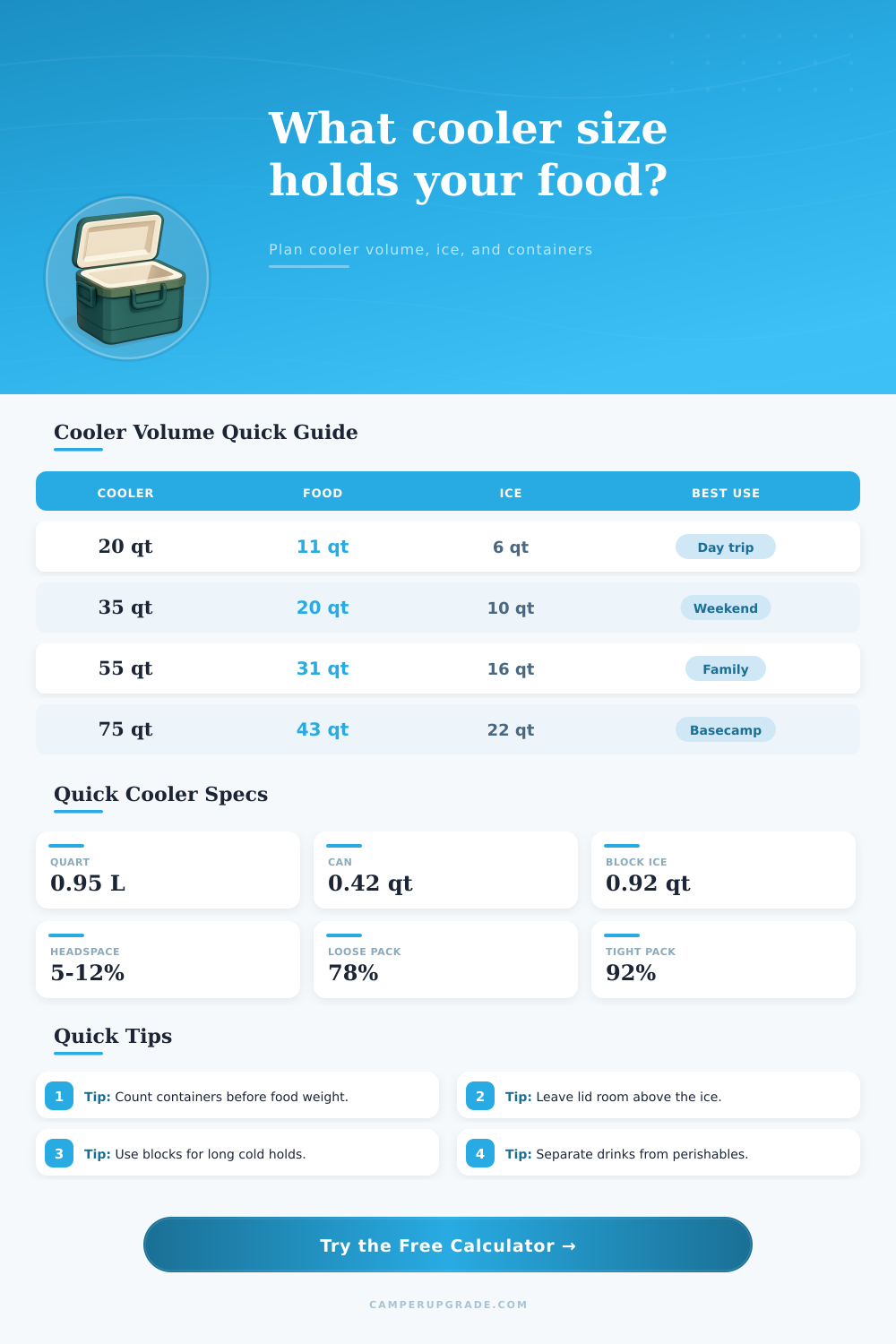
| 20 qt personal cooler | 16.5 to 18 qt after lid clearance | 5 qt | 11 to 13 qt for food and drinks |
| 35 qt weekend cooler | 29 to 32 qt after lid clearance | 9 qt | 20 to 23 qt for containers |
| 55 qt family cooler | 46 to 51 qt after lid clearance | 14 to 18 qt | 30 to 36 qt for chilled storage |
| 75 qt basecamp cooler | 63 to 70 qt after lid clearance | 19 to 25 qt | 42 to 51 qt for perishables |
| Cold Method | Volume Rule | Best Use | Storage Tradeoff |
|---|---|---|---|
| Loose cubed ice | 25% to 40% of listed size | Food surrounded by cold meltwater | Fills gaps but steals container space |
| Block ice | 15% to 30% of listed size | Longer hold with fewer openings | Efficient shape but less contact area |
| Frozen water jugs | 1 gal jug uses about 4 qt | Clean meltwater and dry food storage | Rigid shape can leave side gaps |
| Dry ice layer | 8% to 15% plus separator | Frozen food or long travel legs | Needs venting and a barrier layer |
| Powered cooling | 0% to 8% cold packs | RV, van, and truck power access | Compressor hump reduces clear volume |
| Common Item | Approx Volume | Planning Note | Fit Concern |
|---|---|---|---|
| 12 oz beverage can | 0.38 qt plus packing gap | Use 0.42 qt for real cooler packing | Stack height and ice contact |
| Quart deli container | 1.0 qt nominal | Great for soups, fruit, sauces, and leftovers | Round sides waste corner space |
| Gallon freezer bag | Up to 4 qt when full | Flatter bags pack tighter when partially filled | Leaks need secondary containment |
| Dozen eggs in carton | 1.4 to 1.8 qt | Hard cases are easier to stack than paper cartons | Crush room above the carton |
| One gallon milk jug | 4.0 qt plus handle gap | Use 4.5 qt for cooler displacement | Height often limits lid closure |
| Scenario | Likely Food Volume | Cold Volume | Suggested Listed Size |
|---|---|---|---|
| Solo lunch or kayak day | 5 to 8 qt | 2 to 4 qt | 12 to 20 qt soft or hard cooler |
| Two-person weekend | 14 to 22 qt | 8 to 12 qt | 35 to 45 qt cooler |
| Family campground food | 26 to 38 qt | 14 to 20 qt | 55 to 65 qt cooler |
| Basecamp perishables | 40 to 58 qt | 22 to 32 qt | 75 to 100 qt cooler or split coolers |
💡Cooler Packing Tips
You’re cramming a gallon of milk into an overstuffed cooler and you know what happens: you get all panicky. You slam the cans to one side; you mash them down onto ice. And then you pray the lid clicks shut before your buddies arrive. The problem is that most folks think in terms of weight rather than volume. A ten pound bag of flour doesn’t take up as much room in your camping rig as a ten pound block of cheese. That is why trips goes wrong.
That’s where our calculator comes in, running the numbers for you, converting your wild-ass guesses about quarts into something you can actualy use. No more fighting with the lid, time to cook up some grub.
How To Pack Your Cooler Better
The best way to look at this is this: Cooler sizes lie by omission; the advertised capacity is always larger than the actual space inside. Rotomolded coolers is measured by their outside dimensions or include the thickness of the insulation, leaving you with a much smaller inside space than the size suggests. For example, that fifty-five-quart cooler may only fit forty-five quarts of ice and food due to the walls freezing your meat. That wasted interior space should of immediately be included in your math.
But what about a simple plastic hard-sided tub or a soft-sided bag? Those setups changes the amount of space you have to work with once more, but this tool takes all of these designs into consideration so you don’t make assumptions regarding what’ll fit simply by price tag.
People also consider ice a magical variable that seems to appear out of nowhere to fill every inch of space they thought was clear. Cold mass displaces thing! And if your trip is in July, there’s a good chance you’re gonna need at least 30 percent of your interior area filled with either ice or frozen packs (thus reducing the available space for real stuff). The calculator lets you choose how long your trip will be and what kind of cooling system you’ll use, making you face that tradeoff head-on. It then subtracts the cold mass you specified to reveal just how little you have left over for perishables.
Next is packing efficiency (or the lack thereof, which is to say: wasted air). Flat freezer bags and square containers will fit far more into a cooler than round tubs and loose fruit; irregular produce and round cans takes up dead space that no amount of jamming will allow you to use. The effective storage numbers are laid out neatly in the reference table on the page, showing the impact of packing style. Eighty percent efficiency is average for casual campers who throw their gear in willy-nilly without a thought to its shape, while pros pushing that number up pre-freeze there water bottles in straight shapes.
How you store your drinks also plays an important role (more than you’d imagine!). By storing them in the same cooler with perishables, you’re almost guaranteeing that every time somebody reaches in for a soda, the temperature will swing around. Every time you open it up, cold air escapes and warm air enters; it’ll speed up melt rates. Store the drinks in their own cooler if your party’s thirsty. This will keep the food side of things colder for longer without having to add any additional ice. You can toggle this option using the tool, which will adjust the final required volume to match whether your drinks is staying put or not.
The silent killer of cooler packing is height. You might have plenty of horizontal space to pack all of your stuff. But if you stack up a bin or put a tall juice jug inside, the lid won’t seal. This interior depth info protects against that error and makes sure you’re not planning on using too much volume that won’t actualy fit into the closed cooler. It is a little thing, but it matters when nobody wants their food sitting out in the heat because the lid won’t latch.
Look at the sizing recommendation for coolers because they tend to suggest going up one size, which I have found means more wiggle room for when you’re on the trail. And trust me, it’s insurance. Packing in the field is messy business and having that little buffer (not padding) makes sure you don’t have to make another trip back into town for milk or snacks.
The physics of space are real. Ice takes up space. Volume is limited. Buying a big-box cooler isn’t as much about packing capacity as it is respecting that fact. When you measure what actualy fits within your cooler’s insulated walls instead of guessing, the stress melts away. You know exactly how many sandwiches to take before they fight for their lives with the latch. You go straight to the tailgate confident that you’ll be able to close it.