Group Meal Portion Calculator
Estimate shared camp meal portions from guest mix, appetite, activity, seconds, service style, side count, serving pans, and waste buffer.
🍽Group Meal Presets
⚙Meal Portion Inputs
📊Camp Portion Spec Grid
⚖Meal Service Spec Comparison Grid
Plated Line
3% service add. Good when one cook controls the scoop size and wants fewer leftovers.
Family Style
6% service add. Bowls on tables need some slack because first tables often serve heavily.
Self-Serve Buffet
10% service add. Best for mixed appetites, but the first pass tends to overscoop.
Youth Camp Line
14% service add. Adds margin for uneven scoops, seconds, and plate waste.
Potluck Table
4% service add. A lower main target works when several dishes overlap.
Basecamp Pot
80% fill target. Keep hot foods below the rim so ladling stays clean and safe.
📘Portion Equivalent Reference
| Guest Type | Equivalent Factor | Typical Portion | Use In Camp Planning |
|---|---|---|---|
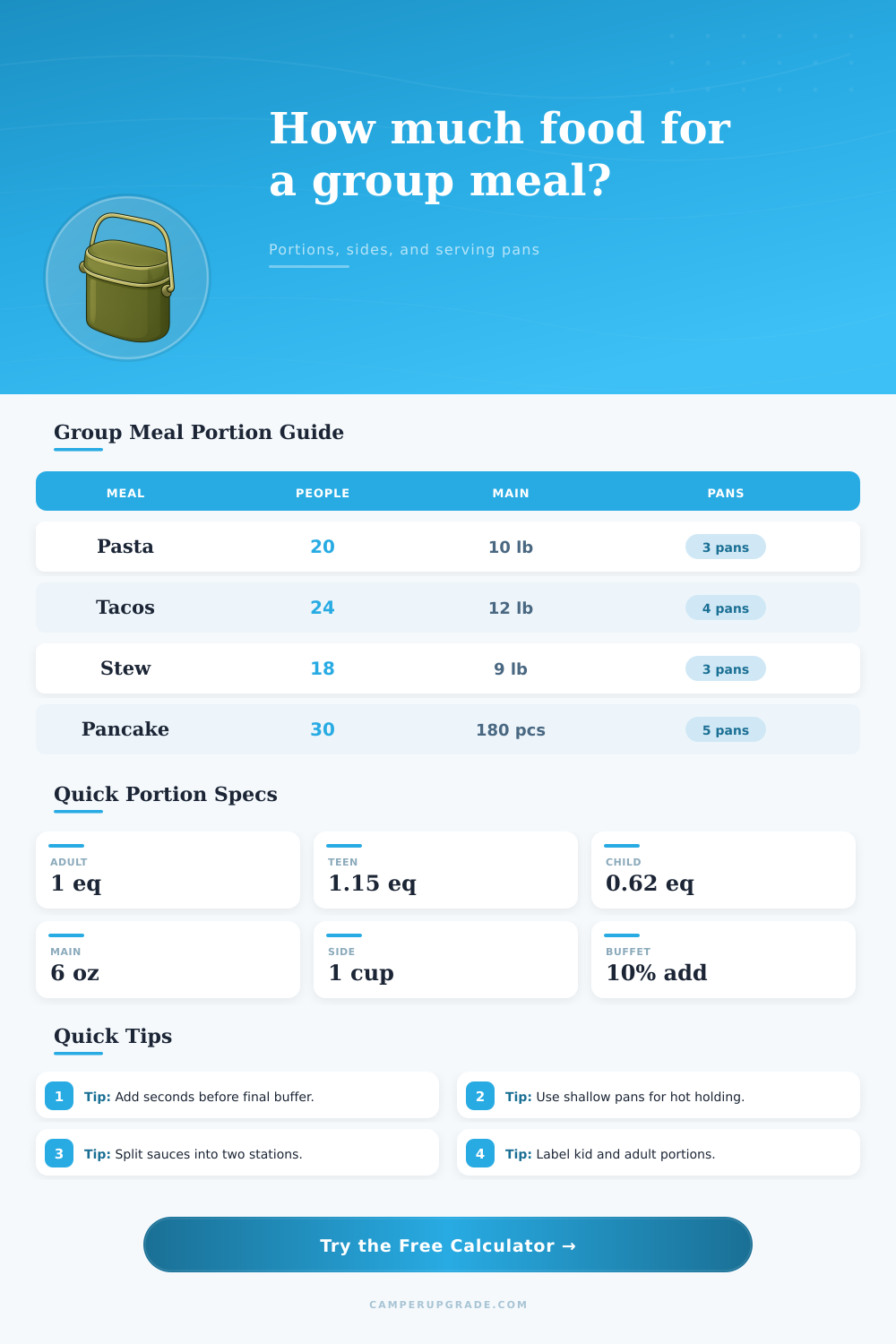
| Adult | 1.00x | Full plate | Baseline for main dish, starch, vegetables, bread, and sauce. |
| Teen or hungry adult | 1.15x | Full plate plus more seconds | Useful for scout troops, trail crews, race support, and cold trips. |
| Child age 6 to 12 | 0.62x | Small plate | Works for school-age kids when toddlers and infants are not counted. |
| Light eater group | 0.85x appetite | Smaller plates | Use for breakfasts, older groups, hot weather, or meals with dessert. |
| Athletic group | 1.30x appetite | Large plates | Use after hard paddling, long hikes, trail work, or cold evenings. |
🍲Meal Style Base Portions
| Meal Style | Main Per Eq | Starch Per Eq | Other Planning Notes |
|---|---|---|---|
| Pasta dinner | 5.5 oz cooked sauce/protein | 1.15 cups pasta | Include 2 tbsp sauce reserve per equivalent for dry plates. |
| Taco or burrito bar | 5 oz filling | 0.75 cup rice or beans | Plan 2.2 tortillas per equivalent before buffer. |
| Stew, curry, or one-pot | 8 oz stew | 0.6 cup bread or rice | Volume matters more than separate side weight. |
| Sandwich or wrap lunch | 4.5 oz filling | 0.25 cup side | Plan 1.25 bread pieces or wraps per equivalent. |
| Pancake breakfast | 3.2 pancakes | 0.35 cup fruit or side | Butter and syrup need a larger sauce allowance. |
| Grilled cookout | 6.5 oz cooked protein | 0.85 cup side | Good when sides are salads, beans, potatoes, or corn. |
| Breakfast burrito line | 5.2 oz filling | 0.35 cup potatoes | Plan 1.3 tortillas per equivalent before buffer. |
| Rice bowl dinner | 5.5 oz topping | 1.25 cups rice or grain | Vegetables and sauce carry the portion visually. |
🥣Serving Vessel and Volume Reference
| Container | Nominal Size | Plan Fill | Best Use |
|---|---|---|---|
| Half steam pan | 4 qt | 3.2 qt at 80% | Pasta, rice, taco meat, cooked vegetables, breakfast fillings. |
| Full steam pan | 8 qt | 6.4 qt at 80% | Large buffet batches when the table is stable and supervised. |
| 12 inch Dutch oven | 6 qt | 4.8 qt at 80% | Stew, rice, cobbler, beans, and one-pot basecamp meals. |
| Stock pot | 12 qt | 9.6 qt at 80% | Soups, hot drinks, pasta water, and large sauce batches. |
| Insulated carrier pan | 4 to 6 qt | 3.2 to 4.8 qt | Holding hot food when service is delayed or staggered. |
👥Common Camp Group Estimates
| Scenario | People Mix | Main Estimate | Serving Setup |
|---|---|---|---|
| Family pasta camp | 14 adults, 8 kids | About 10 to 12 lb cooked main | Three half pans plus separate sauce. |
| Scout breakfast | 6 adults, 22 youth | About 160 to 190 pancakes | Five shallow pans or repeated griddle waves. |
| Trail crew lunch | 18 hungry adults | About 7 to 9 lb sandwich filling | Wrapped portions plus side bins. |
| Campground BBQ | 24 mixed guests | About 12 to 15 lb cooked protein | Four pans if sides are moderate. |
| Potluck side dish | 30 mixed guests | About 6 to 8 qt side | Two half pans with a small backup bowl. |
There’s a particular sort of panic that sets in when you’re three miles away from civilization and realize you only got enough pasta for half the group. No second helpings was anticipated. The kids didn’t tell you they wanted bread and not beans. On paper, it seemed like enough. But then reality has a way of growing to fit all available stomachs. That’s where rough guesses break down in the world of camping kitchens.
The calculator above take the messy mix of small children, hungry teens, and adults and turns them into single portions. It does the hard work so you can turn chaos into real shopping list. That’s the point: people do not eat the same. An 18-year-old hiker on a 10-mile trek require food. An older adult relaxing in a lawn chair requires less fuel. To account for these differences, the tool weights guests differently. Teens get weighted higher (since they tend to clean their plate and then return for seconds). Kids is weighted less, but not so much that they come away with empty stomachs. That’s the adjustment that allows for group planning. You no longer count heads; instead, you count volumes. It’s all about appetite.
How the Food Calculator Works
If you’re having a laid-back, low-key day at camp and aren’t doing much of anything, one meal will seem like plenty. If you just spent several hours paddling in the cold on an evening hike, it is another story entirely. With this calculator, you can include those things in the mix and stop ripping your hair out. Sure, you may think that hunger is constant, but it isn’t. Calorie requirements increases dramatically when it’s cold outside. Physical exertion also causes the same effect. Ignoring these factors can lead to undercooking dinner or running out of coffee in the morning. It’s a small detail, but it matters immensely for morale. Run out of coffee in the morning? It’s no big deal, but it makes a world of difference in terms of morale.
Amount of food required can be driven by service style too. With a plated line, one person has control over the size of the scoop, which is efficient. But if it’s a self-serve buffet, portions will be larger (people typically overfill their scoops when hungry) and there’ll be more waste. The reference table on the page makes this clear and provides specific adders for each format. For example, if you’re setting up a family-style meal that sends plates straight to tables, expect some slack as first tables usually load up heavily, leaving less for those arriving later (unless you plan extra).
But there’s one more thing that complicates the main dish: sides and seconds. The fewer sides, the more likely people are to fill up on the main event (starch or protein). Adding salad, bread, veggies, fruit, etc., means they’ll all be eating just a bit less of the heavy stuff. Seconds are a different matter. Before calculating your last buffer for leftovers/spills, factor in how many folks will actualy take seconds. Then calculate how many people will take seconds before adding your final buffer for spills or leftovers to separate real appetite from kitchen waste. This tool takes care of those calculations without double-counting your safety margin.
There is too little space for vessels. This one is easy: Until it’s too late, most people forget about vessel size. Don’t fill a steam pan all the way up. Leave room for ladles, lids and stirring. Move your stew pot around uneven terrain? That stuff spills if it’s packed in to tightly. The calculator assumes you’ll use each container at a safe fill level, accounting for the actual usable volume so that you know exactly how many you’ll need. Embarrassed because some pans are empty when everyone’s still hungry? Not anymore.
The typical method is to begin with cup measurements: cups of rice or pounds of meat. This almost always fails, since it does not account for people. Equivalents are a universal measurement that adjust based on who is eating them. If you cook frequently enough pancakes or make Taco Bars, set up the meal as presets and skip straight to tweaking the input values for your actual crowd. What was once a source of anxiety becomes a matter of logistics.
Sure, there’s shopping for food, but now you have an idea of what that food should of been when bought en masse. Is it perfect? No. Adequate plus some padding. Eating too much sucks. Running out of food sucks worse. Figuring out how to get enough plus a little extra without overdoing it takes practice; you have to learn what goes in and trust what comes out. And the calculator provides you with a starting point, respecting both the resource and the need for food. It’s confidence-in-a-box, walking up to the table knowing you’ve got your bases covered. Worth a couple bucks more in buffer ingredients.
Until you figure out a system that works, planning for groups of people feels like herding cats. But when you quit thinking of each guest as the same, when you begin to account for how they actualy eat, the noise clears up. You see the pattern behind the portions. It’s not arbitrary; it works for a reason. Next time you’re stocking the camp kitchen or packing your own cooler, try thinking of equivalents first. Let the numbers guide the bags. And then serve with confidence.