Dutch Oven Serving Size Calculator
Estimate servings from Dutch oven capacity, safe fill level, recipe style, appetite mix, seconds, and leftover buffer for group camp meals.
Dutch Oven Serving Results
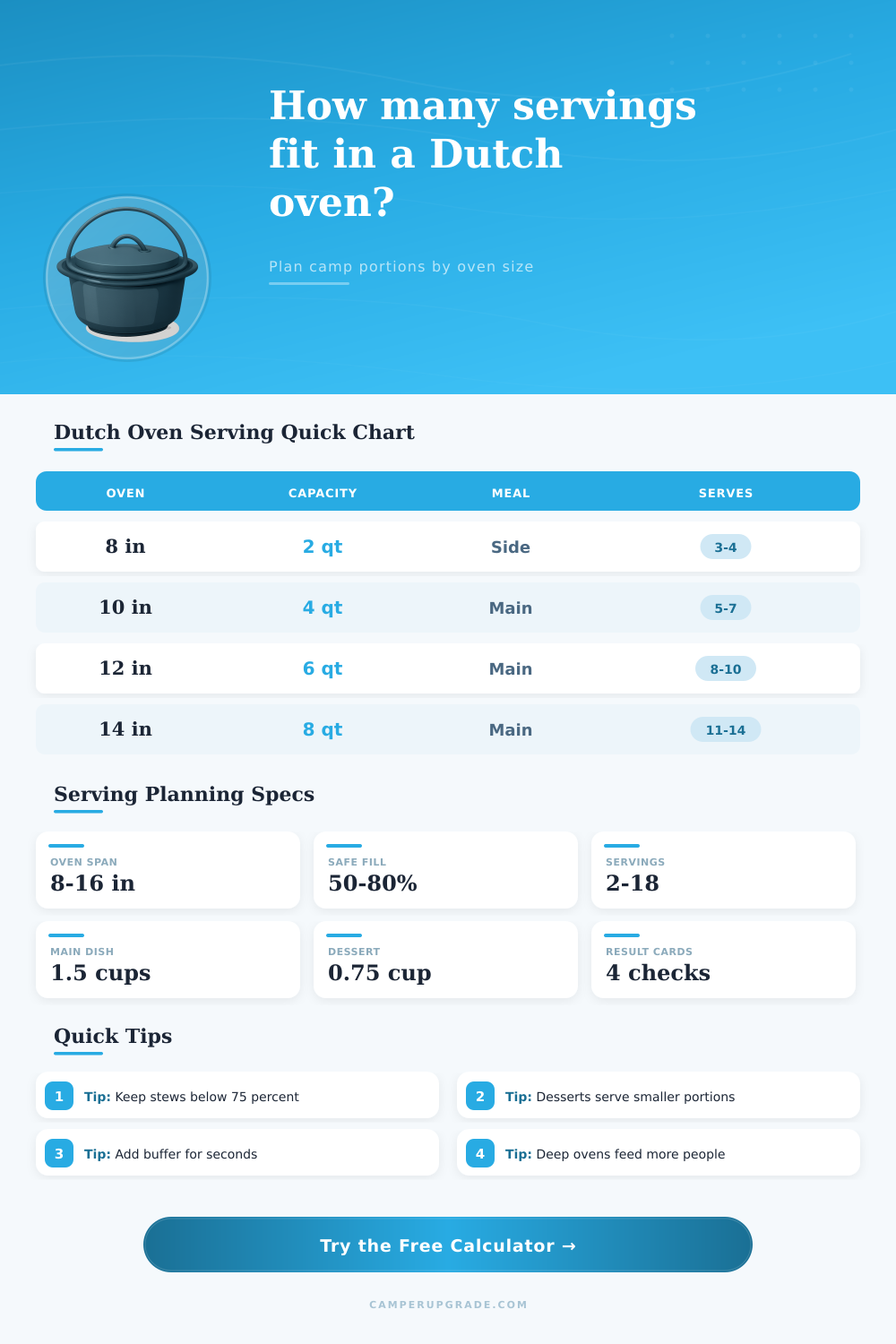
| Oven size | Typical capacity | Usable at 70% | Main dish servings |
|---|---|---|---|
| 8 inch shallow | 2 quarts / 1.9 L | 5.6 cups | 3 to 4 servings |
| 10 inch standard | 4 quarts / 3.8 L | 11.2 cups | 6 to 7 servings |
| 12 inch standard | 6 quarts / 5.7 L | 16.8 cups | 9 to 11 servings |
| 12 inch deep | 8 quarts / 7.6 L | 22.4 cups | 12 to 14 servings |
| 14 inch standard | 8 quarts / 7.6 L | 22.4 cups | 12 to 14 servings |
| 14 inch deep | 10 quarts / 9.5 L | 28.0 cups | 15 to 18 servings |
| 16 inch standard | 12 quarts / 11.4 L | 33.6 cups | 18 to 21 servings |
| Recipe style | Base adult portion | Best fill range | Planning note |
|---|---|---|---|
| Chili or thick main | 1.5 cups | 65% to 78% | Dense and hearty, often gets seconds. |
| Stew or saucy braise | 1.75 cups | 60% to 75% | Leave headroom for stirring and simmer bubbles. |
| Casserole | 1.35 cups | 60% to 72% | Sets up thicker, so slices can be portioned cleanly. |
| Side dish | 0.75 cup | 55% to 75% | Served with another main or grilled protein. |
| Bread or biscuits | 0.9 cup | 45% to 62% | Needs expansion room and even heat. |
| Cobbler or dessert | 0.75 cup | 50% to 68% | Rich servings are usually smaller than mains. |
| Pulled meat | 1.25 cups | 55% to 70% | Pair with buns, tortillas, rice, or potatoes. |
| Rice or grains | 1.25 cups | 55% to 72% | Expansion and steam need extra headroom. |
| Fill level | Use when | Capacity multiplier | Example on 6 qt oven |
|---|---|---|---|
| 50% | Breads, cakes, foamy desserts | 0.50 | 12 cups usable |
| 60% | Casseroles and rice dishes | 0.60 | 14.4 cups usable |
| 70% | Most thick mains and sides | 0.70 | 16.8 cups usable |
| 75% | Stews with careful stirring | 0.75 | 18 cups usable |
| 80% | Low-simmer beans or held food | 0.80 | 19.2 cups usable |
| Camp group | Suggested oven | Main meal target | Good preset match |
|---|---|---|---|
| 2 to 4 people | 8 inch or 10 inch | 6 to 10 cups | Camp biscuits or small side |
| 5 to 8 people | 10 inch or 12 inch | 12 to 18 cups | Trail chili or cornbread |
| 9 to 12 people | 12 inch deep or 14 inch | 20 to 28 cups | Breakfast casserole or stew |
| 13 to 18 people | 14 inch deep or 16 inch | 28 to 38 cups | Pulled pork or crowd dessert |
| 19+ people | Two ovens | Split by dish | Main in one, side in one |
When you’re camping, it’s tempting to improvise dinner; after all, who wants to pack a bunch of gear just to stand around a fire? But panicking while preparing a meal over campfire, especially one that needs to feed others, is something few people like to do. Your dutch oven is on the fire and coals are hot, until somebody says “Hey, is that gonna be enough food?” Improvising doesn’t beat planning.
Once you know how many people you plan to serve and what size oven you’ll use, input them into the calculator above and it will take care of rest without needing to change or guess numbers. It turns an abstract feeling of hunger into a concrete volume needed.
How to Plan Your Campfire Meal
The typical camper’s approach is quantity; how many people do I have to feed? But volume is what matters when it comes to cooking. A normal 12-inch Dutch oven has capacity for six quarts. Sounds like a lot, right? But with a bubbling stew, there needs to be space so you don’t boil over the top and waste precious fuel when food spills onto your hot coals. Not only is that wasteful and inefficient, but it’s also messy. This is the physical reality of cooking liquids that the safe fill level input on the tool gets right.
A pot isn’t a water bottle. It’s not something you can fill up all the way. Bread rises won’t know where to go, liquids expand, sauces will shrink down in an uneven way. Depending on how much space there is above what you’re filling, the calculator changes overall capacity. For example, if you have some thick sauce to simmer, it recommends you fill more since those thick things don’t really expand too much, but if it’s biscuits or cornbread you want to bake? It lowers that number quite a bit so you’ll have room to grow.
A stew isn’t a bread, after all; if you overfill a bread recipe, it leads to a soggy bottom and burnt lid. If you underfill it, you won’t get that proper simmer with the meat steaming. You can switch between two kinds in the tool. The math adapts itself to match the physics of what’s happening as you cook.
Another gotcha: Newbie home chefs has no clue what a “serving” is. They think it’s a standard portion for each person, no matter what kind of thing it is. Nope! You need more of something like pulled pork as a main course compared to a piece of cobbler as a dessert, or a bowl of baked beans as a side dish. The tool lets you designate serving role so that its baseline cups-per-person takes this into account.
Secondly, it takes into account the age/mix of your party. Kids camped by fire require less calories than adult hikers burning their buns off all day. With the kid portion factor input, you can adjust based off how much your group eats, such as hung-over teens who eat like adults. Or are they light-eating toddlers? Adjusting this ratio ensures no one runs out of food while others is still hungry. In the worst case, you would of end up with three pounds of leftover stew that you’ll carry on your back for a week.
Experienced camp cooks know their secret weapon: buffer zones. Using a little extra in the seconds buffer input equals extra food for inevitable return visitors. Appetites bulge after a long hike and in cold weather. For only a small increase in ounces, a 10-20% increase in food buys you buckets of goodwill, it demonstrates that you’ve planned ahead. Same goes for the remaining buffer, which I’d suggest setting at zero if you’re backpacking and want to pack as lightly as possible or follow strictly than the leave-no-trace principle. These buffers make a close fit easy with plenty of room for error.
The last piece of the puzzle is deciding what size to use. For couples and little families, a ten inch oven works fine. Scout troops is going to need several batch sessions with a ten inch model. To break it down into group size and suggested pot diameter, check the reference table on the page. That will help you determine if you want to go with one big heavy pot, or two little light ones. Sometimes splitting your load is smarter…if you want to serve more than one dish at once.
After getting your head wrapped around it; fill levels, capacity, portions, etc… You worry less about running out of grub and enjoy the aroma of dinner instead. It’s priceless to have that peace of mind; I’d save a couple ounces of gear weight for it. When you know who gets what and you can count on it, you’re going to be eating better too.