Trek Porter Load Distribution Calculator
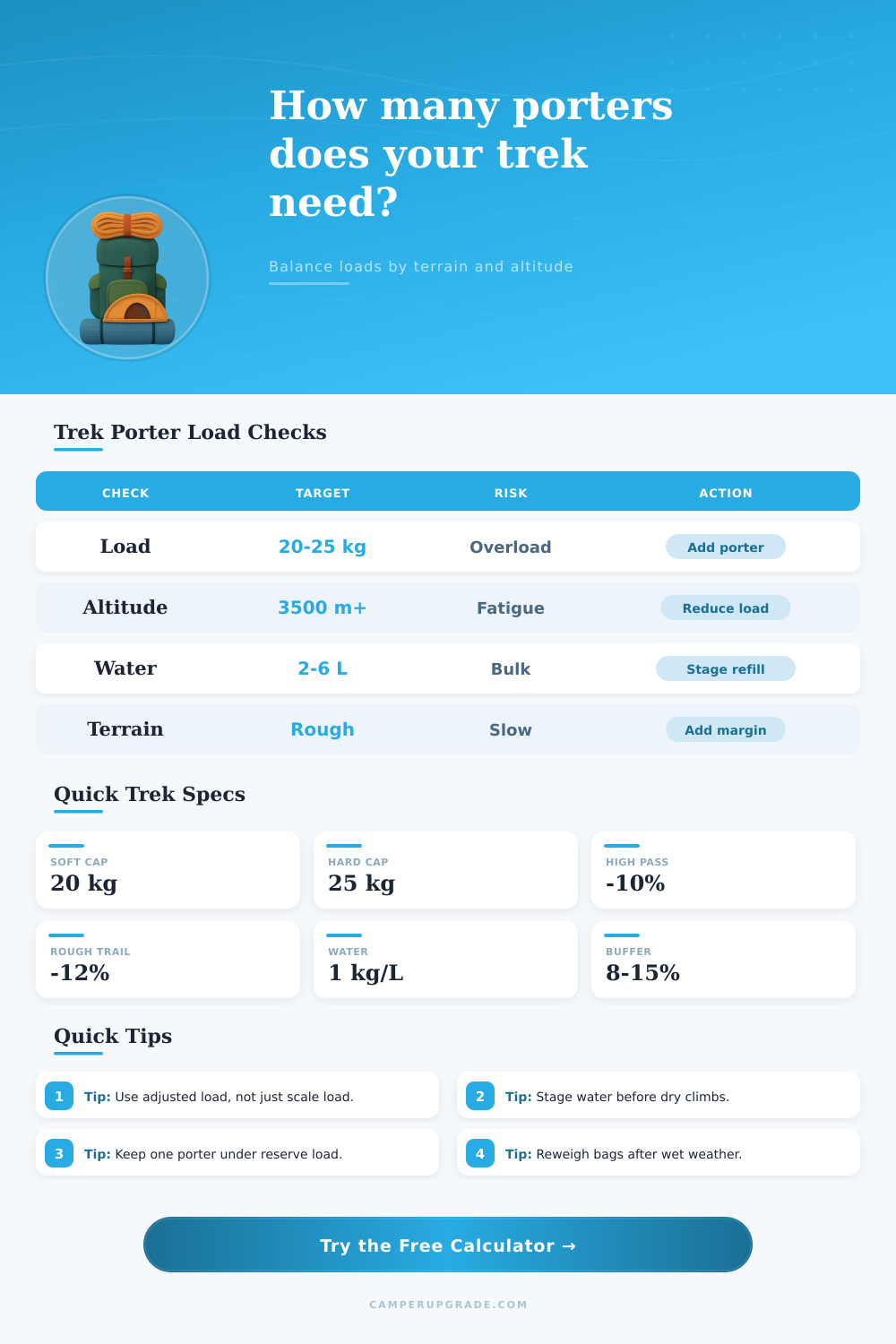
Estimate total expedition load, adjusted porter capacity, suggested porter count, client pack share, and reserve margin for trekking routes with altitude, water, food, and terrain changes.
🗺Trek Route Presets
Porter Load Distribution Snapshot
⚙Porter Load Inputs
Use local rules first: Porter rules vary by country, park, agency, and operator. This calculator is a planning aid; follow the strictest posted or contractual load limit.
🧳Load System Spec Comparison
📋Reference Tables
| Route or Guideline Type | Common Load Limit | Planning Use | Adjustment Note |
|---|---|---|---|
| Conservative lodge trek | 15-18 kg per porter | Tea-house routes with frequent stairs | Good when clients carry heavier daypacks. |
| Standard supported trek | 18-20 kg per porter | Most multi-day porter-supported routes | Use as a soft cap before altitude factors. |
| Expedition or park hard cap | 20-25 kg per porter | Remote camps or regulated route limits | Never exceed local posted or contractual caps. |
| High altitude load stage | 10-15% below normal | Loads above about 4000 m | Reduce carried mass or add a reserve porter. |
| Rough technical approach | 15-25% below normal | Moraine, snow, ladders, steep mud | Bulk and balance matter as much as weight. |
| Terrain Factor | Capacity Multiplier | When To Use It | Load Planning Signal |
|---|---|---|---|
| Graded lodge trail | 1.00x | Wide path, firm footing, regular villages | Nominal limit is usually usable. |
| Rocky trekking trail | 0.94x | Uneven steps, roots, rocks, narrow bridges | Keep duffels dense and tied tight. |
| Scree, moraine, or big stairs | 0.88x | High step-ups, loose ground, poor balance | Reduce bulky loads first. |
| Mud, snow patches, exposed traverse | 0.82x | Wet footing or hand-use on trail | Add time and reserve load capacity. |
| Ladders, ropes, or bush route | 0.76x | Hands needed for movement or route finding | Split loads into smaller stable pieces. |
| Expedition Item | Typical Weight Range | Best Load Location | Distribution Rule |
|---|---|---|---|
| Client duffel | 10-15 kg each | Porter duffel stack or pack liner | Pair one dense duffel with light shared gear. |
| Two-person tent | 2.2-4.5 kg | Shared camp load | Separate wet fly from dry inner when possible. |
| Kitchen and fuel kit | 8-18 kg group load | Dedicated porter or mule handoff | Count fuel at the heaviest resupply stage. |
| Food bags | 0.7-1.1 kg per person-day | Dense waterproof sacks | Rebalance daily as food is consumed. |
| Water for dry camp | 1 kg per liter | Low and close to back | Stage refills instead of overloading early. |
| Medical and comms kit | 2-8 kg | Guide or known porter | Keep accessible, not buried in a duffel. |
| Total Managed Load | 18 kg Adjusted Cap | 20 kg Adjusted Cap | 25 kg Adjusted Cap |
|---|---|---|---|
| 60 kg | 4 porters | 3 porters | 3 porters |
| 90 kg | 5 porters | 5 porters | 4 porters |
| 120 kg | 7 porters | 6 porters | 5 porters |
| 180 kg | 10 porters | 9 porters | 8 porters |
| 240 kg | 14 porters | 12 porters | 10 porters |
💡Load Planning Tips
Once you make your first hard ascent and realize you have porters lugging around unbalanced pack, the real work begins. You thought this was just a hike to see something, right? Well, now it’s all about the logistics. Weight distribution is typically deciding factor between a trip running smoothly or turning into a logistical train wreck. And while most hikers goes light for themselves, they forget that every gram of client duffel, fuel canister, or wet tent add up fast when multiplied by distance and altitude.
Now that you’ve plugged in your exact weight of gear and conditions of the route, you no longer have to guess how many porters you’ll need. Six? Eight? The calculator will do the math for you (above). And because a twenty-kilogram load feels different on a flat lodge path than it does on loose scree at four thousand meters, it automaticly adjusts for both altitude and terrain.
How to Pack Smart for Trekking
The tool doesn’t simply total up the kilos. It use multipliers that take into account the real-world experience of hauling yourself through challenging terrain. The result is not a raw number but an adjusted capacity figure, which show much better what your crew could realisticly sustain for several days.
That’s where terrain comes in: the quiet assassin of otherwise sound plans. When the ground is flat, you can carry what you please with confidence… Your feet know where they are supposed to be and you don’t need to think about losing your balance every other step. But change that to a staircase or some boulder and suddenly your useful load shrinks considerabley.
The calculator above handles the math once you plug in your specific gear weights and route conditions. This tool adjusts based on level of challenge, meaning that a hiker traversing some rock steps gets penalized accordingly. On paper, that means a 12% cut in efficiency; in real life, that means that a porter must use two hands to steady themselves while crossing a section of muddy trail.
And it’s not made up. It represent the increased effort required to keep your center of gravity under control, plus the higher likelihood of spraining an ankle or pulling a muscle. If you add exposed sections or ladders, it gets even harder because you won’t be relying on just your leg power anymore.
There’s another wrinkle: Altitude. Regardless of your fitness, above three thousand five hundred meters fatigue hit quicker. The tool takes into consideration the physiological drag and reduces capability at higher elevations. So although you may be planning on carrying a heavy load at lower elevations where the air is fine, you’ll find it unsustainable as you push toward high passes and the air get thin.
By planning backwards from the hardest stage instead of basing it off the average day, you avoid bottlenecks further along. And if you don’t leave room to adjust for altitude, you would of have to move your gear around mid-trek when everyone else is tired.
Many people also get tripped up on the water weight. A single liter weigh a kilo. That doesn’t sound like much, but carrying three liters for two days adds six kgs to a porter’s pack before they even pick up a spoon! Splitting your water carries or staging refills can realy help even out the total load weight. You can also put your heaviest water carry into the calculator to see the impact visually. That way you won’t underestimate how bulky hydrating yourself can be on those dry stretches with few refilling opportunities.
The same goes for food/fuel: Plan for the maximum duration (not a typical day) in between resupplies. Group meals and fuel canister pile on fast. Kitchen gear adds weight too. That’s where this tool comes into play, splitting out the group stuff vs. This tool splits group gear from personal client gear so you can see where the extra weight is.
More often than not, the duffels are good but your kitchen kit is over-inflated with more fuel than needed or extra pots when one should do. Trim off the blubber and make room for additional comfortly items/emergency gear. Keep a single porter under their max weight (which is important as a safety buffer).
Need to shift some gear around if a strap breaks? Someone’s sick? Tent fly soaked from a surprise rain storm? With extra room you’re able to redistribute without stalling out the entire group. The spare space won’t go unused… That’s an insurance policy for the unknowns of trekking in the mountains.
The planner allow you to find exactly how much wiggle room remains once deducting everything else. In the end, good trek planning is not about packing light per se. It’s about packing smart so that nothing weighs too much to become someone’s breaking point on any single day. If there’s a reason and spot for each kilo, then the load feels easier on everyone. You will fret less over your pack and see more of what lies before you.