Expedition Resupply Weight Calculator
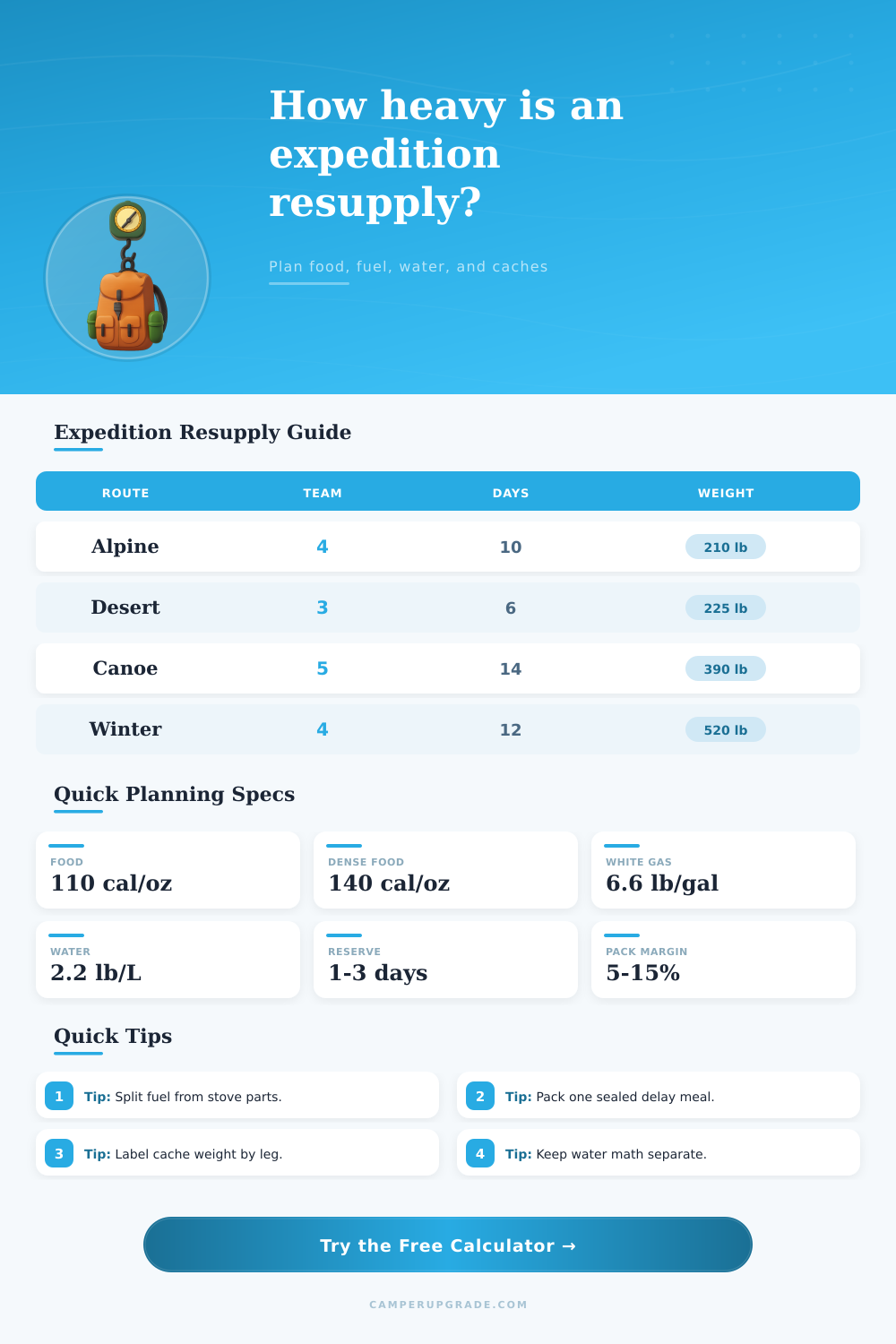
Estimate expedition resupply loads from food calories, fuel burn, water carry, shared gear, route depth, cache spacing, and reserve days.
🎒Expedition Resupply Presets
⚙Resupply Inputs
📊Material and Spec Comparison Grid
Freeze-Dried Meal Plan
125 cal/oz. Light and predictable for alpine, packraft, and fly-in routes where volume matters.
Dense Expedition Ration
140 cal/oz. Nut butter, oils, chocolate, salami, and high-fat snacks reduce total food weight.
Fresh-Heavy Basecamp
70 cal/oz. Useful for vehicle, raft, or field camps where quality matters more than carried weight.
White Gas Fuel
6.6 lb/gal. Efficient for cold groups, snow melt, and longer trips using refillable bottles.
Canister Fuel
Fuel plus steel. Good for small teams, but empty canisters add carried-out dead weight.
Cache Hardware
Shared load. Barrels, dry bags, labels, hang kits, and boxes should be counted before the trip.
🍚Food Density Reference
| Food Style | Calories per Ounce | Pounds per 3000 kcal | Best Expedition Use |
|---|---|---|---|
| Freeze-dried meals and dry breakfasts | 110 to 135 | 1.4 to 1.7 lb | Remote routes where low spoilage and fast cooking matter. |
| Mixed expedition ration | 95 to 120 | 1.6 to 2.0 lb | Balanced menus with tortillas, cheese, rice, pasta, bars, and snacks. |
| High-fat dense ration | 130 to 160 | 1.2 to 1.4 lb | Long carries, polar routes, packrafts, and trips with strict load limits. |
| Fresh-heavy field camp food | 55 to 85 | 2.2 to 3.4 lb | Vehicle, raft, canoe, or basecamp plans where weight is secondary. |
| Canned and wet pouch meals | 65 to 90 | 2.1 to 2.9 lb | Durable group food when pack-out weight and bulk are acceptable. |
🔥Fuel Weight and Burn Reference
| Fuel Type | Weight Factor | Typical Burn | Planning Note |
|---|---|---|---|
| White gas | 6.6 lb per gallon | 1.5 to 3.5 fl oz per person-day | Reliable for cold weather, large pots, and snow melting. |
| Isobutane canister fuel | 16 oz fuel plus canister shell | 0.8 to 1.8 fuel oz per person-day | Add carried-out empty canisters when estimating pack weight. |
| Alcohol fuel | 1.7 lb per liter | 1.5 to 3.0 fl oz per person-day | Simple for mild routes, less efficient for snow or big groups. |
| Propane | 4.2 lb per gallon | 1.0 to 2.5 fl oz equivalent | Common for raft, vehicle, and basecamp cooking systems. |
| Solid fuel tabs | 0.03 lb per small tab | 1 to 3 tabs per person-day | Good emergency backup, less flexible for real group cooking. |
💧Water Carry and Route Depth Reference
| Condition | Water Carry | Weight per Person | Resupply Planning Use |
|---|---|---|---|
| Frequent streams or lakes | 1 to 2 liters | 2.2 to 4.4 lb | Carry filter capacity rather than large water loads. |
| Normal dry camp spacing | 2 to 4 liters | 4.4 to 8.8 lb | Good default for mixed backpacking, canoe, and bike routes. |
| Desert or unreliable sources | 5 to 8 liters | 11 to 17.6 lb | Cache water separately and verify each source before launch. |
| Snow melt route | 1.5 to 3 liters | 3.3 to 6.6 lb | Water weight drops, but fuel weight rises sharply. |
| Vehicle or raft support | 8 to 20 liters | 17.6 to 44 lb | Use hard containers and count slosh-safe storage weight. |
🗺Common Expedition Resupply Scenarios
| Scenario | Leg Pattern | Typical Starting Load | Cache or Drop Strategy |
|---|---|---|---|
| Four-person alpine basecamp approach | 10 days, 4 day longest leg | 45 to 65 lb per person | Stage fuel and group shelter below the high camp. |
| Three-person desert traverse | 6 days, 3 day dry gaps | 65 to 90 lb per person | Separate water caches from food to reduce single-point failure. |
| Five-person canoe or raft traverse | 14 days, 7 day food legs | 70 to 110 lb per boat share | Pack heavy shared food into barrels balanced across boats. |
| Two-person remote bikepacking route | 8 days, 3 day market gaps | 35 to 55 lb per bike | Use dense dry food and reserve calories outside frame bags. |
| Winter sled or pulk expedition | 12 days, 6 day fuel legs | 110 to 170 lb per sled | Plan fuel first because melting snow controls the whole load. |
Eventually, typically on day three somewhere between a cold dinner and a steep climb, you’ll understand how much weight you’re carrying. That’s when you realize every ounce you carry matter, and every ounce you leave behind feels insignificient. An expedition extend the limits of what is comfortable until it becomes painful.
Before embarking on a long trek, you think about the weight obsessively. Once you know how many days you’re going and who you’re taking with you, tool above will do the math for you; then you can concentrate on strategy rather than guesswork regarding coefficients and conversions.
Mastering Pack Weight for Long Treks
A huge trap with trip planning is assuming your food weight stay the same. Your food choice change how much weight you need to carry. Freeze dried meals are light and predictable. However, they requires water and time to prepare.
If you go high fat (e.g., chocolate, oils, nut butters), they pack much more calorie bang per ounce, so if you can’t afford even one extra pound on your back, those extra calories will helps you move faster. Fresh food tastes great, but has a heavy penalty in weight and spoilage risk. This should of only make sense if you are vehicle supported or based at a camp. The tradeoff of weight vs convenience is something you decide way before zipping up your pack.
Fuel estimation is where intuition goes wrong for everyone. Everyone underestimates their consumption, particularly if it’s nasty out there. Boiling water off a stream burns less fuel than melting snow, and you’ll cook up that reserve quicker then expected if you’re battling the wind at high altitude. While the table below provides some comparison of efficiency between white gas and the various canisters (weight per volume), the takeaway here is redundancy.
If you have half your fuel stored with someone else or stashed in a sealed reserve bottle, then losing one doesn’t spoil your party. Remote places frown upon single points of failure.
In water, though, there’s an extra wrinkle: Water doesn’t lose its mass as you use it up. If you’re skipping known spots and crossing a long section of dry land, you’ll begin with a full pack on one leg, perhaps eight liters apiece. That’s nearly eighteen pounds of dead weight!
It is not just about calories, but about packaging. You may need to stash some of your water away from your food in case you drop your pack and leave yourself stranded without anything to drink or eat. Thinking of water as a distinct load line will let you know where your pack are going to be heaviest when you begin each leg, giving you a chance to even out the communal items.
People often forget last-minute items like shared gear. These include communication devices, repair kits, stoves, and group shelters. These things really add up. Even if there are only four people in your team, they may be hauling around fifty pounds of shared gear. Nobody has to own it, but everybody relies on it.
To avoid having one mule while others can travel light, divide the load among everyone. Also consider the total mass of cache hardware (dry bags/barrels) when calculating overall weight… Not just as cargo, but also as gear. This is a small consideration (the buffer percentage considers labels and packaging), but make a big difference when packing within a strict weight limit.
A few additional days worth of fuel and food will also add some much needed peace of mind. If you miss a rendezvous or get injured, or experience some type of weather hold up on trail, having an emergency reserve gives you a little breathing room and peace of mind. You don’t want it to happen, but you will be glad you have it if it does.
The multiplier settings is there so you can bump them up when hiking in harsh conditions. You can use them when you know you’re burning more calories because of rough terrain. A plan is the balance between comfort and risk. Risk, you’re never going to get rid of that. But you can reduce it by working out realistic figures so you are prepared for them.
When you start to understand the connection between water carry, fuel burn and food density, you’ve moved from guesswork to structure. And that first sense of overload on day three becomes a rhythm that you manage rather than a crisis. You know exactly what you have and why you’re carrying it when you leave.