Glide Ratio Distance Calculator
Estimate still-air glide distance, wind-adjusted reach, reserve altitude, terrain clearance, and target landing-zone margin for outdoor aviation route planning.
🪂Outdoor Flight Presets
Glide Planning Snapshot
| Planning Check | Value | Formula | Status |
|---|
⚙Glide Ratio, Altitude, Wind, and Route Inputs
🛩Profile Spec Comparison Grid
📊Reference Tables
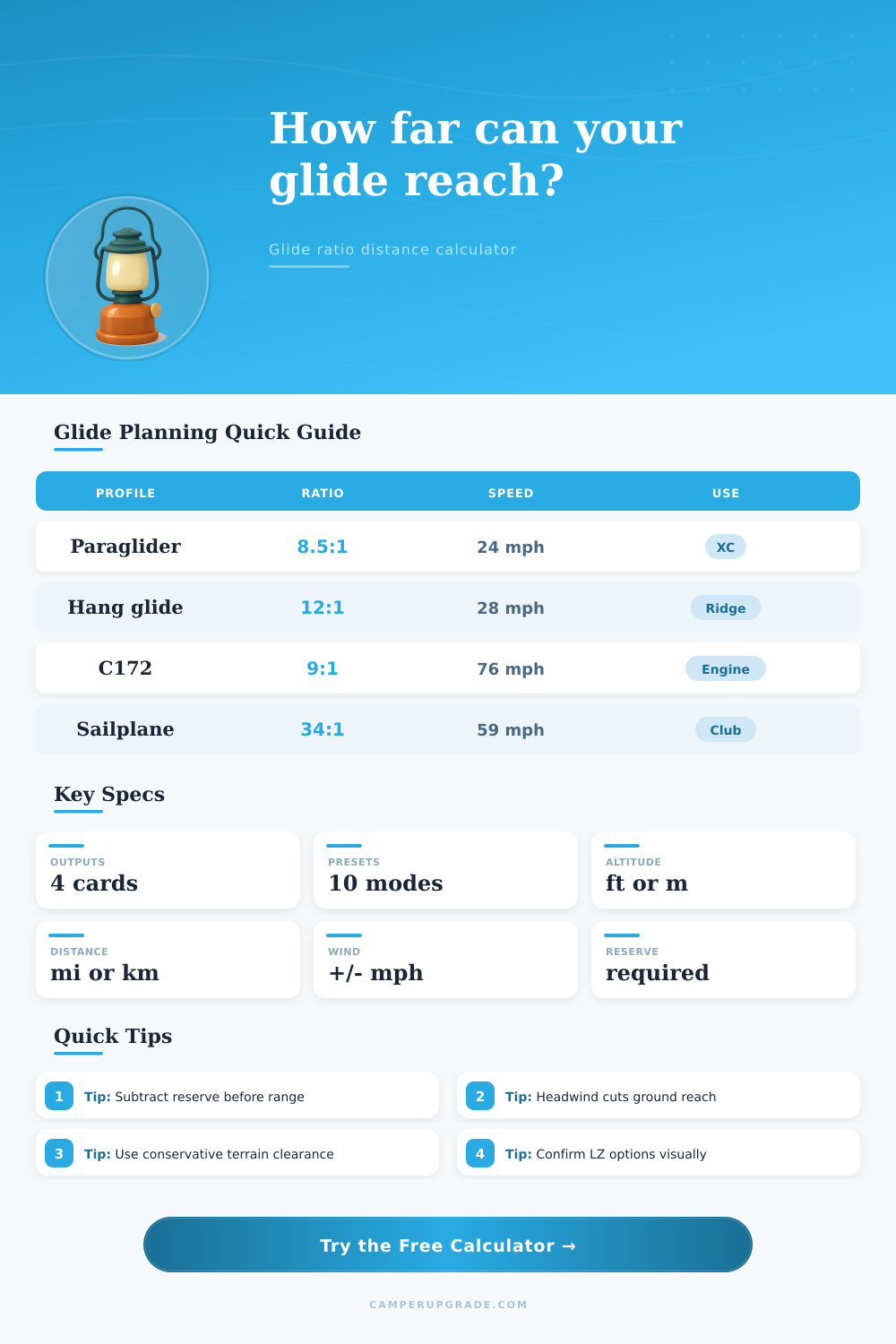
| Flying Profile | Typical Glide Ratio | Typical Speed | Planning Note |
|---|---|---|---|
| Ram-air skydiving canopy | 2.5:1 to 3.2:1 | 16 to 25 mph | Wind and pattern altitude dominate final reach. |
| Modern wingsuit | 2.0:1 to 3.0:1 | 70 to 110 mph | Use terrain clearance and exit geometry conservatively. |
| Recreational paraglider | 7.5:1 to 10:1 | 22 to 28 mph | Active air and headwind can erase a large margin. |
| Intermediate hang glider | 10:1 to 14:1 | 25 to 34 mph | Good for ridge decisions if wind is well known. |
| Light airplane best glide | 8:1 to 11:1 | 65 to 95 mph | Use the aircraft operating handbook when available. |
| Club training sailplane | 28:1 to 36:1 | 50 to 65 mph | Ballast, bugs, and turns can reduce practical glide. |
| Wind Component | Effect On Ground Speed | Range Change At 25 mph | Range Change At 75 mph |
|---|---|---|---|
| 15 mph headwind | Ground speed much lower | About 40% of still-air reach | About 80% of still-air reach |
| 10 mph headwind | Shorter glide over ground | About 60% of still-air reach | About 87% of still-air reach |
| Calm wind | No wind correction | 100% of still-air reach | 100% of still-air reach |
| 10 mph tailwind | Longer glide over ground | About 140% of still-air reach | About 113% of still-air reach |
| 20 mph tailwind | Large downwind reach | About 180% of still-air reach | About 127% of still-air reach |
| Reserve Type | Typical Altitude | Metric Equivalent | Use Case |
|---|---|---|---|
| Canopy final pattern | 600 to 1000 ft | 180 to 305 m | Skydiving, speedflying, and canopy alternates. |
| Paraglider landing decision | 500 to 1200 ft | 150 to 365 m | Field selection, approach setup, traffic, and wind check. |
| Hang glider approach margin | 700 to 1500 ft | 215 to 460 m | Large pattern, setup turns, and LZ inspection. |
| Light airplane forced landing | 1000 to 2000 ft | 305 to 610 m | Pattern, troubleshooting, and final landing commitment. |
| Sailplane final glide reserve | 800 to 2500 ft | 245 to 760 m | MacCready margin, circuit height, sink, and traffic. |
| Route Scenario | Primary Input | Suggested Derate | What To Watch |
|---|---|---|---|
| Valley crossing | Altitude above far field | 12% to 25% | Ridge clearance and sink in the crossing line. |
| Ridge return | Headwind component | 15% to 30% | Wind gradient, rotor, and no-landing gaps. |
| Airport pattern glide | Reserve altitude | 8% to 18% | Pattern entry, runway choice, and traffic spacing. |
| Canopy spot | Wind at canopy altitude | 10% to 25% | Upper wind drift and landing area obstacles. |
| Sailplane final glide | Required arrival height | 10% to 20% | Sink lines, ballast, bugs, and final turn distance. |
💡Glide Planning Tips
So far gliding math looks easy… Until you actualy have to do it.
Ten to one is the glide ratio of a light plane, which means that for each foot of altitude you lose, you go ten feet forward. If there’s enough altitude you can theoretically go forever (in a textbook vacuum). Except of course air isn’t a vacuum and wind won’t follow your theoretical plan.
Why Glide Math Is Harder Than It Looks
Three thousand feet above a landing zone and how safe vs. Emergency is rarely about the plane at all but rather how well you calculates for terrain and wind loss. In addition, pilots often underestimate how much ground they loses in winds because they assume they’re maintaining airspeed rather than ground speed. Even though you might be flying your wing at a best-glide speed through the air mass, that mass could be moving against you. Gliding at sixty-five miles per hour into a fifteen-mile-per-hour headwind result in fifty miles per hour of ground speed. That’s slower: It makes getting back harder while reducing your range.
The calculator takes that into account automatically when you enter the wind component. Depending on how strong the headwind is, your effective glide distance can be cut by forty percent or more, turning what would of been a comfy margin into a tough stretch.
In unpowered flight, your altitudes are like money. Called “altitude,” it’s used up when spent: don’t count on burning all of it to get home. Keep some altitude in reserve. You will need it to go around obstacles, fix your approach, fly traffic patterns and handle sink during those maneuvers. Reserve is typically five hundred feet if you’re a paraglider (or other low wing load) or a thousand for a light airplane, depending on conditions and load factors. Subtracting this reserve, which allows you to calculate your range using only the altitude you have available, differentiates your paper altitude from your usable altitude.
Flat maps do not reflect terrain. What looks like a straight line can be over trees, a power line, a ridge or something else. Even if field is within glide range, you might not be able to clear that thing in the middle. If you fly faster and higher than the minimum you are clearing those obstructions with authority. That consumes more of your altitude budget and also causes you to sink at a faster rate. By including a percentage added to your turn/distance deviation, the route offset take this into account.
Each aircraft will respond different than in these situations. A high-performance sailplane can have a glide ratio as high as thirty-to-one, allowing it to travel great distances without using much energy. Wingsuits and ram air skydiving canopies typically has a lower profile, such as less than three-to-one, so you will feel the effects of wind even more. If you don’t know the number, look on reference tables which list the average gliding ratios for different aircraft types. Don’t rely on the best-case scenario from a set of manuals; the real world doesn’t cooperate most of the time. Wind, turbulence, and thermal distortions all affect performance. Always looks better in a clean glide test versus flying a windy valley.
Apply a reduction factor and make your planning more realistic. Reduce your theoretical by 10-20% and create some wiggle room for when the wind shifts or the air is bumpy. It is better to land with some extra altitude than to run out of it over a river. Risk is managed with cautious assumptions in Glide planning. Judgment will be your guide within the boundaries set by numbers.
Altitude is the only thing standing between you and the ground, so always check alternatives and verify weather. After a while, you no longer see glide ratio as a static number. You realize that wind robs range and that terrain calls for clearance. You begin to manage this changing resource known as a glide ratio carefuly when the engine goes quiet and options narrow.