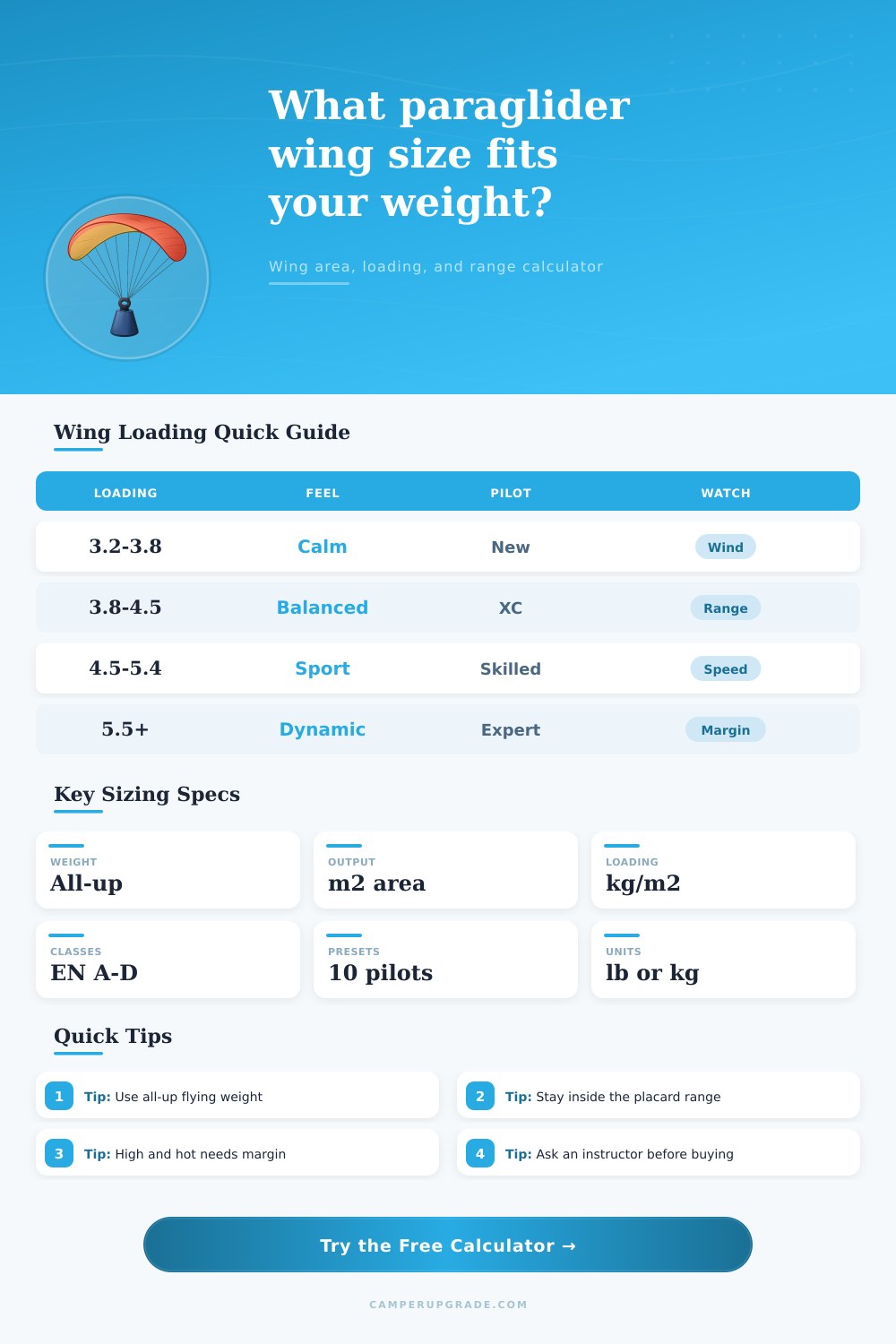
Paraglider Wing Size By Weight Calculator
Estimate a practical paraglider flat area, wing loading, and certified weight range from your all-up flying weight, gear, pilot class, launch style, air density, and conditions.
🪂Paraglider Sizing Presets
Paraglider Wing Size Snapshot
⚙Pilot, Gear, And Wing Inputs
🧵Canopy And Line Spec Comparison
📊Reference Tables
| Wing loading band | Typical feel | Common use | Planning caution |
|---|---|---|---|
| 3.0-3.5 kg/m2 | Slow, floaty, forgiving | School flights, very light pilots, mellow sledders | More wind drift and less penetration in breeze. |
| 3.5-4.2 kg/m2 | Easy, balanced, predictable | EN-A and low EN-B recreational flying | Good default when the pilot is still building hours. |
| 4.2-5.0 kg/m2 | Quicker, firmer, more authority | Experienced XC and sport EN-B or EN-C pilots | Needs stronger active flying and landing precision. |
| 5.0-5.8 kg/m2 | Fast and dynamic | Sport wings, strong-wind soaring, compact sizes | Reduced slow-speed margin and higher descent energy. |
| 5.8+ kg/m2 | Miniwing or speed-wing feel | Expert dynamic flying only | Not a normal beginner paraglider sizing target. |
| Wing class | Typical range width | Good placement | What changes when heavier |
|---|---|---|---|
| School EN-A | 20-25 kg | Lower to middle | More speed, shorter flare window, less sink margin. |
| EN-A progression | 23-28 kg | Middle for most pilots | Better authority but more dynamic reactions. |
| Low EN-B | 25-30 kg | Middle to upper middle | Higher cruise speed and firmer handling. |
| High EN-B / EN-C | 28-35 kg | Upper half only with skill | More energy retention and stronger pitch response. |
| Tandem | 55-75 kg | Middle unless conditions dictate | Passenger comfort and launch technique matter more. |
| Air density case | Calculator factor | Practical effect | Sizing response |
|---|---|---|---|
| Sea level or cool air | 0.98 | Wing feels slightly more supportive | Normal area is usually fine. |
| Typical hill day | 1.00 | Baseline handling and sink estimate | Use the class target. |
| Warm summer valley | 1.04 | Takeoff and flare feel a little faster | Avoid forcing the top of the range. |
| High mountain launch | 1.07 | Higher true airspeed and longer ground run | Leave range and skill margin. |
| High and hot launch | 1.11 | Most noticeable speed and climb penalty | Favor extra area or wait for better air. |
| Item to include | Typical weight | Why it matters | Check method |
|---|---|---|---|
| Standard harness | 4-6 kg | Often heavier than pilots guess | Weigh packed, with carabiners. |
| Reserve system | 1.5-3.5 kg | Can move a light pilot into the next range | Include handle, bridle, container, and maillons. |
| Winter layers | 2-5 kg | Changes launch speed and trim position | Weigh exactly as dressed to fly. |
| Water and flight deck | 1-4 kg | XC days add mass late in planning | Pack normal instruments and bottles. |
| Wing itself | 3-7 kg | All-up weight includes the glider | Use manufacturer mass for the exact size. |
💡Sizing Tips
Be sure to think about your overall flying weight before purchasing a paraglider. Many pilot think their harness is only five pounds. However, including winter gear, water bottles, a helmet, boots, a reserve parachute, and more means your rig will weigh thirty pounds on the scale! If you didn’t account for this all-up weight versus guessing how much you weigh then that’s what’s making your wing seem too small just a few months after your purchase. It’s also why you can has a tough time launching or why your margin for error is smaller when things get bumpy.
So how do you get from here to there? The wing’s math are done by the calculator on this page. Simply input what gear you’re packing and the calculator will match your total mass to the normal wing loading bands and recommend a best wing size within manufacturer’s approved range. You want to find the sweet spot between a wing that feels aggressive and one with predictable handling. In other words, a big wing provide softer landings and more forgiving stall recoveries, important when developing muscle memory in your hands. Size down and your wing becomes faster, but at the expense of less margin for error in turbulent conditions.
How to Choose the Right Paraglider Size
A wing’s performance depends off context. A wing flies differently flying at sea level on a cool morning versus launching off an alpine peak under a hot sun. It is launch day on a hot sunny day. It also varies with altitude as thin air require more speed to get lift, so the same wing load will seem faster and less stable at high altitudes. The tool accounts for this by using your weight entry adjusted for density corrections. So the software may recommend an area larger than if you were flying coastally on a crisp fall day. This maintains your slow speed margin where lift matter most.
Within each manufacturer’s weight envelope, your level of experience determine your seat location. Novices typically like to be at the low end of the range as the wing holds pressure well and responds gradually to brake input (good if you pause on launch). Seasoned XC fliers commonly seek the high end of the range for efficiency and speed, tolerating more direct handling behavior. The charts on this page show how wing class relates to expected behavior. A beginner’s wing is EN-A and it has a broad range, accommodating learning progress. A sport wing is EN-C; it offers a narrower envelope that favors finesse.
Don’t buy small just because it’s less expensive or looks cool. That wing may load up at max and work fine in smooth air during your initial couple of launch, but boy does it punish you in a bumpy thermal core. Buy what fits you now; don’t buy what you think you’ll be capable of next season. You can never replace real flight experience with numbers. If there is ever any chance, test fly as much as you can. How the canopy handles your combination of gear and harness setup are essential to how it will feel. You should of tested more. So the math gives you a good starting point, but only flight experience will prove it.
Balance is key, not extremes. It’s not about buying something that’s so big you are afraid to land it on a piece of paper, but also not so small that it feels squirrely in turbulent air. Once you have your body weight dialed in, you realize that the sky is not your enemy but instead a manageable place.