Slackline Anchor Load Calculator
Estimate the peak force at each slackline anchor from span, sag angle, rider load, pretension, bounce factor, anchor legs, hardware rating, and backup sharing.
📌Real slackline presets
⚙Slackline geometry and anchor inputs
Slackline anchor load results
🧰Material and hardware comparison grid
📊Reference tables
| Loaded sag angle | Force multiplier | What it means | Anchor cue |
|---|---|---|---|
| 2° | 14.3x rider load | Very flat line | Anchor force rises sharply |
| 4° | 7.2x rider load | Tight lowline | Use high-rated rigging only |
| 6° | 4.8x rider load | Common walking zone | Still much more than body weight |
| 8° | 3.6x rider load | Deeper sag | Lower anchor load, more clearance needed |
| 12° | 2.4x rider load | Soft practice line | Often easier on anchors |
| Movement profile | Dynamic factor | Use when | Planning note |
|---|---|---|---|
| Careful walking | 1.10 to 1.25x | Low, steady practice | Best for first anchor checks |
| Learning corrections | 1.45 to 1.65x | Frequent foot saves | Loads pulse above body weight |
| Small hops | 1.80 to 2.10x | Playful lowline use | Increase safety factor |
| Trickline bounce | 2.30 to 3.00x | Deliberate bounce tricks | Use specialized rated equipment |
| Anchor or connector | Typical rating cue | Derate concern | Calculator use |
|---|---|---|---|
| Wide tree strap | Often 5,000-20,000 lbf MBS | Bark damage, small radius | Enter weakest published MBS |
| Steel rigging ring | Often 20-50 kN MBS | Side loading | Good central connector |
| Climbing carabiner | Major axis often 20-30 kN | Gate or cross load | Derate if not perfectly aligned |
| Ground stake array | Soil dependent | Pullout and creep | Use conservative field rating |
| Posts or frames | Structure dependent | Bending at base | Verify structural design |
| Safety factor | Use profile | Pass signal | Warning signal |
|---|---|---|---|
| 3x | Controlled tests only | Low consequence, no public use | Too thin for routine recreation |
| 5x | Recreational lowline planning | Common minimum target | Still inspect every component |
| 7x | Conservative shared setup | Useful with unknown dynamics | May require stronger anchors |
| 10x | High consequence or uncertain anchors | Large reserve | Do not force marginal anchors to pass |
💡Anchor load tips
The tension is pulling hard on the trees, the webbing is tight, the straps is cinched tight around the trunks, and there you stand at the end of a rope strung across your back yard. A few steps will put you out on a strip of nylon slung over ground like grass or soil.
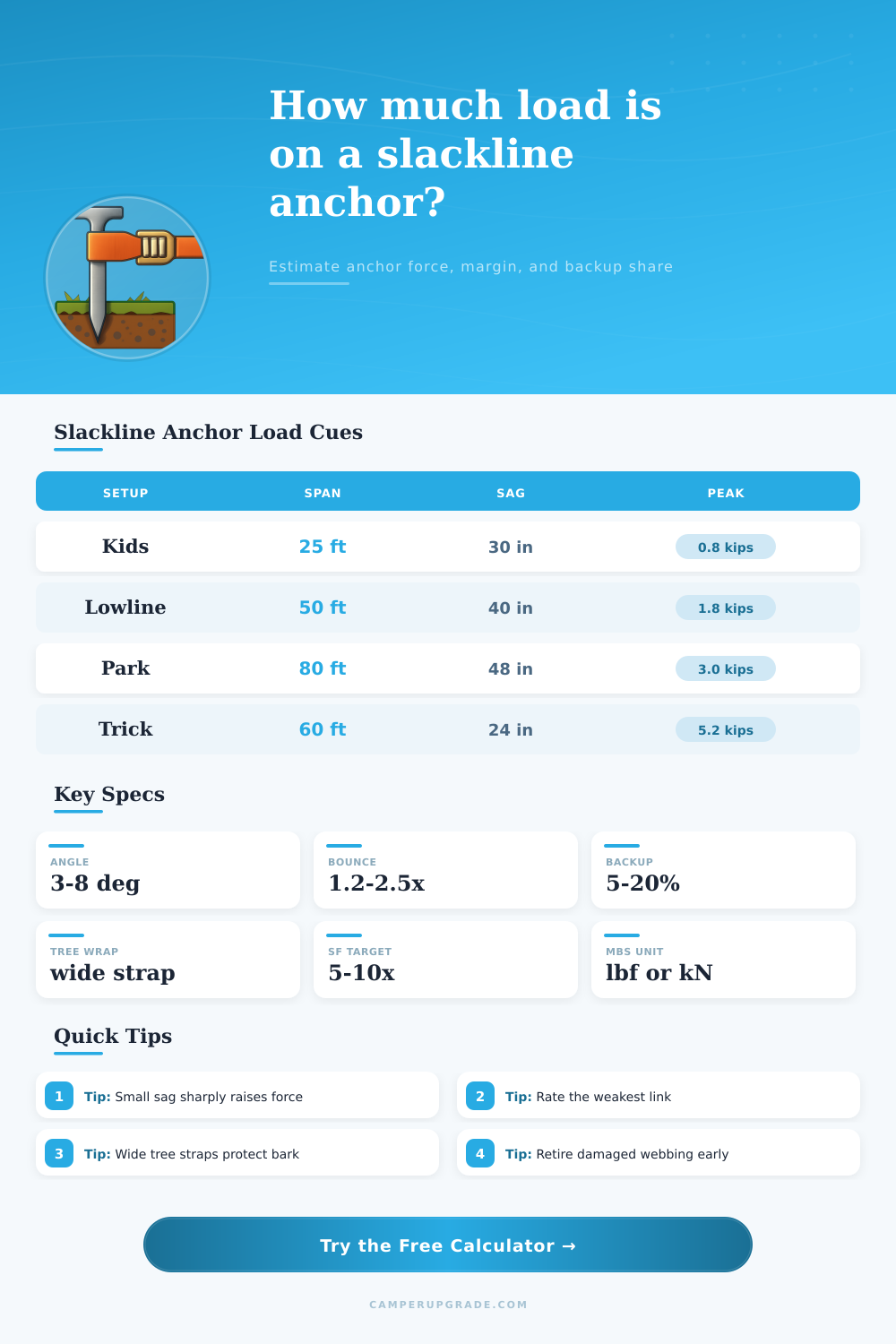
Most people see slacklining as just an exercise in core strength and balance. What they neglect to consider is that no matter how balanced you are, physics doesn’t give a hoot. Physics only cares about tension. And tension is pulling on those trees with five to ten times your body weight when you factor in any amount of bounce.
Why Slackline Safety Matters
Now, plug those numbers in to the calculator above and it does the math for you, so you don’t have to guess at how hard a catch will be on your carabiner. So what’s it telling you? It takes geometry and translates it into force. The longer the span and the less sag, the shallower the angle of your line. And the shallower the angle, the more horizontal tension is needed to hold all that vertical weight. A small change in the sag produces a huge change in stress.
In fact, dropping the sag from four feet to two feet can almost double the loading on your anchors if the line is fifty feet. You thought you were simply tightening it up to get a better walk, but you’re actualy turning your gear into a pressure cooker. Now here’s where it gets dynamic. Walking gently is low-stress. Bouncing, jumping, or falling suddenly significantly multiplies that static tension.
You can choose how aggressively you want to use the tool, all the way from careful walking to tricklining. But if you’re planning to jump, you should of be thinking about a force that is more than twice your weight and often three times. Because that’s what happens when you make a mistake. It is more than just your body weight. A shockwave travels down the line to the anchor before you even know you have lost your footing.
What’s the real margin? Your hardware makes all the difference. Are you using steel shackles (heavy duty, very strong)? Are they aluminum carabiners (lightweight, but brittle, so can fail catastrophically if side loaded or struck with gate open)? What’s your weakest link? Is it a knot? Is it a tree strap? Is it a worn out carabiner? Rate the entire chain based off its weakest link.
Does the tree strap distribute load across a large enough surface area to protect the bark? Does a wide tree strap matter more than raw strength (it does) because you’re working with a living anchor? A narrow strap cuts into the wood like a wire, reducing the friction holding power and creating a hazard for both the tree and you. Some of that peak load is shared by backup systems that gives us the peace of mind to know we can stay on the line even if they only remove ten percent of the force from the main anchor. That’s enough to maintain tension on the line during those spikes in tension that can occur.
As the tables on the page illustrate, safety factors scale with consequence. Lower margins may be OK for a backyard session, but high waterline or any public place requires more reserves. It’s not just about protection of your gear; it’s about protection of other people and the environment.
Retire damaged webbing early. Frayed edges appear harmless until they begin splitting under tension. Check all knots and make sure hardware is clean of grit and grime. Your gear works when it’s clean, and fails when it isn’t. That may seem like a small detail, but it matters much more then any number on a spec sheet. Rely equally on your eyes and the numbers in the calculations.
You don’t want to be nervous about the carabiner snapping or the strap slipping when you step out on that line. You should feel stable, not anxious. A good rig feels invisible because it simply holds firm while allowing you to concentrate on keeping upright.