Solar Still Water Yield Calculator
Estimate fresh distilled water output from a camping, RV, beach, or emergency solar still using basin area, sun exposure, water depth, salinity, cover material, heat loss, and collection efficiency.
💧Solar Still Yield Presets
Your Solar Still Yield Snapshot
⚙Still Area, Sun, Water, And Collection Inputs
🔧Solar Still Material And Spec Comparison
📊Reference Tables For Solar Still Planning
| Still design | Typical field efficiency | Best use | Planning note |
|---|---|---|---|
| Emergency pit with sheet | 18% to 28% | Survival soil moisture or seawater sump | Yield is small unless the pit is large and fully sealed. |
| Single-slope basin box | 30% to 42% | RV, cabin, and campsite experiments | Dark shallow basin and clean cover are the main drivers. |
| Double-slope basin box | 34% to 46% | Longer sun windows with two collection sides | Usually collects better in morning and afternoon angles. |
| Wick evaporator still | 38% to 52% | Lightweight high-surface-area test still | Works best when the wick stays wet but not flooded. |
| Multi-basin tray still | 42% to 58% | Camp table or basecamp production | More wetted area and warmer trays improve output. |
| Solar condition | Peak sun hours | Solar energy | Unadjusted max water |
|---|---|---|---|
| Heavy cloud or forest edge | 2.5 hours | 2.5 kWh/m²/day | About 4.0 L/m² before losses |
| Cloudy humid camp | 3.5 hours | 3.5 kWh/m²/day | About 5.6 L/m² before losses |
| Clear summer campsite | 5.5 hours | 5.5 kWh/m²/day | About 8.8 L/m² before losses |
| Bright beach or desert | 6.5 hours | 6.5 kWh/m²/day | About 10.4 L/m² before losses |
| Feed water | Typical salinity | Yield factor | Calculation note |
|---|---|---|---|
| Fresh pond, creek, or rainwater | Under 1 ppt | 1.00 | Little vapor-pressure penalty; still output may be limited by cleanliness. |
| Brackish water or muddy seep | 1 to 10 ppt | 0.96 | Mild salinity and suspended solids reduce practical output slightly. |
| Seawater or salty beach well | About 35 ppt | 0.90 | Common planning value for beach emergency stills. |
| Very salty brine or mineral pan | 70 ppt or more | 0.82 | High salt concentration slows evaporation and leaves heavy residue. |
| Vegetation moisture under sheet | Variable | 0.70 | Moisture source is limited by plant water release, not only solar energy. |
| Cover material | Transmission factor | Runoff behavior | Field caution |
|---|---|---|---|
| Clean glass | 0.90 | Excellent with 10 to 20 degree slope | Heavy but consistent for box still tests. |
| Greenhouse film | 0.86 | Good if stretched smooth and sealed | Good balance for portable campsite boxes. |
| Clear thin plastic | 0.78 | Fair when weighted to a clean drip point | Wrinkles and sagging can return drops to the basin. |
| Twin-wall polycarbonate | 0.74 | Good rigid slope but lower light | Insulation helps heat retention but reduces transmission. |
| Cloudy or dirty plastic | 0.62 | Poor unless cleaned and tensioned | Low light transmission can dominate all other improvements. |
💡Solar Still Calculation Tips
Some survival myths claim that a solar still will make gallons of clean water by afternoon. That’s not true. A solar still is nothing but a heat trap. Energy turns the water from a liquid state to a gas (evaporates) and then condenses it back down again. Magic? No. Physics. Avoid dissapearance by knowing distinction between theoretical evaporation and real-world yield.
The calculator above does thermodynamics for you. It considers cover material, salinity, basin size, and sun exposure. This lets you get an estimate based off your own knowledge rather than that of an engineer.
How Solar Stills Actually Work
The single most neglected variable are water depth. Yes, I know some assume the more they fill it the more stuff it will have. But remember that deep water absorbs heat. It takes a lot of solar energy just to heat up that mass, much less evaporate anything out of it. What warms up quickly are shallow basin, particularly ones where the bottom has been painted dark to absorb sunlight.
If you enter your own water depth and sun hours into calculator, it can accounts for this. With a shallow basin and seven peak sun hours in a desert, yield isn’t bad. With two or three hours of direct sunlight (as might be found in a cloudy forest) output goes way down because the water never gets hot enough for strong vapor generation.
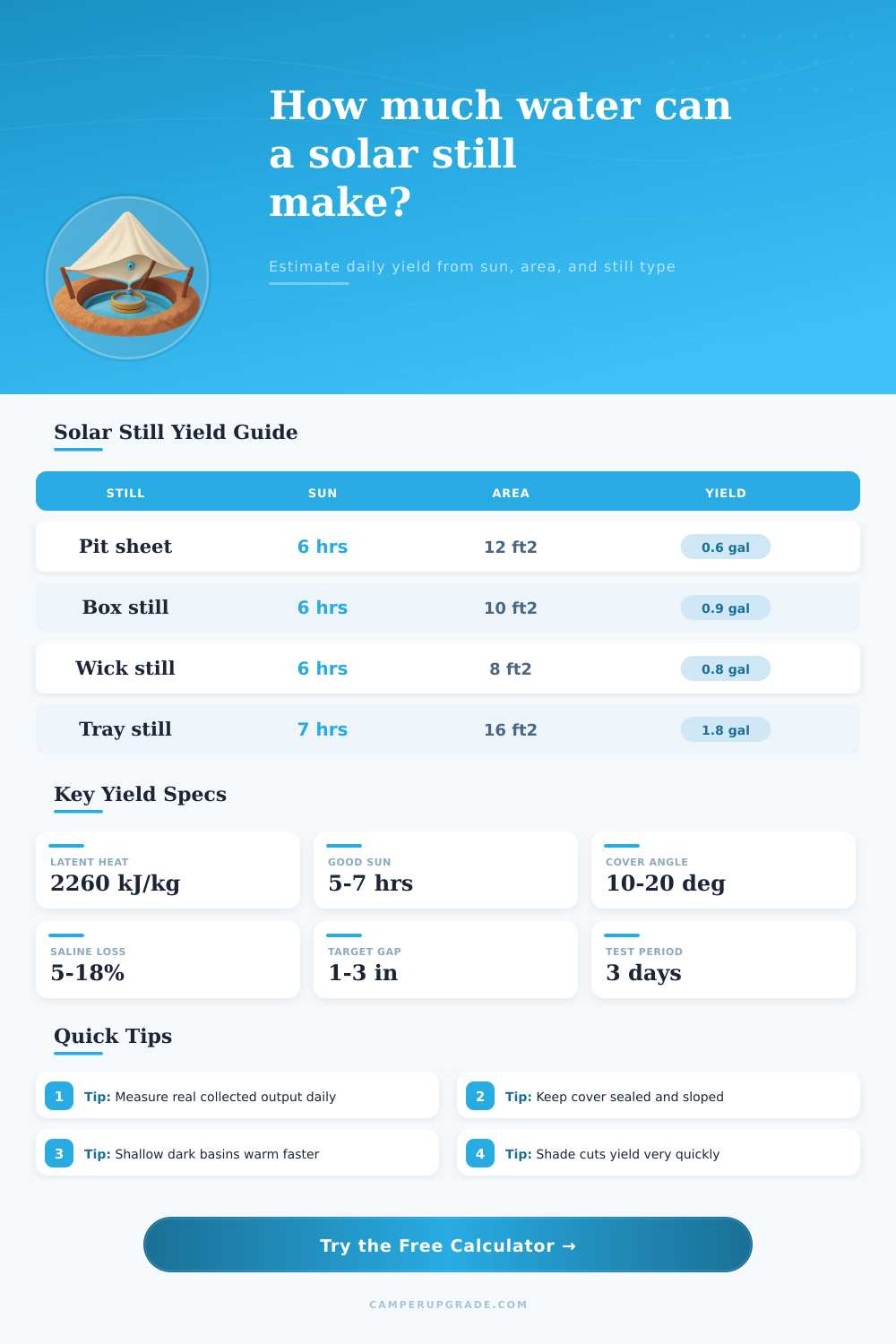
Salt matters (but not as much as you might think). Because salt reduces the vapor pressure just a bit, sea water will take longer to evaporate then fresh pond water. But that is a small loss in efficiency compared to poor sealing and wrong angle on the covers. If the plastic sheet dips down into the water you’ll have dirty runoff rather than pure distilled water. These efficiency limits are neatly displayed in reference table. Even with a good design, multiple tray can produce almost twice as much as a poorly dug pit.
Second, the cover material makes a big difference. High quality greenhouse film or clean glass transmits solar radiation and holds heat, creating the necessary temperature differential for condensation. Cloudy, wrinkled plastic will block the light and prevent as much energy from getting into the system. If it’s not clear and taut it won’t work.
Finally, wind steals heat out from under edges of your still. To keep that heat focused on evaporating the water instead of heating up the surrounding air, put your still in some kind of insulated box or shelter it with a rock wall.
For most, a solar still will be supplementary. Not a main source of water. And even with the best setup, on average days it may generate less than a litre per square metre. You should of prepared for that. This is why calculating your desired output can help. If you require two litres daily but are getting only half a litre per square foot on average, you’ll know right away that one small still isn’t going to cut it. In that case, either get better placement or go big.
Understanding measurements is tricky because gross evaporation isn’t the same thing as collected water. The calculator subtracts out any drops lost from leaks at the seal or those falling back down into the basin. So you gets a realistic picture of output. In the warm sun it’s easy to get all optimistic about it, but conditions in the field can vary widely. A leaky cover makes a hydration station a damp tarp.
Go for the lower end of the estimate. Maintain a tight seal, keep the slope steep enough for runoff and make sure your water stays shallow. When you do, that steady drip becomes more than a scientific curiosity, it’s reliable sustenance. You should try to achieve this.