Campsite Electrical Extension Drop Calculator
Estimate campsite cord voltage drop, load voltage, heat loss, and gauge fit for RV pedestals, tent sites, shore power cords, and outdoor extension runs.
⚡Common Campsite Presets
🔌Cord And Load Inputs
Voltage Drop Result
📊Cord Gauge Spec Comparison
📘Reference Tables
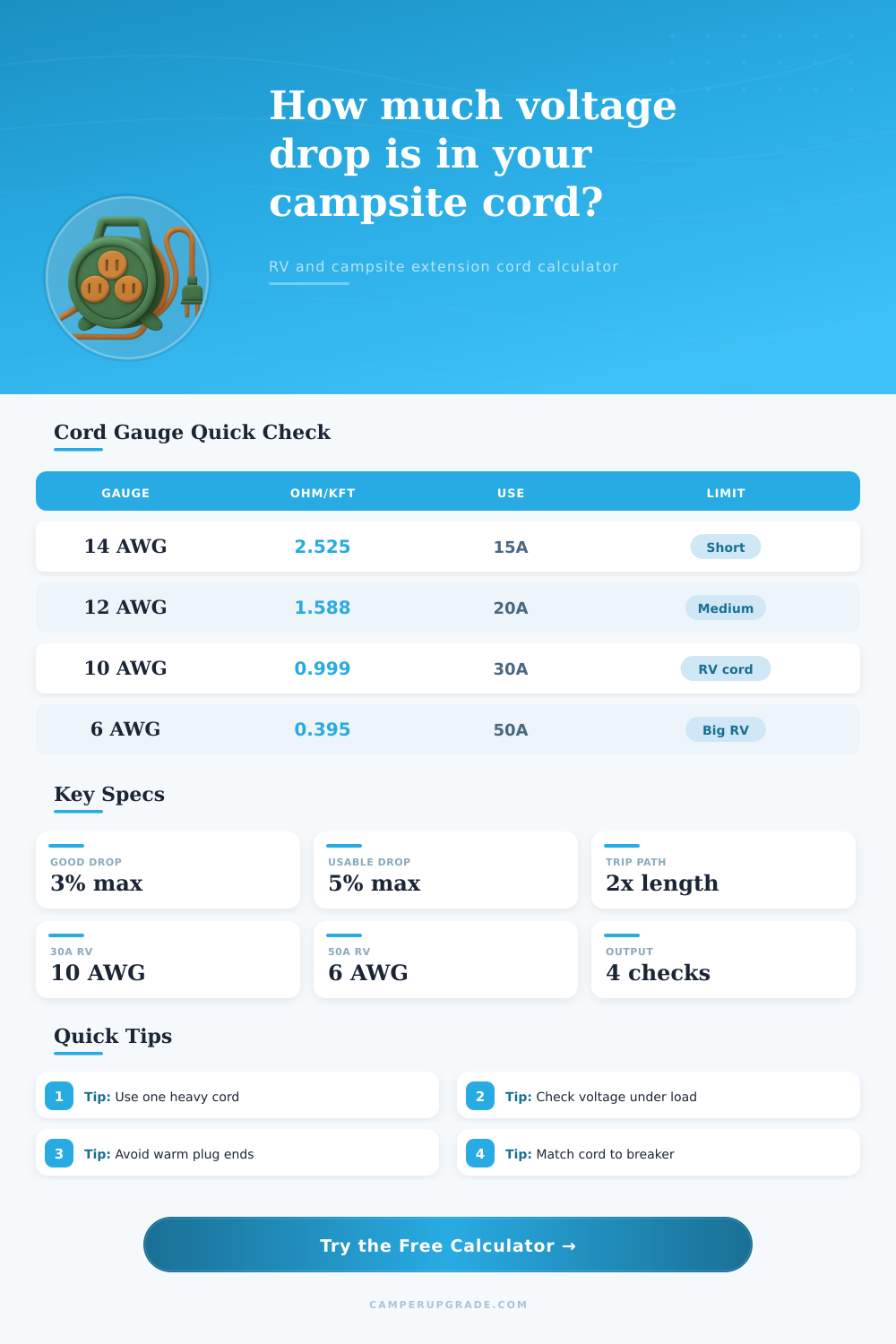
| Wire gauge | Copper ohms per 1,000 ft | Typical flexible cord ampacity | Common campsite use |
|---|---|---|---|
| 18 AWG | 6.385 ohms | 10 amps | Small lights, low chargers, very short low-load cords |
| 16 AWG | 4.016 ohms | 13 amps | Light tent loads and low-draw accessories |
| 14 AWG | 2.525 ohms | 15 amps | Standard 15A outdoor extension use |
| 12 AWG | 1.588 ohms | 20 amps | 20A campsite outlet loads and longer 15A runs |
| 10 AWG | 0.999 ohm | 30 amps | TT-30 RV shore cord and heavy campsite appliances |
| 8 AWG | 0.628 ohm | 40 amps | Longer heavy runs where drop control matters |
| 6 AWG | 0.395 ohm | 55 amps | 50A RV shore power cord assemblies |
| Outlet or cord type | Nominal voltage | Breaker rating | Voltage-drop note |
|---|---|---|---|
| NEMA 5-15 household style | 120 V | 15 amps | Voltage drop matters quickly with heaters and long cords. |
| NEMA 5-20 T-slot campsite outlet | 120 V | 20 amps | Use 12 AWG cord for sustained high loads. |
| TT-30 RV pedestal outlet | 120 V | 30 amps | 10 AWG shore cord is the common full-load match. |
| NEMA 14-50 RV pedestal | 120/240 V | 50 amps | Most RV branch loads are still checked per 120 V leg. |
| Daisy-chained cords | Varies | Lowest cord wins | Extra plug pairs increase resistance and heat points. |
| Voltage drop target | Meaning | 120 V equivalent | Campsite interpretation |
|---|---|---|---|
| Under 3% | Preferred branch-circuit target | 3.6 V drop | Good for compressors, converters, electronics, and steady loads. |
| 3% to 5% | Usually workable | 3.6 to 6.0 V drop | Watch for warm cord ends and low pedestal voltage. |
| 5% to 8% | Caution range | 6.0 to 9.6 V drop | Reduce load, shorten cord, or use a heavier gauge. |
| Over 8% | High drop | Over 9.6 V drop | Not a good sustained-use setup for campsite power. |
| Example load | Typical amps at 120 V | Preferred cord | Calculation note |
|---|---|---|---|
| Phone chargers and LED lights | 1 to 3 amps | 16 AWG short cord | Drop is usually small unless the cord is very long. |
| Battery converter or charger | 6 to 12 amps | 14 or 12 AWG | Lower voltage can reduce charging performance. |
| Outdoor griddle or kettle | 10 to 15 amps | 12 AWG | Resistive loads create steady cord heating. |
| Portable space heater | 12 to 13 amps | 12 AWG short cord | Avoid coiled cords and inspect plug temperature. |
| 30A RV air conditioner mix | 18 to 28 amps | 10 AWG RV cord | Long runs can sag during compressor starts. |
| 50A RV high-load leg | 35 to 45 amps | 6 AWG RV cord | Check each 120 V leg if loads are unbalanced. |
🚧Campsite Calculation Tips
The sun’s setting low as you pull into what you hope will be a sweet campsite with a hot grill waiting. Only, the pedestal are located on a half-acre away. After dragging out the extension cord, you plug in electric griddle and wait for that perfect sear… nada. The heating element glow a weak orange color rather than the angry red color of heat. Before you know it, the air conditioner cut on and off, every ten minutes. Perhaps you’ll replace the appliance, but more likely the culprit are in the wire.
Just as water resist flow down a narrow pipe, electricity resists flow down a copper wire. This results in a loss of voltage, a.k.a. This causes a voltage drop which robs power before it even arrives at your tent or RV site gear.
Why Your Campsite Power Is Weak and How to Fix It
You can put in how long your cord is and what you are expecting to draw, then let the calculator do the rest (no need for conversions and coefficients). It begins with simple question of “how far is your campsite from the pedestal?” Why? Because there is a hundred feet of conductor path from your rig to your load. It is fifty feet one way and fifty coming back. The electrons has to go out to your load and back. A lot of folks just look at distance to the load and think half of that is all the drop they get. That is not the case, that’s where a lot of folks miss it.
You tell it what gauge your wire is. For example, use 16 awg if you have a light load like some tent, or 10 awg if you are running an RV with 30 amps. Then it will calculate how much resistance that copper runs.
Another invisible expense of voltage drop is wasted energy as heat. Instead of doing any productive work, that wattage become heat. For example, a lengthy power run on undersized wiring can be toasty at the plug ends. This is not only inefficient but also possibly hazardous over time if it melt insulation. The calculator tell you precisely what percentage of watts are being lost to thin air so you can tell if you have an efficient set up or simply one that’s keeping the mosquitoes comfy by radiating ambient warmth.
Surprisingly, it turns out that connector condition matter as well. Resistance from a loose connection in an old campground outlet isn’t caused by the wire; it’s just an additional obstacle. That is usually what causes the plug to feel warm after being in use for an hour. The tool accounts for connector quality, recognizing that there are few if any perfect campground sockets in the real world. And it takes into account daisy-chained cords, those extra connection points that multiply the risk of something going wrong. A single heavy-duty cord is nearly always preferable to two lesser cord taped together halfway down their length.
The numbers make more sense when you understand what a voltage drop target means. For example, we want a maximum of three percent drop for high-current loads such as air conditioners and other items that must start motors or have sensitive electronics. On the flip side, five percent is often considered the limit of usefulness for resistive heating elements. Anything more and you’ll notice reduced performance. You’ll find that your refrigerator compressor have a hard time starting which leads to short cycling, bad ice, and a strained motor. It’s all spelled out nicely in the reference table on the page, which details how each gauge performs with different loads.
Gauge matters beyond preventing breaker trips. Gauge also keep voltage steady to ensure your equipment works how it was meant to. While maybe 15 amps would of not overheat a 12 gauge cord, that doesn’t mean it won’t drop the voltage enough to noticeably dim your LED lights or make an on-board battery charger mad at you. More expensive, harder to coil up after the trip, yet heavier gauge wire will give you electricity that you can trust. Electrical peace of mind against physical inconvenience: the choice is yours.
Finally, campsite power isn’t exactly magic; it’s physics. There are limitations: copper have them, distance has them, connections will degrade them. Avoid frustration with a weak power source by checking your setup beforehand, before you even unroll the cord. It is a small detail but it is important. Your burger gets that perfect sear because of this more than you’d think.