Golf Club Distance Gapping Calculator
Build a carry-distance ladder from driver through wedges, apply course-condition adjustments, and identify the club slots where your bag leaves too much or too little room.
⛳Golfer Presets
Club Gapping Snapshot
| Club | Adjusted Carry | Next Gap | Status |
|---|
🏌Carry Distance Inputs
Carry-first method: the calculator models full-swing carry distances. Total distance, rollout, and partial wedge shots vary too much by turf, slope, and ball speed to make a stable gapping ladder.
⚙Club Spec Comparison Grid
📊Reference Tables
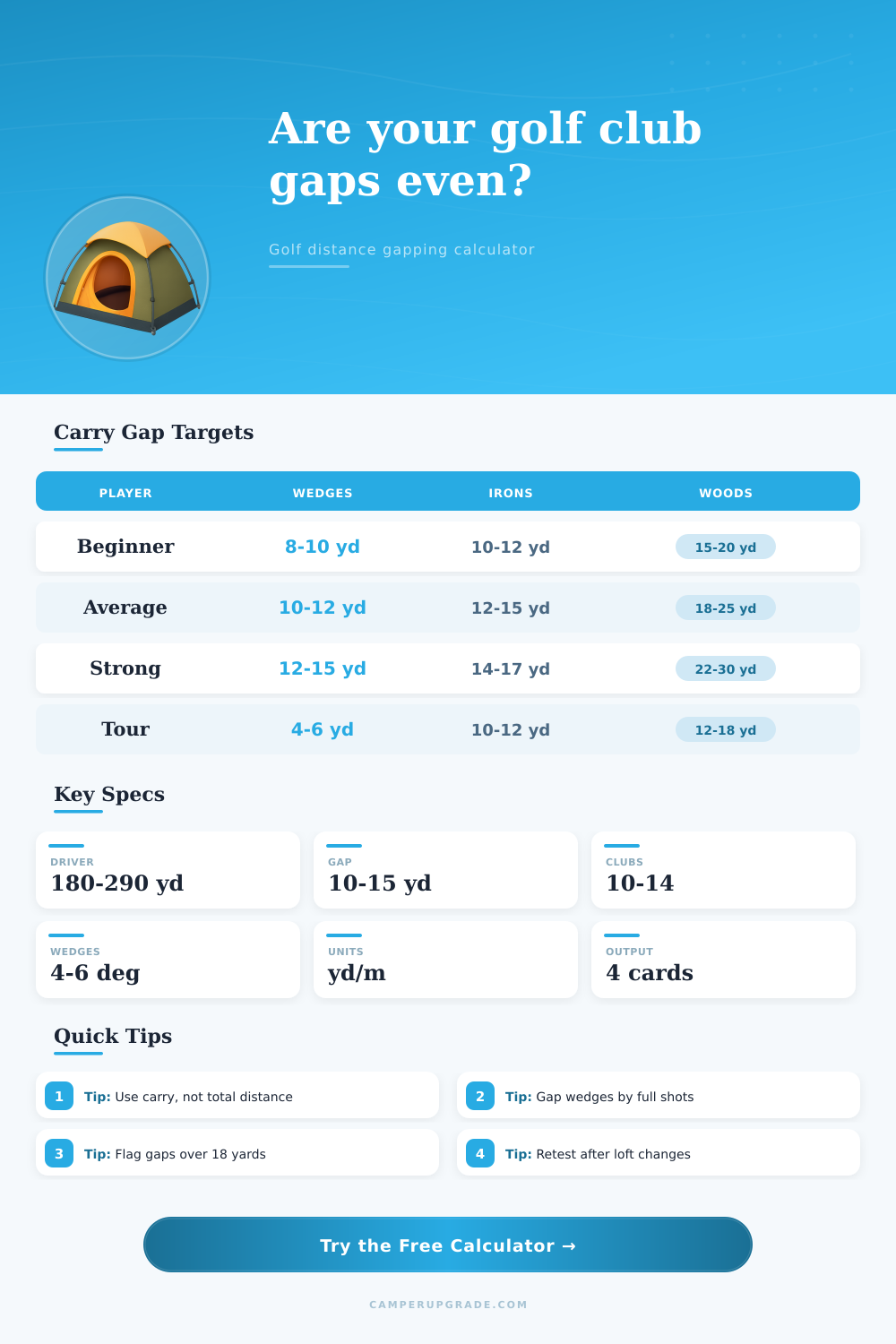
| Player type | Wedge gap target | Iron gap target | Wood / hybrid target |
|---|---|---|---|
| Newer golfer | 8-10 yd | 10-12 yd | 15-20 yd |
| Average recreational | 10-12 yd | 12-15 yd | 18-25 yd |
| Strong ball striker | 12-15 yd | 14-17 yd | 22-30 yd |
| Tournament / fitted bag | 4-6 yd | 10-12 yd | 12-18 yd |
| Club zone | Typical loft band | Normal spacing | Gapping note |
|---|---|---|---|
| Driver to fairway | 8-19° | 20-35 yd | Largest legal spread is often at the top of the bag. |
| Hybrid / long iron | 18-27° | 12-22 yd | Launch height often matters more than stamped loft. |
| Mid / short irons | 28-44° | 10-15 yd | The 7-iron and PW anchors estimate this ladder. |
| Scoring wedges | 46-60° | 8-14 yd | Use measured full swings, then add partial shots separately. |
| Condition | Carry change used | Best use | Watch point |
|---|---|---|---|
| Cold air / heavy ball | -4% | Early season or cold range sessions | Ball speed and launch can both drop. |
| Warm dry day | +2% | Summer carry planning | Total distance may rise more than carry. |
| High altitude trip | +6% | Mountain or desert courses | Retest wedges because spin changes stopping power. |
| Into-wind planning | -7% | Conservative club choice | High-spin players lose more at the top end. |
| Bag setup | Counted clubs | Gap strength | Common tradeoff |
|---|---|---|---|
| 10-club light bag | 9 full-swing clubs | Simple decisions | More long and wedge gaps |
| 12-club weekend bag | 11 full-swing clubs | Balanced travel setup | Usually one top-end choice missing |
| 14-club standard bag | 13 full-swing clubs | Most complete ladder | Requires honest overlap checks |
| Wedge-heavy scoring bag | 12-13 full-swing clubs | Tighter approach yardages | May open a fairway-to-hybrid gap |
💡Gapping Tips
That lasts until you turn up at the first tee all pumped up to take on anything. And there’s that pin: three hundred yards down the hole. Oh my. How am I going to hit that? Will my driver reach it or will my three wood overshoot? What about my three wood (too far? If that happens), it’s hardly ever because you can’t hit the shot.
Almost always, it’s a gapping issue. A calculated ladder of clubs, taken from measured carry yardages, is what the calculator provide. It allows you to identify potential trouble spots before they cost you strokes come Saturday morning.
Fix Gaps in Your Golf Clubs
Few golfers obsess about distance they can hit a ball without questioning if their bag adequately covers the yardage spectrum presented. Sure, you might have a two hundred and eighty yard driver, but if you have large gaps in the middle with your long irons, you’re screwed. Holes like that make club selection a guessing game.
This process relies on measurements of carry distance, not total distance. Total distance takes into account roll out. This depends heavily on factors like the nature of the turf and its firmness, but also the angle of attack (slope). Carry distance doesn’t care about any of that. Whether you’re playing a parkland with soft fairways or a links course with hard ground, carry distance remain constant.
When you plug in your seven iron carry and driver carry into the tool, these become anchor points against which the rest of the bag is established. Because it’s assumed that standard loft progressions will yield typical yardage increases between clubs; if you hit a seven iron one hundred fifty yards then your five iron ought to be something like twenty more yards, give or take what makes up your particular set. The system fills in the gaps between these two anchors.
That’s how the system show you where your true distances differ from optimal spacing. Often players find their clubs is duplicating. In today’s strong lofted iron sets, this happens frequently with the pitching wedge. Your gap wedge could be forty-eight degrees but then your pitching wedge is just forty-four degrees. You’re not really gaining much length between those two iron.
It means you’ve got two clubs that land in the same general area (within five yards). That’s far more redundant and harmful than having a big gap. Now you have to choose which club to rely on. Do you trust the slightly lower launch or the slightly higher spin? Or do you go with the one with a bit less launch? The calculator flags these overlaps. This allows you to make an educated decision about bending down a loft, replacing a club, or simply deleting one altogether.
The other huge variable is course conditions and will make all those gaps feel different on the day. You will get a few percent less carry across the board due to a cold morning with heavy air. There is significantly more from high altitude. Those are things you can adjust for with the tool and use it as a way to mimic a real round scenario versus perfect range conditions.
If you know going into a trip that there’s going to be significant wind or elevation changes, seeing how those affect your gaps can help you decide what clubs to take before leaving the house. It is not just about the number in front of you, but how that number will feel with your own equipment under current atmospheric pressure.
That’s why we need to single out wedges as being particularly important; that’s where you score. Newbies may be happy taking a little more space in this area until they get better, but as you develop more confidence, these gaps should close. For example, if you can handle a twelve yard gap between wedges with partial swings, a six degree loft step might feel like too much of a jump if you struggle to control tempo at fifty percent effort. However, if you have trouble keeping your tempo on track with only half your effort, then going up by six degrees could of being jumping the gun a bit. Competitive players will find the tighter spacing suggested in this list helpful.
Remember, the mechanics behind pitching/chipping and your full swing wedge are completely different and you’ll want to test your distance on each independently. It’s not about new stuff. It’s not even necessarily about getting the newest stuff. It’s about measuring honestly and building a bag around a cohesive bag. You’re never going to plug a hole in your bag with willpower.
Either get rid of the bad stick that creates a hole elsewhere, or use data to measure and find out what is missing. And when you do that? The answer is often a lot easier than you might think. Maybe you swap an iron for a hybrid to fill a long game hole. Maybe you add a 52 degree wedge and cover a painful short approach range. But either way it’s making sure you have something you like walking up to at each yardage (not just something that will work).
It can be a bit tedious at first while setting up. But it will become very useful the next time the wind blows up and the distances get shorter than they are accustomed to being. This takes all the guesswork out when you are not sure which club to hit for that three hundred and ten yard carry on a windy day.
Doubt is the enemy of rhythm and speed. Having a well gapped bag allows you to commit to your swing because you know the distance is set. Start at the extremes and fill in the gaps intentionally. Every rung must have some weight for the ladder to work.