Golf Handicap Index Calculator
Estimate a WHS-style Handicap Index from adjusted gross scores, Course Rating, Slope Rating, PCC, low index caps, and the best differentials in your scoring record.
⛳Golf Handicap Presets
Handicap Index Snapshot
🏌Index, Cap, And Tee Inputs
📋Scoring Record Inputs
| Use | Round | Adjusted Gross | Course Rating | Slope | PCC | Posted Diff |
|---|---|---|---|---|---|---|
| 1 newest | ||||||
| 2 | ||||||
| 3 | ||||||
| 4 | ||||||
| 5 | ||||||
| 6 | ||||||
| 7 | ||||||
| 8 | ||||||
| 9 | ||||||
| 10 | ||||||
| 11 | ||||||
| 12 | ||||||
| 13 | ||||||
| 14 | ||||||
| 15 | ||||||
| 16 | ||||||
| 17 | ||||||
| 18 | ||||||
| 19 | ||||||
| 20 oldest |
📐WHS Spec Comparison Grid
📊Reference Tables
| Differentials In Record | Counting Differentials | Adjustment | Calculation Method |
|---|---|---|---|
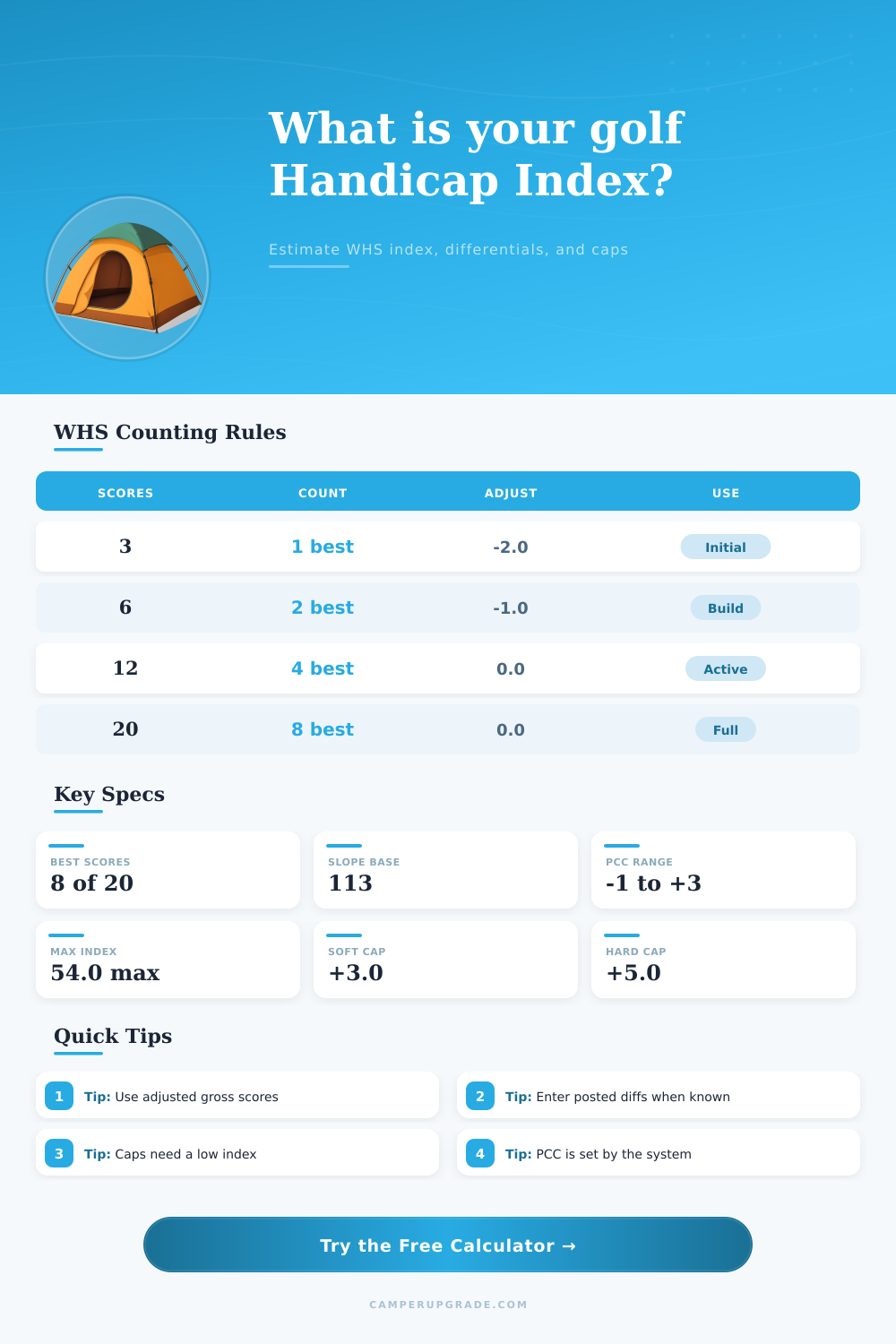
| 3 | Lowest 1 | -2.0 | Lowest differential minus 2.0 |
| 4 | Lowest 1 | -1.0 | Lowest differential minus 1.0 |
| 5 | Lowest 1 | 0.0 | Lowest differential only |
| 6 | Lowest 2 | -1.0 | Average of lowest two minus 1.0 |
| 7 to 8 | Lowest 2 | 0.0 | Average of lowest two |
| 9 to 11 | Lowest 3 | 0.0 | Average of lowest three |
| 12 to 14 | Lowest 4 | 0.0 | Average of lowest four |
| 15 to 16 | Lowest 5 | 0.0 | Average of lowest five |
| 17 to 18 | Lowest 6 | 0.0 | Average of lowest six |
| 19 | Lowest 7 | 0.0 | Average of lowest seven |
| 20 | Lowest 8 | 0.0 | Average of lowest eight |
| Slope Rating Band | Course Type | Differential Effect | Use In Calculator |
|---|---|---|---|
| 55 to 89 | Short or easier rated course | Raises the differential less slowly | Enter exact tee slope |
| 90 to 112 | Below standard difficulty | Score is scaled up less | Common for forward tees |
| 113 | Standard WHS baseline | No slope scaling change | Reference value |
| 114 to 140 | Moderate to hard course | Score is scaled down more | Typical championship tees |
| 141 to 155 | Maximum difficulty range | Strongest slope adjustment | Use only if listed on card |
| PCC Value | Meaning | Differential Formula Impact | Practical Result |
|---|---|---|---|
| -1 | Course played easier | Subtracting -1 increases differential | Good scores get less credit |
| 0 | Normal conditions | No daily adjustment | Most common input |
| +1 | Course played harder | One stroke removed before slope scaling | Differential improves |
| +2 | Much harder day | Two strokes removed before scaling | Bad weather allowance |
| +3 | Extreme scoring day | Three strokes removed before scaling | Largest PCC adjustment |
| Handicap Index | Slope | Course Rating / Par | Course Handicap Example |
|---|---|---|---|
| 5.0 | 113 | 72.0 / 72 | 5: baseline tee |
| 10.0 | 130 | 72.4 / 72 | 12: harder slope and rating |
| 18.0 | 120 | 69.8 / 72 | 17: rating below par |
| 24.0 | 140 | 74.1 / 72 | 32: hard championship setup |
| 36.0 | 100 | 67.2 / 72 | 27: easier forward tee |
💡Calculation Tips
As you walk to the first tee, your scorecard weigh more then it ought. Less important than the number printed on it is the unseen measure of what you might be capable of.
Your golf handicap index isn’t simply an average of past scores; it’s a statistical representation of your best possible performance minus outlier results from off-days. Knowing how it gets there will make each shot you take on the course even more meaningful.
What Is a Golf Handicap?
The system rely on differentials rather than raw scores. Differentials are what this system uses. So a 76 on a flat municipal course is one thing, but a 76 on a championship layout is another. After plugging in your specific slope ratings for the tees you played (as well as adjusted gross scores), the calculator above do the math and turns all these different experiences into one common form of currency: ability.
That’s where the slope rating comes in. It serve as the difficulty factor used to level the playing field among various courses. Otherwise, golfers would just play the easier layouts in order to keep their numbers down. The adjustment make sure that the index shows skill, not course selection.
But how does that apply to me? I’m new and I don’t know anything yet. That’s where the few score rule works. When your records are sparse, the rules takes less of them into account. So if you’ve only posted three rounds, you’ll get a handicap based off your best differential with two points deducted. This is meant as a reduction for new golfer who shouldn’t start out with their worst round.
Once you post additional rounds, the formula will change. It will start by averaging your lowest six, then seven, eventually settling in on your lowest eight from the previous 20. This allows for the number to gradualy steady over time. Instead of one great round, it rewards consistency.
And then there are guardrails that stop you from inflating too rapidly if things go badly for you. You have a soft cap that will limit your rising index when your play take a big turn for the worse. And you have a hard cap that puts a limit on just how high your index can rise versus whatever it was at its bottom point over the last year.
That’s because, well, shit happens. Every now and then we all get some shitty days, but these guard rails keep those few terrible day from wrecking your standing for good. On the page, the reference table breaks this down so you know exactly how many scores to consider as you build up your record.
Now we get into the nitty gritty. The course handicap. Your index is your portable number, but you also have to adjust it according to the tees you’re playing from that day. For example, someone with a ten handicap may play from 9 on forward tees and 12 from the back. That’s what gives players at different skill levels a chance to play evenly, no matter where they sits on the grass. Whether you’re entering competitions fairly or setting appropriate betting stakes, you should understand the difference between your course handicap and your index. Not doing so will result in unequal competition and it’s a mistake I see all too often.
A handicap is typically thought of as something set in stone. In reality it’s a moving picture of what form you’re currently in. The more honest you are about posting your scores (even if they suck), the better you show your true skill level. If all you ever post are good rounds, then your handicap mean nothing to anyone, not even yourself.
The adjusted gross score system help by preventing any one hole from skewing the score too much. So you won’t have one stinker of a hole mess up an otherwise decent round as far as the system is concerned. It recognize that golf is a game of mistakes, but it also rewards the big picture over any specific mistake.
So what’s it all mean? Simply put, it isn’t about the number. It’s about knowing where you’re at. In a sport full of variables, the math help cut through some of the noise. Wind, heat, fatigue, or even just plain old luck all factor into your day on any given Saturday. The handicap system takes your true ability and separates it from those factors.
So don’t use it as a means to go chasing a better number. Use it to measure progress. One good score is worth nothing compared to continuous improvement. And I’ve found when you focus on the process, the results could of taken care of themselves. The number is simply a by-product of the game. It is not the other way around.