Wakeboard Rope Length Calculator
Estimate a practical wakeboard rope length from rider skill, boat speed, wake width, tower height, rope material, handle section length, and trick focus.
🛥Riding Presets
⚙Rope And Wake Inputs
Rope Length Results
📏Rope Material Spec Grid
📊Wakeboard Rope Reference Tables
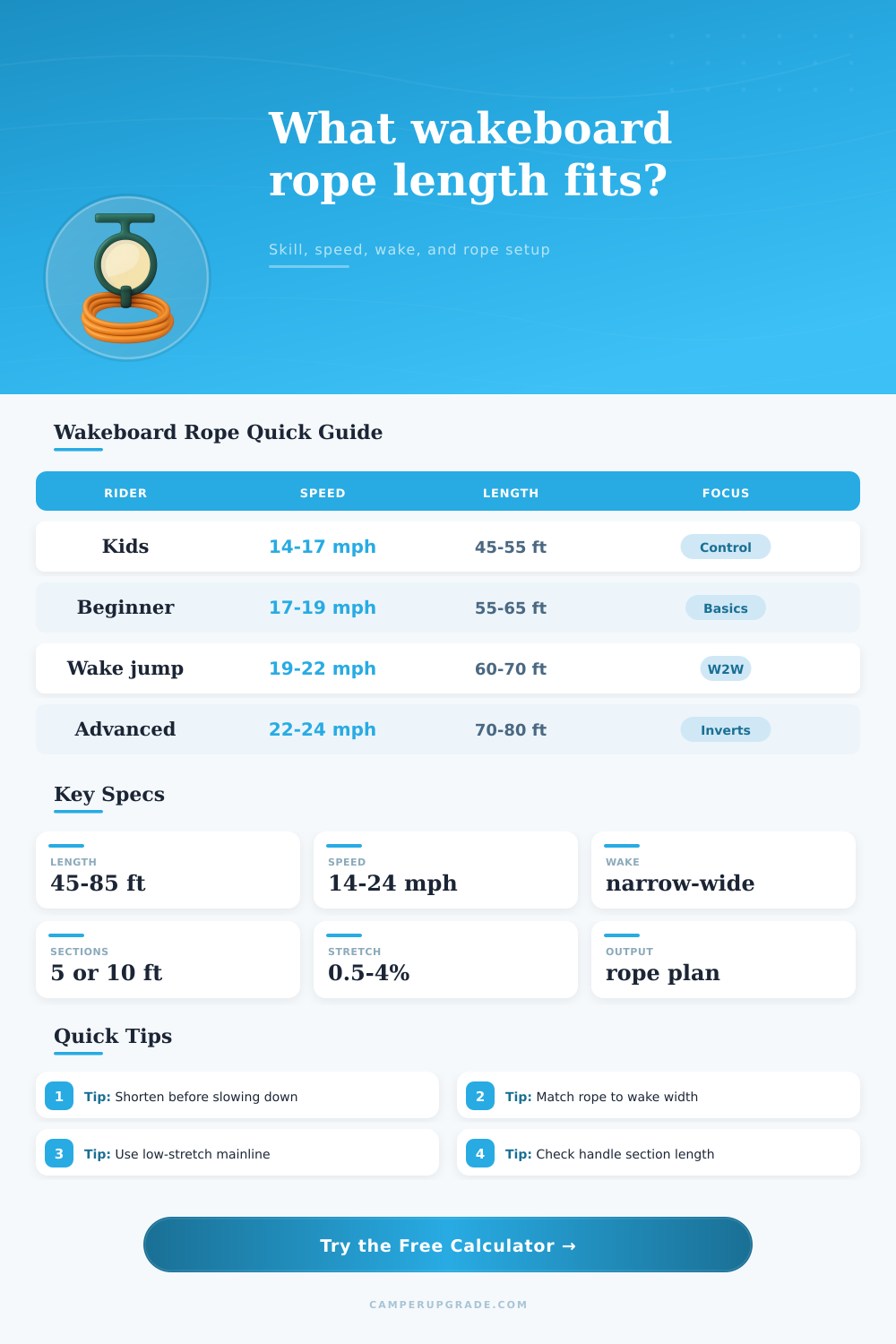
| Rider stage | Typical rope | Boat speed | Why it fits |
|---|---|---|---|
| First timer | 45 to 55 ft | 14 to 17 mph | Shorter line sits in a cleaner, narrower part of the wake. |
| Beginner edging | 55 to 65 ft | 17 to 19.5 mph | Enough room to learn progressive edge without over-speeding. |
| Wake-to-wake | 60 to 70 ft | 19 to 22 mph | Matches many recreational wake widths at normal ballast. |
| Advanced inverts | 70 to 80 ft | 21.5 to 24 mph | Longer line supports more speed, drift, and landing room. |
| Wake width at landing | Starting rope | Metric rope | Common setup |
|---|---|---|---|
| 28 to 34 ft | 50 to 58 ft | 15.2 to 17.7 m | Small wake, low speed, light rider, or no ballast. |
| 35 to 44 ft | 58 to 66 ft | 17.7 to 20.1 m | Beginner to intermediate family boat riding. |
| 45 to 54 ft | 65 to 72 ft | 19.8 to 21.9 m | Wake boat with moderate ballast and clean lip. |
| 55 to 66 ft | 70 to 80 ft | 21.3 to 24.4 m | Wider weighted wake, advanced rider, faster pass. |
| Rope type | Stretch range | Feel | Best use |
|---|---|---|---|
| Spectra or Dyneema | 0.3 to 0.8% | Crisp and direct | Wake jumps, spins, inverts, and consistent edging. |
| Poly-E wake rope | 1.0 to 2.0% | Slight cushion | Beginner to intermediate riders learning timing. |
| Polypropylene | 2.0 to 3.0% | Soft and delayed | Casual riding where precision is less important. |
| Nylon blend ski line | 3.0 to 5.0% | Very elastic | Water ski use; wakeboarding timing is less predictable. |
| Rope section plan | Total length | Handle included | Use case |
|---|---|---|---|
| 40 ft main + 5 ft handle | 45 ft | Yes | New rider, very small wake, or slow practice. |
| 55 ft main + 5 ft handle | 60 ft | Yes | Most beginner wake-to-wake attempts. |
| 65 ft main + 5 ft handle | 70 ft | Yes | Intermediate riding behind a clean wake boat. |
| 75 ft main + 5 ft handle | 80 ft | Yes | Advanced speed, big wake, or longer landing zone. |
💡Calculation Tips
“Okay, now take this rope and put it into your hands on dock. And here’s a rider in the boat that you have to teach not to eat water every 30 seconds. It seems like figuring out what wakeboard rope length you need would be a no brainer. But its really a geometry problem masquerading as a trust fall.
There’s too much line and you’re battling current and missing entire window. There’s not enough and the dude on the back feels pinned up next to boat’s turbulence. Enter the calculator above. Plug in your specific speed and wake width and let the calculator do the number crunching for you. Eliminate the guess work and get down to the real physics of jump instead of arguing about knots.
How to Choose the Right Wakeboard Rope Length
First off, look at who is holding the board. For a first time rider, you generally want to start with a short line, typically between forty-five and fifty-five feet. That puts them in narrow, cleaner portion of wake where the water isn’t quite as chaotic. You build their confidence while avoiding exposing them to harder, wider edges further out. Once they get comfortabley with basic turns and maybe some edging, you’ll lengthen it to about sixty feet so they has enough space to pick up speed and create angle without having to go as fast as required for longer line tricks.
When you choose the rider’s experience level, it take all of this into account and automatically sets your starting range and then adds other variables. Most novices stumble on the first try because they don’t know about wake width. At the landing spot, a small recreational boat casts a narrow wake of only twenty-eight feet. So, how much rope do you need to reach across that?
The answer is… Not any! In reality, increasing your length does nothing except force rider to work a broader arc for zero benefit. On the other hand, introduce ballast or run a specialized wake boat and that wake grow past fifty-five feet wide. Now you’re looking at needing more line to bridge the gap. The table on the page makes this easy to understand as it match common widths with suggested starting lengths. Remember when measuring, its the point where rider comes down onto the water, not where the wake begins near transom. People mess that up.
They think a bigger wake means they need a longer rope, forgetting that shape of the wake also changes with speed. Stretch alters timing. Ropes with zero stretch, such as Spectra or Dyneema, have almost no stretch. So when you pull energy goes straight to board. This precision is very important for inverts and spins, which are measured in millimeters.
Older nylon ropes stretches several percent under load. So although it may look like the right length on paper there is a delay so the rider will get to the wake too late. If you use recreational polypropylene line, you can expect some timing drift. To compensate for this we allow for stretch in the calculator so the recommended length takes into account the give in the material. So that under tension the effective length equals your geometric target.
Reading spec sheets, folks gets confused by handle sections. Do they list just the mainline or do they say total length with the handle? You need to know what standard your rope is set to. Then if necessary, you can enter the length of the handle section and have it spit out a true total for you too. If your mainline is sixty-five feet with a five-foot handle, that’s seventy feet all together…total distance from boat to rider. That additional length add up when you’re trying to hit a certain place on wake.
The other piece in this equation is speed. For example, if you are normally running 19 miles an hour and use a 10-foot rope, you would of been too far off the side to catch it. That’s why longer ropes tend to need faster speeds. The wake gets broader further away from boat. You want to match the arc radius with the speed. So when it gives you a range of speeds, it does so as a throttle position based off how long that rope will be. It’s not simply about the distance, it’s about matching both things together.
Don’t memorize rules; don’t be married to any one set of rules. Be aware of those relationships as you ride. Make an adjustment in one area, then see how the wake reacts. Ride for consistency. When you get that sweet spot of everything lining up and feeling direct, hang on to it until your rider outgrows it. Because that’s what will bring him or her back to water: the balance between challenge and control.