Kiteboarding Kite Size By Wind Calculator
Estimate a practical kite size from average wind, lulls, gusts, rider weight, board style, kite design, current, water state, air density, and your preferred riding power.
🪁Session Presets
⚙Wind And Rider Inputs
Your Kite Size Estimate
📊Calculated Session Checks
📘Reference Tables
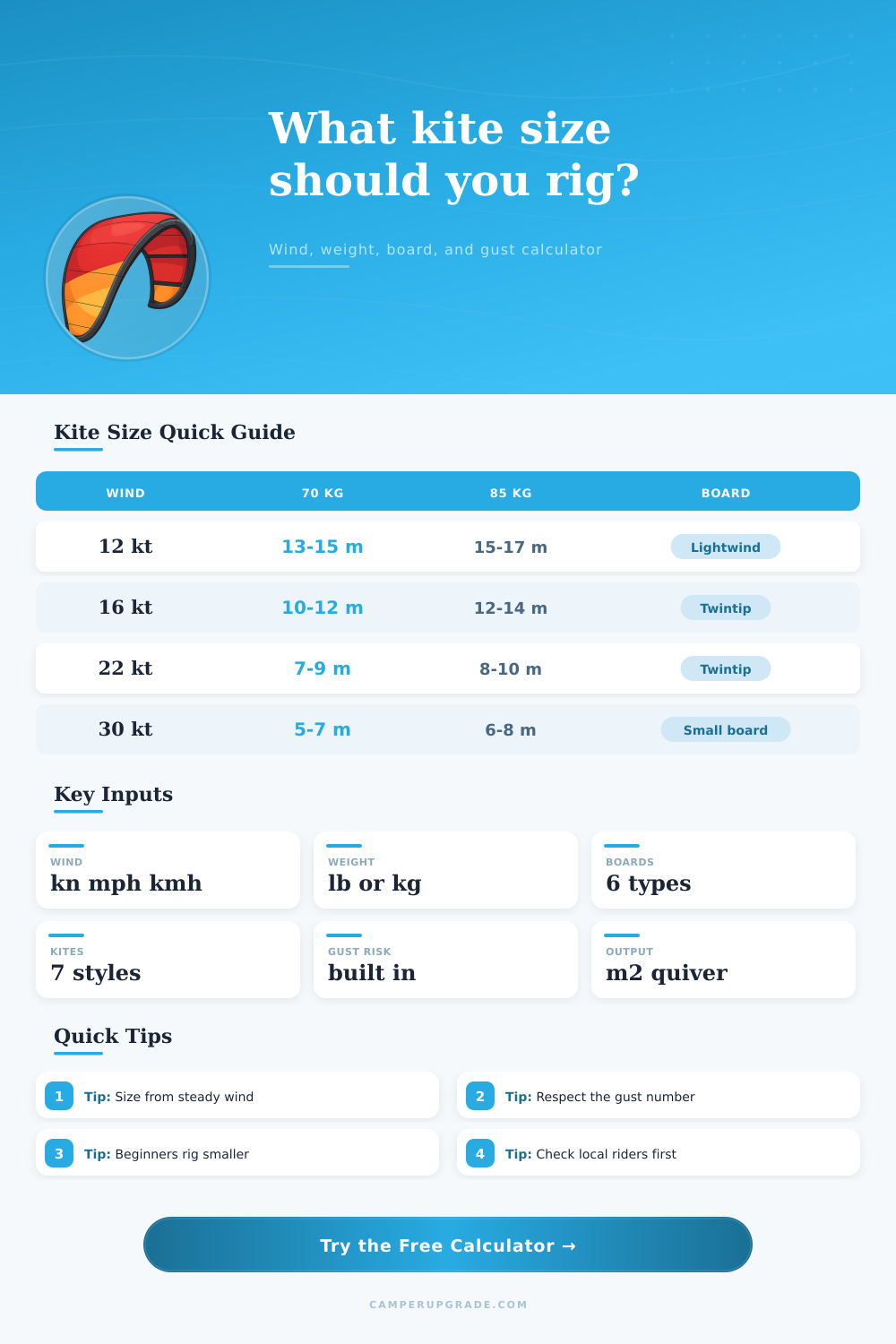
| Average wind | 70 kg rider | 85 kg rider | 100 kg rider | Typical setup |
|---|---|---|---|---|
| 10-12 kt | 13-17 m | 15-19 m | 17-21 m | Lightwind kite, door board, foil, or wait for more wind. |
| 13-16 kt | 10-13 m | 12-15 m | 14-17 m | Freeride twintip with attention to lulls. |
| 17-21 kt | 8-11 m | 9-12 m | 10-14 m | Common all-around riding band for many spots. |
| 22-27 kt | 6-8 m | 7-10 m | 8-11 m | Smaller kite, smaller board, more launch discipline. |
| 28-35 kt | 4-7 m | 5-8 m | 6-9 m | Advanced conditions with gust and rescue checks. |
| Adjustment | Effect on kite size | Why it matters | Practical check |
|---|---|---|---|
| Hydrofoil board | Usually 25-40% smaller | Very efficient board speed and low drag. | Do not size from twintip charts. |
| Large door board | About 10-18% smaller | Earlier planing reduces required pull. | May still be awkward in chop. |
| Gust spread over 35% | Rig smaller or wait | Peak pull rises roughly with wind squared. | Use the gust, not only average wind. |
| Cold dense air | Slightly smaller | More air density increases line load. | Winter fronts can hit harder than charts imply. |
| Beginner lesson | Smaller and supervised | Depower room matters more than upwind angle. | Follow instructor and school limits. |
| Launch factor | Size action | Reason | Decision check |
|---|---|---|---|
| Onshore wind | Rig smaller | Less room for mistakes | Need clear downwind space. |
| Offshore wind | Do not rely on size | Rescue risk dominates | Boat support required. |
| Crowded beach | Derate 5-15% | Launch errors are costly | Wait for open water. |
| Storm clouds | Stop session | Wind can spike fast | Watch radar and sky. |
| New spot | Ask locals | Current and wind bends vary | Start conservative. |
🚩Rigging Tips
You stand on the beach watching those wind flags flapping around, but you don’t know what size kite to open. That’s when you grab the wrong bag of kites. You’re watching local guy flying a big wing, then someone else is barely keeping theirs up with a smaller one. Why? Power isn’t well predicted by wind speed. Moisture content in the air, altitude, and even temperature all affect how it behaves. Twenty-knot cold January air hits harder than the same-speed humid July heat. This is a physics fact most people learn the hard way after getting dragged down the launch zone.
After you plug in your conditions, the calculator do all of the math for you. By knowing your board type and weight, it calculates a starting point for how much power you’ll need. More weight mean more drag and inertia, so you need more surface area. Your board is also important; if you’re flying a hydrofoil you’ll be able to ride comfortabley on a kite that wouldn’t budge a heavy freeride twintip in the same wind. It generate lift while using very little resistance.
How to Choose the Right Kite Size
You’re inputting your rider weight and board type and this will calculate your base power need for kiting. If you input wrong type of board here, you’ll throw your estimation off by several sq meters.
Most sessions go sideways because of gusts. Most folks look at average wind, rig to that and gets surprised by a squall out of nowhere. That’s why the tool ask you what’s your expected peak gust? Then it figures true loading you’ll see during those peaks. If your peak gust is far away from your steady wind, you better derate down on kite size big time. Your peak pull increase with the square of wind speed. If you double your wind speed, you have more than double the load on your body and lines. It is not linear.
Your gut instinct about how much power an extra knot of wind add is almost always wrong. But it’s an equation where your skill comes into play as well. Novice rider benefit from more depower room and a forgiving window to learn to ride upwind safely. To match this, the calculator will recommend smaller sizes for novice riders because their system has some slack if it gets crazy. On the other hand, advanced rider chasing big air or jumps may want to drive the system closer to its limit of control. It’s on you to determine what margin you’d like between having a fun ride versus a scary moment trying not to blow out of the air. There’s no one correct answer, just what your own comfort level is.
Another variable that flies under the radar are air density. Denser air has more mass packed into the same amount of volume. Hot air is less dense than cold air. That added mass directly means increased pull and lift. When flying in cold weather at high altitudes, the thin air again fight you as it lacks the same density. You’ll need slightly bigger kites to make up for its lack. Give tool your elevation and temperature info and it will factor this in automatically. Sounds like minor detail work but could of be the difference between staying planing or sinking into the water each time you hit a lull.
It lays it all out broadly across the page’s reference tables, great for a quick check but assumes average conditions. And real life isn’t very average. Usually you’re working with a specific bank of incoming clouds, a specific tide, and a specific spot. The detailed inputs let you dial down those broad guidelines. Consider the output a starting point for what you’ll rig, not some divine commandment. Watch the water and look at what other riders do. What if everybody’s on ten and the calculator tell you it’s gonna be twelve? Trust them before you trust the algorithm. It’s all about feeling the rhythm and flow of it.
You also need to get the gear correct to set the stage for that ride. Less time on the beach dragging a limp kite or fighting an over powered one mean more time riding. Numbers first. Adjust based off the feel of the day. Keep your launch zone free from any additional drama and let the wind talk to you.