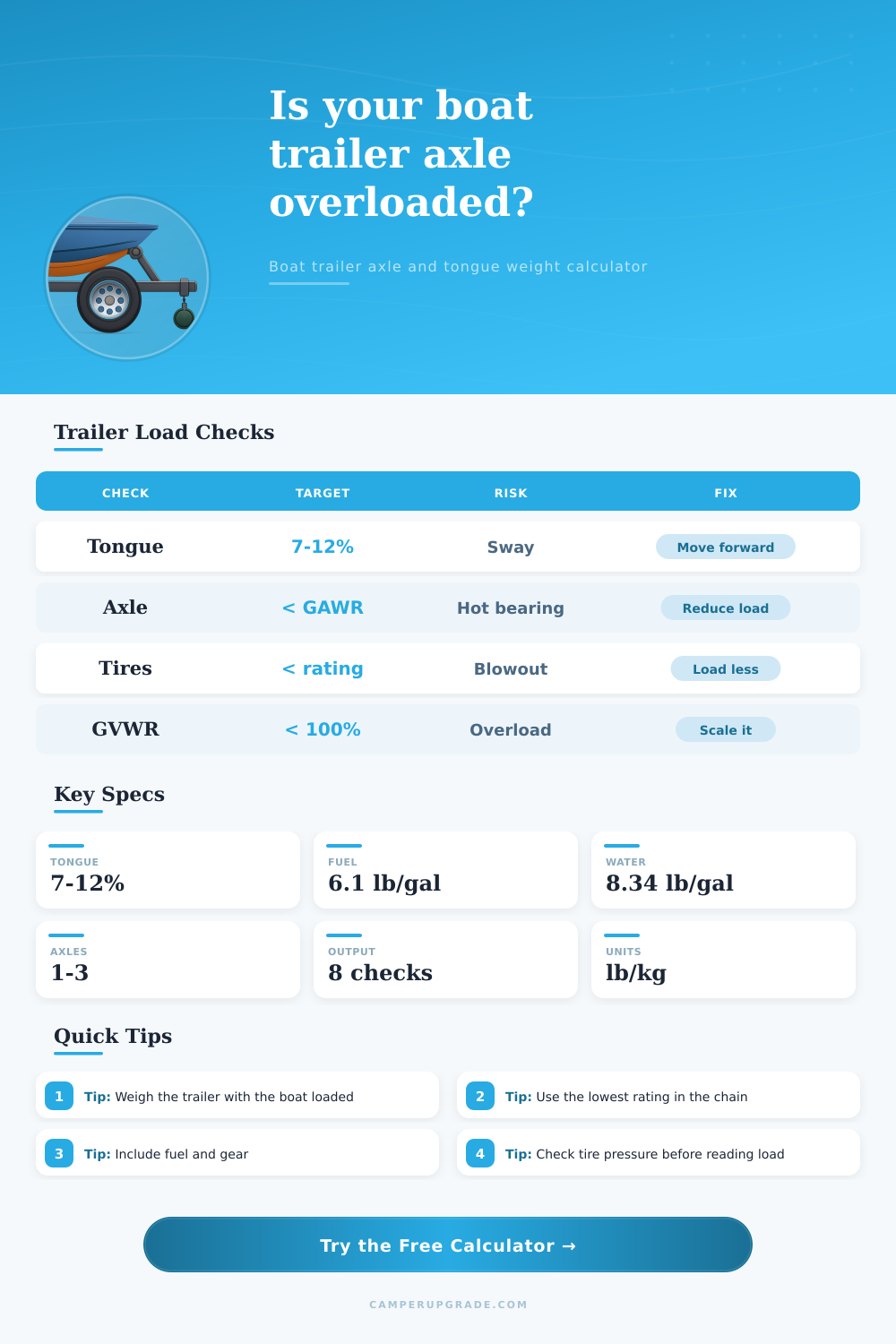
Boat Trailer Axle Weight Calculator
Estimate loaded axle-group weight, tongue weight, per-axle load, per-tire load, GVWR use, and how fuel, batteries, coolers, anchors, and gear placement change trailer balance.
⛵Boat Trailer Presets
Loaded Axle Weight Snapshot
🚚Trailer, Axle, And Rating Inputs
Scale note: This calculator uses static moment math. Confirm final axle, tongue, and gross weights with a public scale, especially after changing bow-stop position, engine, batteries, or trailer axle placement.
⚓Boat And Load Inputs
📊Live Rating Summary
📋Boat Trailer Reference Tables
| Item | Typical value | Why it matters | Calculator input |
|---|---|---|---|
| Gasoline | About 6.1 lb per gallon | Full fuel can add hundreds of pounds and shift tongue percent. | Fuel gallons and fuel station |
| Water/livewell | About 8.34 lb per gallon | Water is dense and should be drained for road towing when practical. | Water gallons and station |
| Lead-acid battery | 40 to 75 lb each | Stern-mounted batteries reduce tongue load on many outboard boats. | Battery weight and station |
| Spare tire on tongue | 35 to 90 lb | Forward trailer accessories increase tongue weight. | Bow gear or trailer empty tongue |
| Tackle and coolers | 50 to 300+ lb | Easy to move, so it is useful for balance correction. | Loose gear and movable cargo |
| Reading | Usually OK | Watch zone | Action |
|---|---|---|---|
| Tongue percentage | Within selected profile | Below range or above range | Move dense cargo or adjust boat position, then reweigh. |
| Axle group load | Under combined GAWR with margin | 90%+ of GAWR | Reduce load, verify axle rating, bearing condition, and tire capacity. |
| Per tire load | Under tire rating at cold pressure | 85%+ on highway trips | Inflate to spec, inspect age, and keep speed within tire rating. |
| Gross trailer weight | Under GVWR | Near GVWR before supplies | Include fuel, gear, ice, tools, and launch ramp extras. |
| Negative tongue estimate | Never acceptable | Very stern-heavy | Move boat forward or move axle group rearward with a qualified trailer shop. |
| Rating point | Where to check | Common limit | Load note |
|---|---|---|---|
| Trailer GVWR | VIN plate | 1,500-14,000 lb | Includes boat, fluids, and gear. |
| Axle GAWR | Axle tag or plate | 1,200-7,000 lb each | Use combined axle rating for tandems. |
| Tire rating | Sidewall | Per tire at PSI | Multiply by tires on the axle group. |
| Coupler rating | Stamped coupler | Class specific | Must exceed tongue and gross load. |
| Receiver rating | Hitch label | With or without WD | Tow vehicle payload can be lower. |
💡Axle Weight Calculation Notes
For most of us, a scale ticket from local public weigh station is a scary piece of paper. Unlike brochures, it reveals hidden cost of our summer lifestyle. And if you’re like most boat owners, you purchased a trailer based off the hull weight provided by manufacturer. While this is good information, it’s only part of the story; it doesn’t account for engine, the gas or the water in the livewell…or those two coolers full of ice for upcoming fishing trip.
More often than not, what we have are an overweight axle group and a tongue weight that feels more like wrestling with a wild animal when traveling down highway. No, that’s not a guess. That’s a calculated load. Moment and leverage comes into play when calculating how much weight is landing on each tire and axle. For example, a 50lb battery in the bow locker creates substantial downward pressure on hitch. The same 50lbs hanging from back of boat removes weight from the tongue. If you’re willing to measure out your configuration, the calculator at top of page will do all of that math for you. It’ll turn those vague measurements into real-world pounds per tire/axle.
How to Balance Your Boat Trailer Weight
Common remedy for an unsteady feel while towing is tongue weight. Usually seven to 12 percent of gross trailer weight are the sweet spot. Less then that and you run a risk of dangerous sway back there. More than that and your steering gets heavy. Your stopping distance becomes longer. Your tow car also sag.
A common misnomer among many boat owners is shifting things forward to improve stability. This may help with traction on tongue, but only if you don’t hit your truck’s payload limit and put too much weight on a receiver that can’t hold it. Another source of confusion are axle ratings. Combined axle ratings means there are no separate limits that you can disregard. Even if you load more weight onto one side than the other, one axle group still share the whole load. This depends on tire pressure and suspension geometry.
The reference table in this tool walks through checking those limits vs. It checks those limits against what you’re towing. And it will remind you tires is typically the weakest link before axles break.
Anytime there’s fuel in boat it adds unexpected mass. At roughly six point one pounds per gallon, gas has some serious weight on any rig. If you’re running a thirty-two-gallon tank, that’s almost two hundred pounds of liquid sloshing back and forth under you when driving. Add water which weighs more than eight pounds per gallon and you have no excuse to leave those livewells full when hitting road. All that added weight is down low and typically at the back, so it pulls down your tongue percentage and really beats up on rear suspension of both tow vehicle and trailer.
You also need to consider batteries in this equation. Each of your lead acid batteries are a solid block of lead weighing anywhere from 40-75 pounds. A bank of trolling motor batteries mounted on the transom will pull weight off the coupler and reduce tongue load. This sounds nice because it makes boat easier to steer, but it could of hurt trailer stability if you slide under that seven percent mark. Counterbalance that heavy engine package by moving coolers or tackle boxes toward front of boat.
After we run through those numbers, it is time to verify them. Tow capacity assumes ideal conditions, perfect weight distribution between tandem axles, no wind gusts or grade on the road. In the real world, tow a bit below what the calculator said you can and have some margin for error. Don’t go anywhere near your GVWR, and don’t even get close to it by adding a spare tire to the hitch just in case.
A large part of towing safely is all about numbers and being prepared. Towing what you don’t know how to tow is no good. Knowing where each pound comes from removes the guesswork at the scale, helping you understand your scale ticket the next time you are there. There is no surprises. It is just confirmation that you loaded your boat right.