Boat Fuel Burn Rate Calculator
Estimate boat fuel burn from a measured trip log or from engine horsepower, load, fuel type, sea state, idle time, reserve policy, tank size, and cruising speed.
⛵Boat Fuel Burn Presets
Your Boat Fuel Burn Snapshot
⚙Fuel, Engine, Trip, And Reserve Inputs
📋Fuel Burn Reference Cards
📘Fuel Burn Planning Tables
| Engine and fuel type | BSFC used | Fuel weight | Best use | Planning note |
|---|---|---|---|---|
| Gasoline four-stroke outboard | 0.50 lb/hp-hr | 6.1 lb/gal | Modern planing boats | Good first estimate near cruise load. |
| Gasoline sterndrive or inboard | 0.47 lb/hp-hr | 6.1 lb/gal | Runabouts and cruisers | Often efficient at steady midrange RPM. |
| Gasoline two-stroke outboard | 0.58 lb/hp-hr | 6.1 lb/gal | Older boats and light skiffs | Needs a larger margin unless measured. |
| Marine diesel | 0.38 lb/hp-hr | 7.1 lb/gal | Trawlers and auxiliary sailboats | Often best at steady displacement speed. |
| Gasoline jet drive | 0.55 lb/hp-hr | 6.1 lb/gal | Jet boats and PWC | Load and pump condition affect burn quickly. |
| Scenario | Typical load | Reserve to use | Tank use target | Fuel log priority |
|---|---|---|---|---|
| Protected lake day trip | 25% to 45% HP | 10% to 20% | 80% to 90% | One refill log can be useful. |
| Coastal center console run | 35% to 55% HP | 20% to 33% | 75% to 85% | Average several runs by sea state. |
| Displacement diesel cruise | 30% to 55% HP | 20% to 33% | 80% to 90% | Hours and RPM logs are very useful. |
| Offshore or remote leg | 40% to 65% HP | 33% to 40% | 70% to 80% | Measured flow meter data is preferred. |
| No-wake or trolling day | 5% to 20% HP | 20% to 33% | 80% to 90% | Use idle burn and hours carefully. |
| Boat class | Common speed | Economy check | What hurts range | What to compare |
|---|---|---|---|---|
| Small skiff or aluminum utility | 18 to 28 kn | 2.5 to 6 NM/gal | Overloaded stern and chop | Trim angle at same RPM. |
| Pontoon or deck boat | 14 to 24 kn | 1.5 to 4 NM/gal | Windage and full crew load | Speed after lifting strakes are loaded. |
| Fast bass or bay boat | 28 to 45 kn | 2 to 5 NM/gal | High RPM and jack plate mismatch | Best economy trim before porpoise. |
| Twin offshore center console | 24 to 36 kn | 0.8 to 1.8 NM/gal | Head sea, ice, fuel, and crew weight | Economy by sea state, not just speed. |
| Trawler or auxiliary sailboat | 5 to 10 kn | 1.5 to 6 NM/gal | Pushing above hull-speed comfort | RPM versus speed over several hours. |
🧭Fuel Planning Tips
It’s a familiar scene: You fill your tank on a Saturday morning, go cruising/fishing for the day, and you’re back home with less gas in the tank then you expected. Just about any boater have experienced this scenario. Usually it’s not an issue with their engine; most of the time it results from some sort of mental math that fail to account for unseen factors like heavy chop (drag), extra pounds of cooler water, or sitting idle waiting for buddies. Horsepower isn’t the sole determiner of fuel burn; it’s a combination of human behavior, weather and physics. So, guesswork = anxiety, measurement = confidence.
Once you input your trip information and engine specifications, however, the calculator do all that complicated stuff for you. You do not need to manage sea state penalties and brake specific fuel consumption coefficients at the same time. That’s just too much. The concept is simple enough.
How to Calculate Your Boat’s Fuel Use
Unlike a car on an open highway, engines don’t consume a given number of gallons every mile, instead they consume fuel by the hour. The real variable, therefore, is how fast you are going. The slower your boat goes due to headwakes, the longer it will be in the water, right? Longer trips mean more hours, More hours mean more gallons consumed, even while running at the same engine load. This is precisely why nautical miles per gallon is such a lousy metric when it comes to planning trips. It varies a lot depending on sea state and trim.
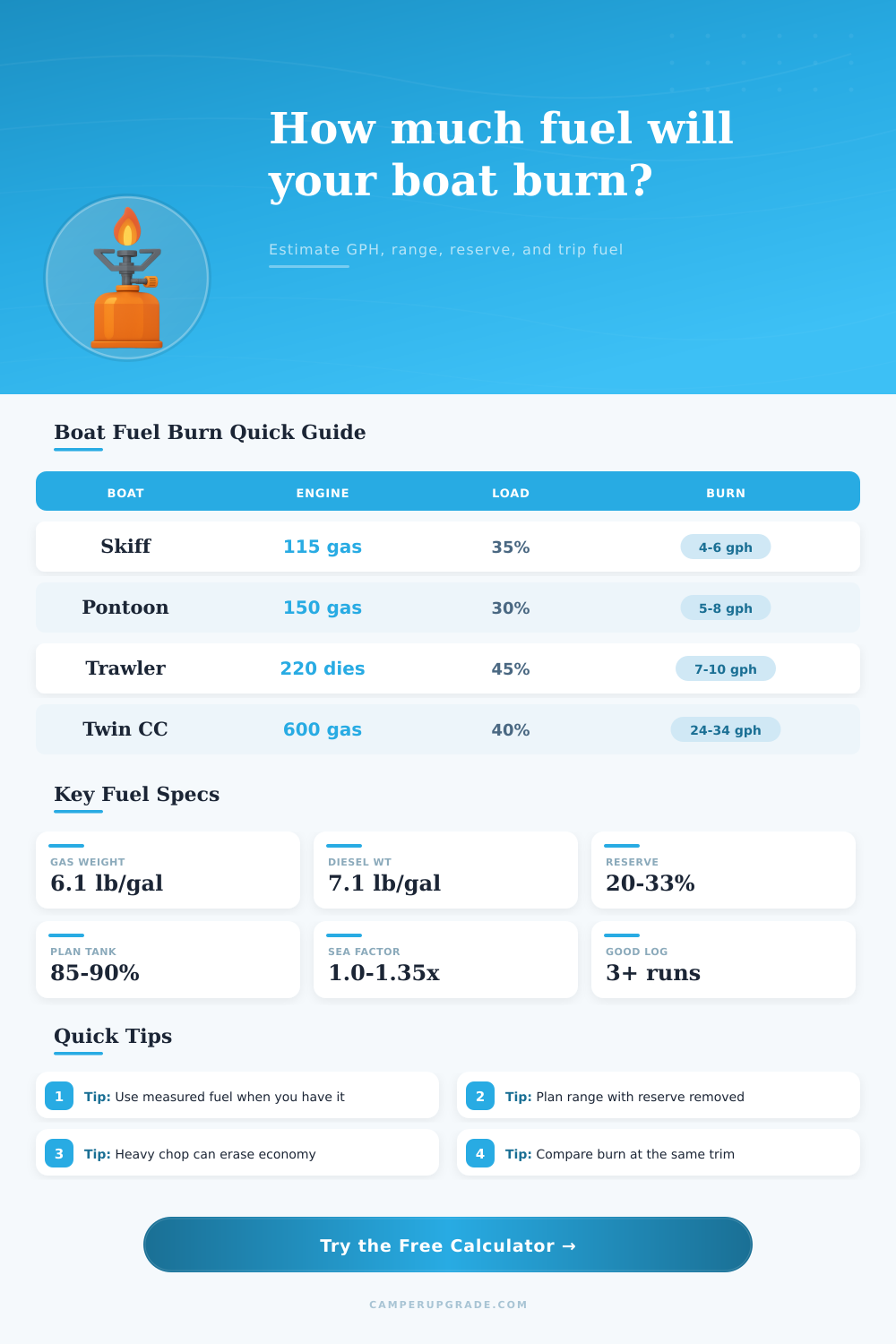
First you must determine your hourly burn rate, and only then can you apply it to length of your trip. For example, take a displacement trawler versus a planing hull. At cruising speed the trawler will burn four gallons an hour cruising at eight knots, whereas the center console burns twenty gallons an hour doing twenty-five knots. On paper the trawler is more efficient, but what happens if you attempt to push her up to twelve knots? That fuel curve kicks right up exponentially. To fix this, the calculator let you enter an average percentage of your boat’s load for cruising. Most folks cruise their boats between thirty and fifty percent of rated power. In other words, they are making time but not screaming engine into the redline. So the higher number you put in the program, the more gallons per hour it bumps up to reflect that stressful run. This helps you decide if you can fit in an additional stop.
Range is hugely affected by sea state. If you’re seeing five nautical miles per gallon on a smooth lake run, you’ll drop 30% or more with a bit of chop on top of head current. That’s why the tool has a sea state factor. When the wind blows up, you don’t want to run out because you ignored it. You are paying for the effort to punch into water that isn’t flat.
Also consider the idle time. Waiting at docks, maneuvering in marinas and trolling all add up. Those low-load hours might not seem like much individually, but they can chew off a surprising chunk of your tank over a full day. Use these inputs to separate idle and accessory burn from cruise fuel so you can see true cost of the whole outing.
Safety and strategy collide in reserve policy. Because sediment and the angle of the fuel pickup prevent you from emptying the tanks, you shouldn’t plan a trip based off using every last drop. Most savvy boaters will maintain a twenty to thirty percent reserve. The calculator deducts that reserve for you as well to determine max range. No more getting fooled into thinking you’ve got forty gallons when really there is only thirty safe to use. In short, data always wins over optimism.
For several trips, keep track of your engine hours and fueling expenses. Then compare what was spent to these estimates. More often than not, when you account for both your impatience at the throttle and the weather, you’ll see how accurate this is and how your boat operate just like it’s expected to. This knowledge makes boating an adventure rather than a guessing game. It helps you waste less time staring at gauge and more time splashing through the wake.