Sailboat Hull Speed Calculator
Estimate theoretical displacement hull speed from loaded waterline length, compare a target speed, and see speed-length ratio, Froude number, and practical cruise bands.
⛵Sailboat Presets
📏Boat Inputs
Hull Speed Results
⚓Coefficient Reference
📊Reference Tables
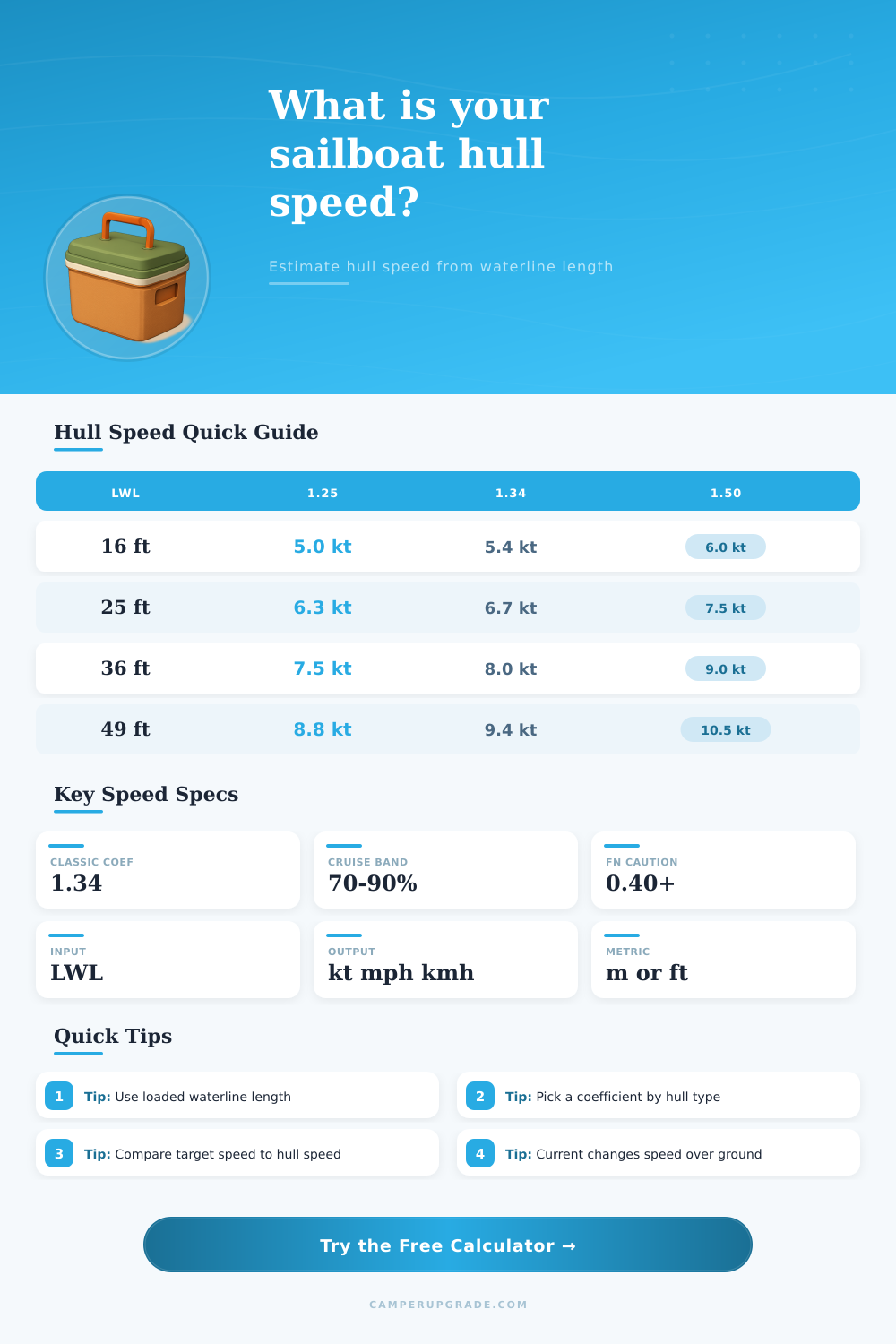
| LWL | 1.25 coef | 1.34 coef | 1.50 coef |
|---|---|---|---|
| 16 ft / 4.9 m | 5.0 kt | 5.4 kt | 6.0 kt |
| 20 ft / 6.1 m | 5.6 kt | 6.0 kt | 6.7 kt |
| 25 ft / 7.6 m | 6.3 kt | 6.7 kt | 7.5 kt |
| 30 ft / 9.1 m | 6.8 kt | 7.3 kt | 8.2 kt |
| 36 ft / 11.0 m | 7.5 kt | 8.0 kt | 9.0 kt |
| 42 ft / 12.8 m | 8.1 kt | 8.7 kt | 9.7 kt |
| Speed-length | Froude | Meaning | Use |
|---|---|---|---|
| 0.90 | 0.27 | Easy pace | Long cruise |
| 1.10 | 0.33 | Firm pace | Day sailing |
| 1.25 | 0.38 | Near limit | Good conditions |
| 1.34 | 0.40 | Classic hull speed | Displacement check |
| 1.50 | 0.45 | High demand | Fine hulls only |
| 1.70+ | 0.51+ | Beyond rule | Surfing or planing |
| Boat Type | LWL / LOA | Coef Range | Planning Note |
|---|---|---|---|
| Classic long overhangs | 70-82% | 1.25-1.34 | Sailing trim can lengthen LWL. |
| Modern cruiser | 86-94% | 1.30-1.40 | Use loaded waterline if known. |
| Cruiser-racer | 88-98% | 1.35-1.50 | Polar data beats the rule. |
| Catboat or beamy hull | 78-92% | 1.20-1.32 | Conservative coefficient fits. |
| Slender multihull | 90-100% | 1.45-1.65 | Different resistance curve. |
| Target | Formula | Example | Result |
|---|---|---|---|
| Hull speed | C x sqrt LWL | 1.34, 25 ft | 6.7 kt |
| LWL needed | (V / C) squared | 7 kt, 1.34 | 27.3 ft |
| Speed-length | V / sqrt LWL | 6.7 kt, 25 ft | 1.34 |
| Froude | V / sqrt(gL) | 6.7 kt, 25 ft | 0.40 |
| SOG | STW + current | 6 kt + 1 kt | 7 kt |
💡Calculation Notes
So you’re disappointed in performance on some coastal passage. The wind’s decent and your sails is up. You’ve got good speed at six knots, yet somehow the boat feels as if it were being pushed against an invisible wall. You’ve no doubt encountered hull speed before, perhaps on a forum post, maybe from the skipper at the dock telling you that displacement boats can’t travel faster then a certain limit. And theoretically, there is such a limit. But in practical terms, it is widely misunderstood.
The first part is easy enough: the calculator will do the math, translating your waterline length into a theoretical ceiling. But it’s how to understand this number that really makes a difference. The basic idea is based off how boats move through water, creating waves as they go. When the length of the hull align with its wavelength, the amount of energy needed to rise up that initial wave skyrockets. Thus the traditional formula includes a coefficient times the square root of the length along the waterline. No hocus-pocus, simply a matter of hydrodynamics.
How to Use Hull Speed Correctly
So how do you find the waterline in question? Most sailors pull out their booklet and take their total length. They input this value, then scratch their heads wondering why they can’t hit projected speed. Why? The formula is interested in the actual waterline, not the one where the cockpit meets the deck. A hull riding high with long overhangs are not moving that part of itself through the water. Loaded waterline length offers a far better calculation different than assuming marketing specs or dry-dock data.
But selecting the proper coefficient makes all the difference. Many classic cruisers has been designed around the standard 1.34 figure. But that’s a blunt instrument. A fine-ended racer slices through 1.34 easily; a heavy, beamy daysailer may never get there without planing. By adjusting this factor according to hull shape, the tool recognizes that all displacement hulls don’t behave identically. A light-displacement slender multihull ignores limits altogether since it doesn’t create a steep enough wave to ever hit them. A heavy trawler boat, however, forms a huge bow wave and tops out far below its theoretical limit.
The best thing about knowing your cruise band is that chasing the top number gets you nowhere. Most long passages are not won by pushing the limit every mile. You just stay in a sweet spot where you’re getting good wind or fuel efficiency and resistance isn’t skyrocketing. The calculator will help you see what 70 to 90 percent of your hull speed looks like. That’s often the most efficient sailing zone in steady conditions. It will also help you to understand current and manage your expectations. Water speed and speed over ground aren’t the same thing. A current might push you faster relative to the ground than your hull speed, but it doesn’t change how your hull moves through the water itself. People get this confused and then make bad plans.
But it’s also psychological: Once you know what your boat can really do, you can make smarter route choices and trim better. You recognize that your realistic cruising speed in chop on your 28-foot cruiser is 6.5 knots, so you no longer fight to get 7 but optimize instead for both safety and comfort. And you accept the limit as part of how it was built, not because it was poorly made. Before even launching, these reference tables gives you a fast way to check various sorts of boats to help you set your expectations.
Hull speed is a good guide but not gospel. Moddern hulls with chines and flatter runs can catch up and ride down waves and momentarily outpace this rule. But as a measure for planning, hull speed is an important reference point. It marks the end of easy momentum and the onset of the hard slog. Take a reasonable coefficient, measure your true waterline and you convert theoretical physics into something tangible: navigation information. Guesswork about why the heck the boat feels sluggish becomes knowledge about exactly what’s going on beneath the surface. When the next invisible wall catches you off guard, don’t look at it as if it’s keeping you in. Look at it like the edge of your design limits, and when you know where that line lies, each knot no longer feels borrowed; it feels earned.
You should of known this sooner to avoid feeling slow. It would of helped much. I am actualy sure most people finds this hard. The furnitures is also a problem for weight. Disapperas are common too. Luxurius boats often struggles. They can absorbs more water. One armchair sits in the way. A sailboat should steers better. Between two adult-sized sofa, it’s tight. It was built wrong then it was sold. I recieve many emails about this. The livig area is small. Everything was based on different than expected.