Pack Mule Load Capacity Calculator
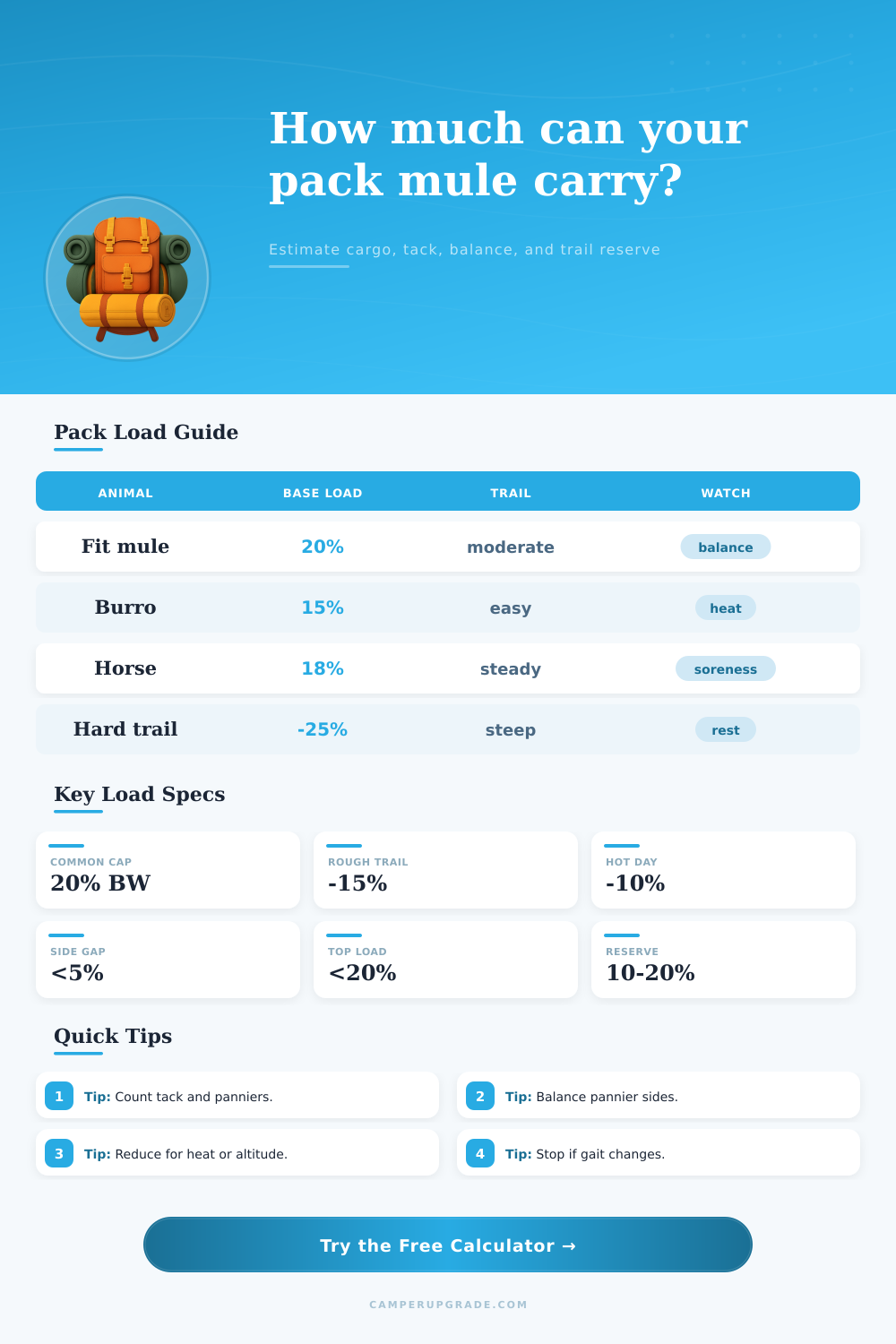
Estimate a trail-ready pack load by counting body weight, tack, panniers, top load, animal condition, weather, terrain, distance, elevation, and balance before you tighten the lash.
🐎Pack Trip Presets
Your Pack Load Snapshot
⚙Animal, Trail, And Load Inputs
📊Load Rules Of Thumb
📋Trail Adjustment Reference
| Factor | Light Deduction | Conservative Deduction | What To Check |
|---|---|---|---|
| Conditioning | 0-10% | 14-28% | Recent miles, hoof condition, back soreness, appetite, and recovery time. |
| Trail footing | 0-10% | 22-34% | Rock, mud, brush, water crossings, sidehill, deadfall, and narrow switchbacks. |
| Weather | 0-8% | 16-24% | Heat index, humidity, dust, storm exposure, cold rain, and wind chill. |
| Altitude | 0-5% | 12-20% | Acclimation, breathing rate, water access, and climbing pace. |
| Distance and climb | 0-8% | 15-25% | Longest loaded day, accumulated gain, rest stops, and return route. |
| Animal type | Start point | Best use | Load caution |
|---|---|---|---|
| Mature pack mule | About 20% | Seasoned mountain packing | Still reduce for heat and footing. |
| Pack horse | About 18% | Moderate trail loads | Watch back soreness and saddle fit. |
| Burro or small donkey | About 15% | Light compact loads | Volume often limits before weight. |
| Large fit mule | Up to 21% | Shorter, well-managed loads | Only with sound feet and conditioning. |
| Green pack animal | About 13% | Training and exposure | Keep sessions short and calm. |
| Pack item | Typical weight | Balance note | Trail check |
|---|---|---|---|
| Pack saddle and pads | 25-45 lb | Counts before cargo | Check dry spots and rubs. |
| Pair of panniers | 8-22 lb | Weigh both empty | Match side weight closely. |
| Water load | 8.3 lb/gal | Dense and shifting | Carry low and balanced. |
| Top load | Light only | Raises center of gravity | Lash tight and compact. |
| Feed or grain | Dense cargo | Good for side trim | Keep dry and sealed. |
⚠Pack Load Notes
This calculator is a planning aid, not a veterinary clearance or a guarantee that a specific animal can carry a specific load. Reduce the load whenever animal condition, saddle fit, footing, temperature, water access, or handler experience is questionable.
Despite all the reading of all those manuals on how to take care of animal as pack animals, you can still overload them on the first morning out and ruin a trip. Yes, it happens more often then folks want to admit, because packing weight seems abstract until you find yourself standing on some steep switchback looking down at your mule’s back while she pins her ears and refuses to go forward.
When she stops there is no need to worry about her being stubborn. She is simply experiencing physics meeting biology and neither care about your itinerary. That moment of physics meeting biology is what is referred to as “refusal.”
How to Pack Your Animal Safely
The weight calculator above takes the body weight of your animal and then removes the invisible tax of rough footing, heat, and altitude. So it spits out a real number instead of an estimate that are hopefully correct. Weight is still important. In fact, most novices fail at this step because they only count visible parts. They count the food and whatever gear they’ll bring with them. But they neglect that empty panniers weigh something. Rigging ropes weighs something. Pads weigh something. Pack saddles weighs something, all before adding a single ounce of food.
Even just carrying a heavy-duty wool pad can add upwards of 20 pounds to your total load and eat up your capacity quicker than you realize. So once you enter these tack weights into the calculator, you’re basically paying the cost of admission for borrowing the beast’s back, after which point we’re finally discussing real cargo capacity. Tiny, but oh so critical if you’re looking to carry three days worth of elk camp vs. It is just a single weekend of lightweight hiking.
Not only does terrain slow you down but it also alters what your animal can actualy physically do before they’re injured. Scrambling up talus field or walking through muddy brush in the high country involves different muscle groups than walking on a flat stretch of desert sand. To account for this, tool will decrease your base capacity if you choose rougher trail terrain. It knows that unstable footing mean you spend more energy maintaining balance instead of moving forward.
If the weather looks nice you may find yourself wanting to discount some of these deductions but gravity doesn’t care how optimistic you feel, nor is it ever impatient. Going light for tough terrain isn’t an indication of being cautious, it’s an acknowledgement of exactly how much work those legs are doing under the saddle.
Another silent killer of good trips is imbalance. A full pack shifts on each step as gravity pulls it down one side or the other. If you have thirty pounds of light tent poles in your right pannier and fifty pounds of dense water in your left, the saddle will roll toward heavy side with each step. Constant shifting causes rubs and sores at friction points and sooner or later you’ll be walking around with a sore back that won’t do any more work for you.
The balance check in the calculator show this difference because it reminds you that symmetry matters more than maxing out the total weight. Less means better if it’s spread out evenly, and your animal will reward you with a steady gait instead of a limping protest by mile two.
Every single thing you put on your pack adds invisible weight, too. Weather and altitude are factors. Heat-induced dehydration makes muscles work less efficienty. This saps your energy and makes it harder to carry a load long before you reach the point where you can no longer carry it. If you’re higher in elevation, the thin air makes your mule has to work even harder to breathe just to sustain life (not to mention pull 100 lbs uphill).
By factoring in weather conditions, this tool also includes multipliers that reduces your safe load limit accordingly. Better to go without one or two bags in your pack at the trailhead than to limp into camp, too tired to raise your shelter after a day spent walking with a broken-down animal.
It really comes down to more than just the weight; it’s all about managing expectations. What do I really need vs what would of been nice to have? The smaller the pack the quicker it goes, the safer it travels and the happier your stock will be in the long run.
If you plan well using these criteria, you turn what could be a disastrous trip into a smooth one where animals are eager to get moving again next week. That is the biggest sign that you planned well from the start.