Horse Trailer Tongue Weight Calculator
Estimate loaded tongue or pin weight from measured empty tongue weight, axle distance, horse positions, tack, water, hay, and cargo placement before towing.
🐎Trailer Load Presets
Loaded Tongue Weight Snapshot
🚚Trailer And Hitch Inputs
Scale note: this calculator estimates tongue weight by moments. Confirm the final setup with a tongue-weight scale or CAT scale, especially after changing horses, water, hay, or tack placement.
📍Horse And Cargo Stations
📊Current Load Specs
📐Tongue Weight Reference Tables
| Trailer / Hitch Setup | Common Target | Too Little Tongue Weight | Too Much Tongue Weight |
|---|---|---|---|
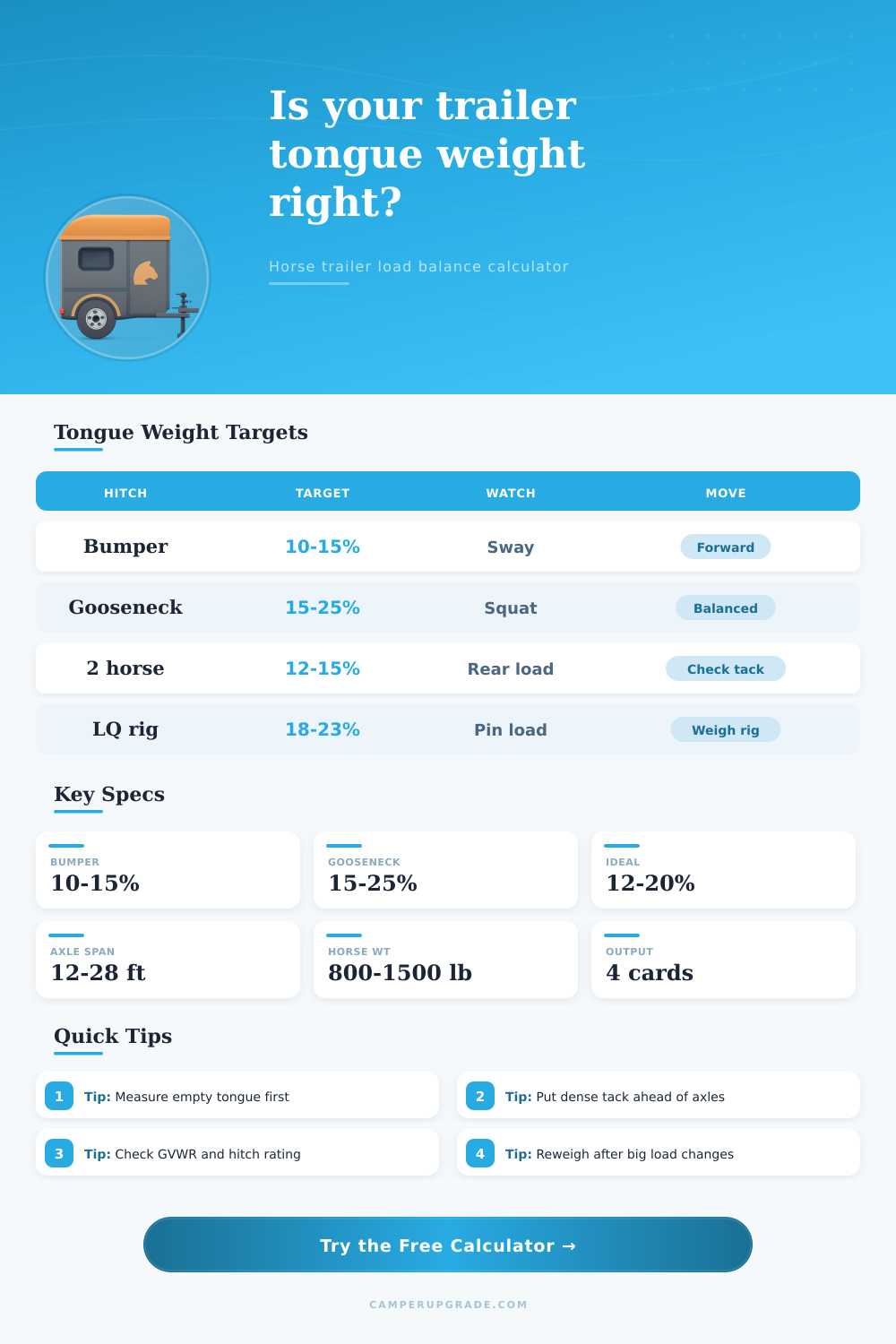
| Bumper-pull horse trailer | 10% to 15% of loaded trailer | Sway, light coupler load, rear-heavy load | Receiver overload, rear truck squat, poor steering feel |
| Weight-distribution bumper pull | 10% to 15%, then set bars by scale | Bars cannot fix a rear-heavy trailer | May overload bars, hitch head, or front axle if mis-set |
| Gooseneck horse trailer | 15% to 25% pin load | Light pin feel, chucking, rear cargo dominance | Truck payload, rear axle, and tire limits become critical |
| Living-quarters gooseneck | 18% to 23% is common | Rear stalls and ramp cargo can pull pin load down | Water, batteries, and LQ storage can push pin load up |
| Load Position | Effect If Ahead Of Axles | Effect If Behind Axles | Calculator Station Tip |
|---|---|---|---|
| Front tack room | Raises tongue weight strongly | Usually not behind axles | Use center of dense saddle and tack storage |
| Horse stalls | Front stall raises tongue weight more | Rear stall can reduce tongue weight | Use the middle of the horse body in the stall |
| Water tanks and jugs | Large tongue-weight change per gallon | Can quickly create rear-heavy trim | Enter the full filled weight, not just water container count |
| Rear ramp or hay rack cargo | Only if still ahead of axle center | Reduces tongue weight and can add sway risk | Measure from coupler to cargo center |
| Approximate Load | Typical Weight | High-Leverage Location | Balance Note |
|---|---|---|---|
| Large horse | 1,100 to 1,400 lb | Any stall near or behind axles | Horse placement dominates most bumper-pull changes |
| Western saddle plus tack | 45 to 85 lb each | Front tack or rear tack compartment | Several saddles together act like one dense cargo block |
| Water | 8.34 lb per gallon | Front dressing room or rear storage | Full tanks can change hitch weight by hundreds of pounds |
| Hay bales and feed | 40 to 80 lb each | Hay rack, manger, or rear compartment | Count stacked bales as one station at their center |
| Living quarters cargo | 300 to 1,500 lb | Cabin storage, batteries, propane, water | Gooseneck pin load often rises fast with forward storage |
💡Load Balance Tips
Few of these cases begin with a failed brake or blown tire. Most begin as a slow sway on your way from driveway to highway entrance ramp. Suddenly you realize you’re no longer in control of steering. At speed, the truck feel like it’s coming off the road, slowly drifting to the shoulder as if there is nothing holding it back. And now you’re keyed up.
It’s not because of how you drive. No, you’ve loaded trailer incorrectly. That’s what folks tend to miss; tongue weight isn’t some arbitrary figure for the rule book. It is the physical connection to your rig and to your horses. After measuring your cargo stations and knowing your trailer’s empty weight, simply enter those numbers into the calculator above and let it do the math for you (no more guesswork around moment arms and leverage).
Why Tongue Weight Matters for Safe Towing
But what is even more important is understanding what these measurements realy mean. Picture your trailer like a huge see-saw with the axle group acting as the fulcrum. Whatever lies ahead of axles attempts to push down on the hitch; anything behind the axles pushes up on the hitch. Typically, we want roughly ten to fifteen percent of the entire trailer weight on that coupler if we’re towing a bumper-pull trailer.
However, gooseneck trailers is different; they typically need much more, sometimes closer to fifteen to twenty-five percent of their total weight on the coupler, since the pivot point is located deeper into truck bed. If your ratio is wrong, your tow vehicle will either lose traction on back wheels while driving or struggle constantly against gravity.
There are a couple of tips to understanding this. First, the total weight of your horses is just one factor. That thousand-pound beast sitting in your front stall doesn’t exert same leverage as if he were parked on the back end. To make up for those distances from the coupler, the calculator considers each location individually, showing where your center of gravity change with each placement.
So you think tacking up in the front dressing room won’t hurt because there’s not much more than your horses? Think again. When we’re talking about dense things like water tanks and saddles, they weigh far more then have a huge effect when sitting right next to the hitch. A full five gallon bucket of water weighs about 41.6 pounds. A full 50 gallon bucket? That’s more than 400 pounds of forward moment… Enough to tip your tongue past capacity of both truck frame and receiver.
On the flip side, stocking up on feed bags or hay bales next to the back ramp door shifts weight toward the back and off the hitch. This will reduce the tongue weight to unsafe levels. If the coupler gets so light that there’s no resistance from the trailer when you step on the brakes or ride through a gust of wind, it will snap back and forth in the lane like a rudder has no rudder. It is a small detail, yet it is very important to stability.
That’s where the table on the page makes it obvious; different hitches handles these unbalanced loads differently. With a bumper pull, not enough weight and you’ll get sway. Too much weight and your rear end squats way too low, raising the front wheels, putting more strain on the back suspension, and robbing you of steering control.
It’s not uncommon for many riders to estimate instead of measure when making those numbers. “Oh my trailer weighs two-thousand pounds. My three horses weigh two-thousand pounds so that adds up to six.” And they’re off into the sunset on their mental math. The problem is they’ve neglected to factor in how much their empty trailer weights. That’s typically a bunch of stuff: tires, wheels, brakes and aluminum siding.
The empty weight of your trailer should be measured and used as a starting point from which everything else can be figured out. If you don’t know where you started, every tweak of load distribution becomes a guessing game. The equation gets more complex with living quarters. Batteries, propane tanks and storage cabinets are frequently positioned way up front in the living quarters’ cab area. This makes life comfortable for people, but it will add a lot to the tongue weight (bumper pull) or pin weight (gooseneck) if not handled properly.
The tool can take into account all those other things you carry around. It quickly demonstrates just how easy it is to overload the rig with good intentions while packing. Don’t freak out if the output indicates the scales aren’t balanced. It’s probably just stuff you can move a few feet forward or backward to adjust the trim.
To tow safely you have to follow both absolute ratings and percentages of the components used. Your trailer could be smack dab in the sweet spot between 12-15% but still top out on gross vehicle weight rating on its side panel. Capacity is for structural integrity; percentage is for stability. Check all loaded numbers against truck payload capacities, receiver tube capacities and hitch ball capacities. Just because your weight is within the right percentage doesn’t mean you aren’t exceeding your equipment’s capacity. Balancing is more than keeping the trailer level, it’s respecting the physics that keeps everything stuck to the earth.