Deer Field Dressing Weight Calculator
Estimate live weight, field dressed weight, hanging carcass weight, boneless venison, trim loss, and cooler space from an actual scale weight or from chest girth and body length.
🦌Deer Weight Presets
Your Deer Weight And Yield Snapshot
📝Deer, Scale, And Measurement Inputs
📊Yield Planning Cards
📋Typical Deer Dressing Percent Table
| Deer Type | Typical Live Weight | Field Dressed Percent | Boneless Meat Planning Range |
|---|---|---|---|
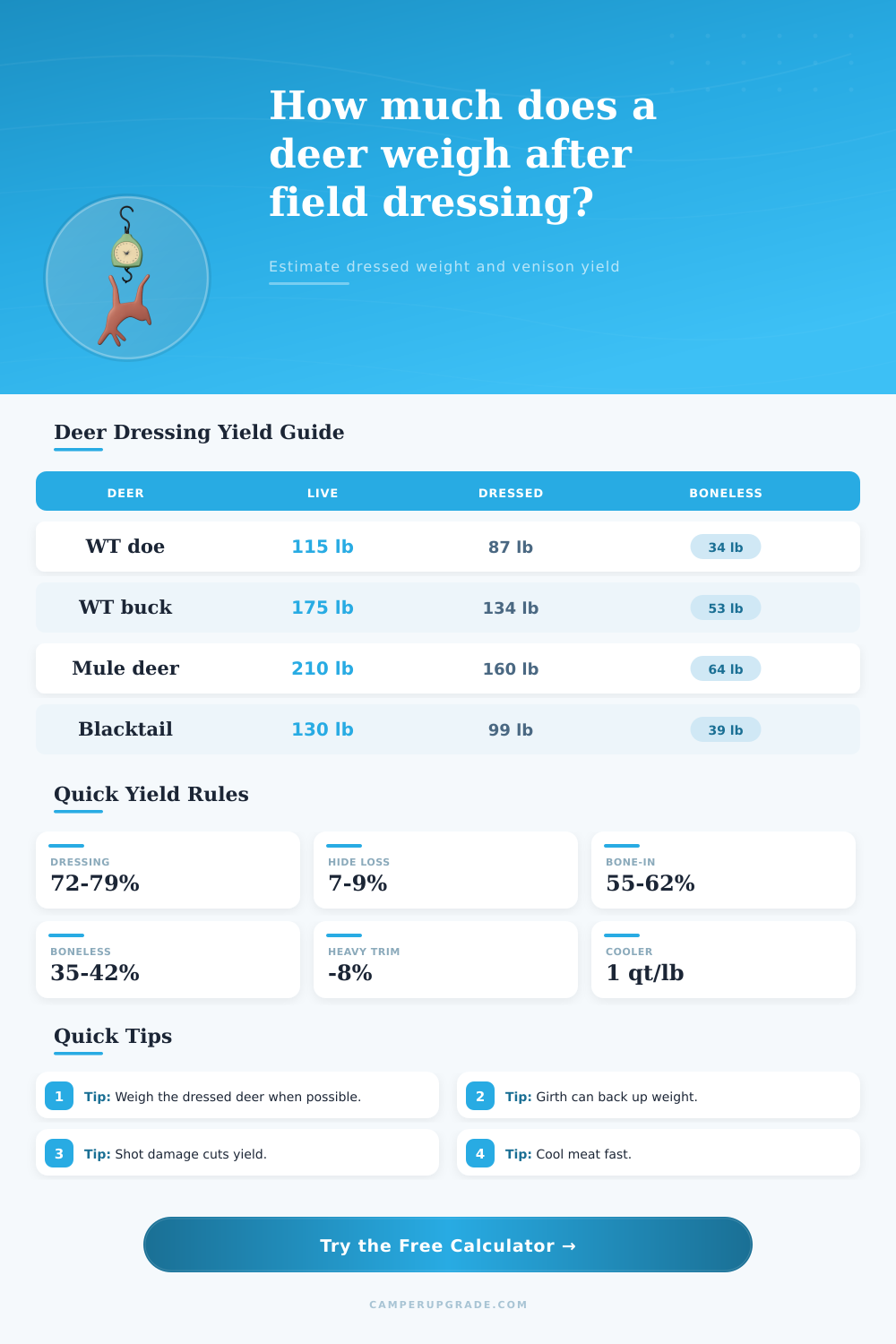
| Small southern whitetail doe | 70 to 105 lb | 71% to 76% | 22 to 34 lb depending on trim |
| Average whitetail doe or young buck | 100 to 145 lb | 73% to 78% | 32 to 48 lb packaged boneless |
| Mature whitetail buck | 150 to 220 lb | 74% to 79% | 48 to 76 lb packaged boneless |
| Mule deer buck | 170 to 260 lb | 73% to 78% | 55 to 90 lb packaged boneless |
| Blacktail deer | 90 to 150 lb | 72% to 77% | 28 to 50 lb packaged boneless |
🔪Processing Yield Reference
| Processing Stage | Approximate Share | What Is Removed | Planning Note |
|---|---|---|---|
| Field dressed carcass | 72% to 79% of live | Stomach, intestines, lungs, heart, liver, and blood loss | Most useful weight for comparing deer at check station or camp. |
| Skinned hanging carcass | 62% to 70% of dressed | Hide, head, feet, lower legs, and some surface fat | Good estimate for gambrel load and meat pole strength. |
| Bone-in quarters | 55% to 62% of dressed | Hide, head, feet, spine trim, and some scrap | Useful for coolers and pack frames when bone stays in. |
| Boneless venison | 35% to 42% of dressed | Bone, hide, silver skin, dried surface, and damaged tissue | Best planning number for freezer bags and meals. |
❄Cooling And Pack-Out Guide
| Situation | Target | Calculator Input To Watch | Field Note |
|---|---|---|---|
| Warm weather recovery | Open body cavity and cool quickly | Aging days near zero | Use shade, airflow, and ice. Do not trap heat in plastic. |
| Quartered pack-out | Know quarter and boneless stage | Butcher stage | Bone-in quarters carry heavier but stay organized. |
| Processor drop-off | Estimate packaged return | Shot damage and processing style | Ask whether trim, fat, and bone are weighed separately. |
| Cooler planning | Enough space for ice and air | Cooler reserve | One quart per pound of boneless meat is a practical minimum. |
💡Field Dressing Weight Notes
You’ve got a rifle in one hand and a field dressing knife in the other and you’re standing in mud staring at a downed deer. Just as the adrenaline begins to subside, another worry creeps in: “Will this thing really make it in my freezer or will I simply have something impressive hanging in a tree somewhere?” And then, arithmetic kicks in and hope give way to reality. Before you cut open single animal, you had better have an idea of what you’ll be carrying back home.
Enter the meat weight calculator. Just plug in measurements, and the calculator do all the conversions and coefficient calculations for you. This saves you time so you can focus on planning how to get it out of woods. This is the bottom line.
How Much Meat Will You Get?
This is live weight. When we’re looking through trophy photos or scanning social media, it’s all about the live weight. And it makes sense: that’s the number you want to see. But when you actualy want to consume some venison, live weight isn’t really telling you anything. You could harvest a beefy buck in middle of autumn with belly full of gut fill. He might also have a layer of winter fat thicker then an Otis Redding baritone bellow, but all of that weight evaporates as soon as you cut it open.
A twenty-five percent loss? Twenty five percent or more of a deer’s bodyweight can vanish once it’s field dressed; but it wasn’t going to end up on your grocery store shelf so don’t sweat it. Knowing how much your deer will lose in this process is crucial for managing expectations around the camp table.
The first cut; the one that leaves guts behind, begins shrinking the yield; however, things really start to get small when you take off head, lower legs and hide. And guess what? The amount of actual meat left after all that depends largely on animal’s body condition. The amount of actual meat left after all this is removed depend largely on how many of these steps you has to do.
That’s where the chart on the page comes into play. It shows average yields for various deer species. Keep in mind that real world scenarios often vary from those averages. If you shoot a fat buck in early October vs a skinny doe in January, the amount of edible meat per pound of total body weight will be drastically different. Why? Because their body condition will be very different. More of their total body weight will consist of non-consumable tissue vs. Convertible protein.
Most folks won’t admit it, but shot placement matter far more to your end result than what they’ll realize when they’re looking at their ruined shoulder. You could get a nice clean hole straight through the lung and lose very little meat. Or, you could miss a bit left or right and go through liver and heart. That would totally mess up backstrap with bloodshot damage that’ll need to be heavily trimmed.
That’s where the tool comes into play, since it lets you set the damage level so that it lowers the boneless estimate to match. Accuracy saves lives (sometimes) and it saves you pounds of steak (in other cases). You cannot cut out blood spread without taking a lot of good meat with it.
Despite their experience, many hunters continue to skimp on cooling capacity here. When you pack boneless venison, remember this: It will fill more than you expect. You must also account for ice and air circulation. Here’s a general guideline: Plan on at least a quart of cooler space per pound of finished meat. That holds true if your packing is perfect. Since most of us won’t achieve perfection (we all have those odd-shaped quarters and those bulging bags of trim), add some extra reserve capacity.
Air circulation matters; if you fill your cooler to the max without leaving breathing room, you’ll trap heat against meat, leading to faster spoilage and a bad ending to good intentions. So the final take away here is prepare, don’t hope. If you have an idea of weight, you can plan the cooler properly. You can also get transportation lined up, make meal plans, and avoid being surprised by deficits along the way.
Dressed carcass weight at the check station or girth measurements in field will lead you to more realistic expectations. This will lead to less frustration later on. Skill takes it down and planning keeps meat. The true work starts right there, in the transformation from hunter to processor.