Game Meat Yield By Weight Calculator
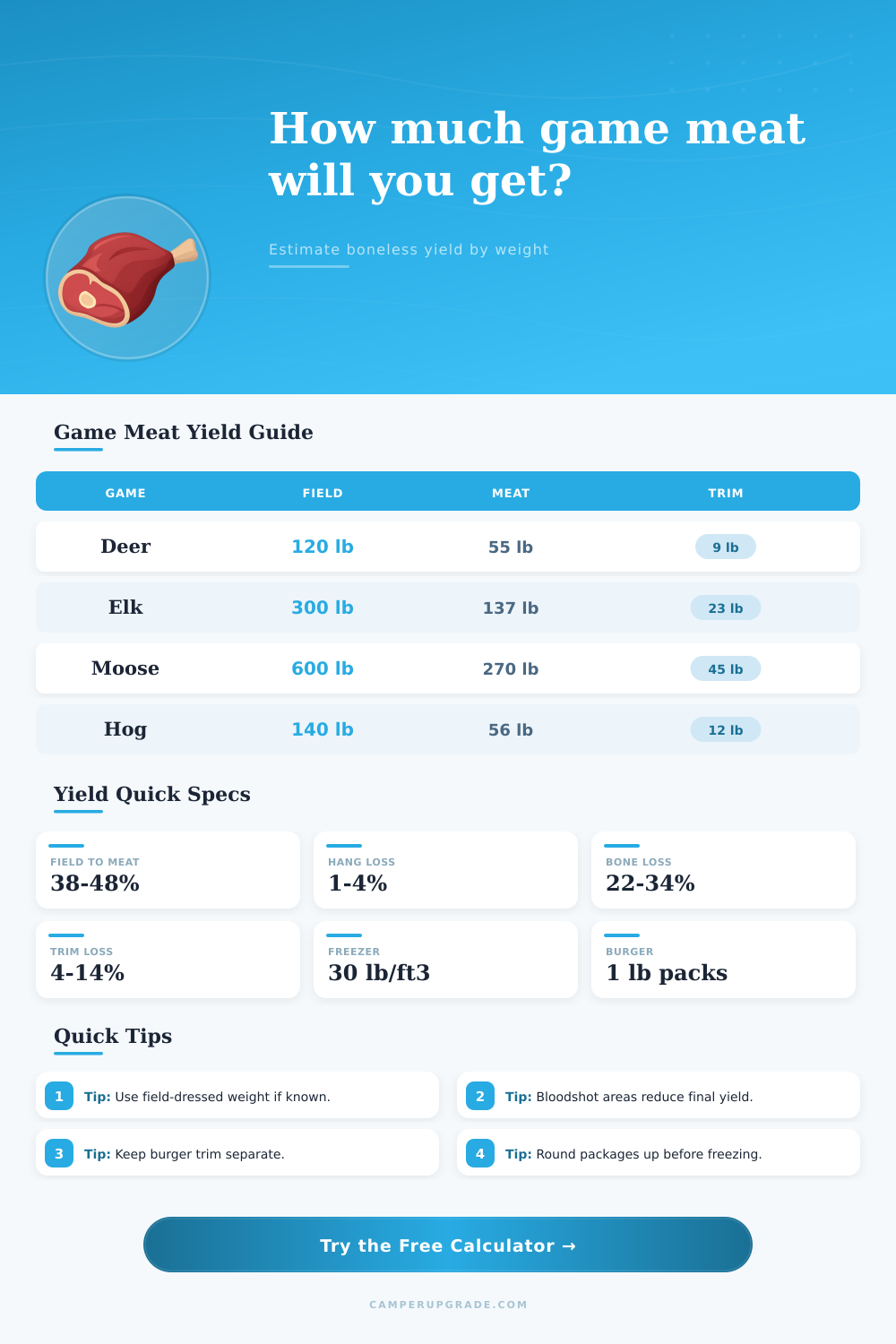
Estimate boneless meat, steaks, roasts, grind trim, package count, and freezer space from live, field-dressed, hanging, quartered, or boneless starting weight.
🦌Game Yield Presets
Your Game Meat Yield Estimate
⚙Animal Weight And Butchering Inputs
📊Yield Snapshot
📋Game Meat Reference Tables
| Game Animal | Field-Dressed To Meat | Hanging To Meat | Processing Note |
|---|---|---|---|
| Whitetail deer | 40% to 47% | 55% to 62% | Shoulder damage and small frame size move the result quickly. |
| Mule deer | 39% to 46% | 54% to 61% | Boneless yield tracks field weight better than antler size. |
| Elk | 42% to 49% | 57% to 64% | Large quarters hold yield well if cooled before trimming. |
| Moose | 40% to 47% | 55% to 62% | Heavy bone and thick connective tissue lower wrapped percent. |
| Pronghorn | 38% to 45% | 52% to 59% | Small carcasses lose a higher share to trimming and drying. |
| Wild hog | 35% to 44% | 50% to 58% | Hide, fat, shield, and boar taint trimming can be substantial. |
| Black bear | 34% to 43% | 49% to 57% | Fat level and clean cooling create wide yield variation. |
| Wild turkey | 28% to 36% | 45% to 55% | Breast and leg yield depends on whether skin and wings are kept. |
| Starting Basis | What It Includes | Best Use | Calculator Conversion |
|---|---|---|---|
| Live weight | Whole animal before field dressing | Pre-hunt or trail-camera estimate | Converted through dressing percentage first. |
| Field-dressed | Gutted animal with hide, head, lower legs often still on | Most common check-in or hanging scale number | Used as the main yield anchor. |
| Hanging carcass | Skinned carcass with bone before cutting | Processor ticket or meat pole scale | Adjusted back to field equivalent and deboned. |
| Bone-in quarters | Quarters, backstraps, neck, ribs, and trim in coolers | Backcountry pack-out batches | Uses quarter-to-boneless percentages. |
| Boneless before trim | Meat already off bone but not cleaned | Final home trimming session | Applies drying, damage, fat, and silver skin loss. |
| Cut Style | Steak Share | Roast Share | Grind Or Stew Share |
|---|---|---|---|
| Steak-heavy | 34% to 42% | 18% to 24% | 34% to 42% for grind and trim. |
| Balanced freezer | 25% to 32% | 22% to 30% | 40% to 50% for burger, stew, and sausage. |
| Roast-heavy | 18% to 25% | 35% to 45% | 32% to 42% for grind and stew. |
| Grind-heavy | 10% to 18% | 10% to 18% | 65% to 80% for burger, sausage, and chili meat. |
| Stew and jerky focus | 12% to 20% | 12% to 22% | 58% to 72% for stew, jerky strips, and grind. |
| Freezer Planning Item | Rule Of Thumb | Example | Why It Matters |
|---|---|---|---|
| Vacuum-sealed meat density | 28 to 35 lb per ft³ | 55 lb needs about 1.7 to 2.0 ft³ | Flat packs stack tighter than butcher-paper parcels. |
| Ground meat packages | Use 1 lb or 1.5 lb bricks | 24 lb grind makes 24 one-pound packs | Uniform bricks freeze faster and stack cleanly. |
| Roasts | Use 2 to 4 lb family packs | 18 lb roasts makes 5 to 9 packs | Larger packs reduce freezer burn but need meal planning. |
| Steaks | Use meal-size packs | 16 lb steaks at 1.5 lb makes 11 packs | Package by meal instead of by muscle only. |
| Freezer margin | Add 10% to 20% space | 2.0 ft³ estimate plans as 2.2 to 2.4 ft³ | Odd shapes and baskets waste some usable volume. |
💡Yield Calculation Notes
When you drag that critter out on a meat pole, you discover there’s a big difference between expectation and reality. What came to mind? Were you thinking of racks of steak? Were you thinking of roast beef for Sunday dinner? But the scale tells a different story about what actualy makes it into your freezer.
Most hunters underestimate what they’ll have based on the difference between field dressed weight and boneless yield. Knowing that helps you avoid over-buying in terms of vacuum bag or underestimating chest space. You must know what kind of starting weight to use to calculate. For trophy measuring purposes, live-weight (e.g., including stomach contents, blood, etc.) might be most appropriate, but it’s not accurate for estimating meat yield.
How to Guess How Much Meat You Will Get
Field-dressed weight… The weight without internal organs but with the hide, head, and lower legs still attached. Is typically what you weigh on your own scale or what the check-in station provides. It is generally your first good guess at the weight. From there, the calculator do the math for you, avoiding the need to guesstimate how much something weighs in terms of its waste products.
The second factor to think about would be condition. When an animal gets a clean hit and cools rapidly, your yield holds up well. On the other hand, if he’s been banged around in rough recovery conditions, his condition will deteriorate fast. Bullet damage and excessive hair contamination can occur if you wait too long before field dressing him. It will also eat at your margin and require you to trim off damaged fibers. Trimmed weight doesn’t show up on the hanging scale, it’s pure loss. To account for this, the tool allows you to choose a condition rating so the resulting numbers are adjusted downward to reflect real world (instead of textbook-perfect).
One thing most hunters don’t consider is bone structure. Because their bones is denser in relation to muscle mass, whitetail deer have a higher yield than other animals. For example, elk and moose are so thick-set and have such heavy skeletons that you get less meat for every pound of starting weight. Check out the page’s reference table for how different animals’ bones affect the end result. If you’re basing your cut sheet off the idea of cutting up a deer, do not compare it to a moose quarter, it makes a big difference.
Finally, there’s a personal meat-cutting preference. Are you someone who loves sausage and burgers? You’re basically opting for greater trim loss for the sake of having versatile options. Steak-heavy plans will leave more bone-in weight or require careful boning, which leaves meat stuck to the rib cage. A grind-heavy plan sacrifices prime steaks for quantity. Your choice here dictates the final package count and meal projections. It also changes how your freezer gets filled.
Freezer space is a budget constraint. Butcher-paper parcels pack loosely (with air). Vacuum-sealing meat into those fancy packs tucks it all tightly together, but even with mixed packaging like butcher paper, a good rule of thumb is about 30 pounds per cubic foot. You can cram a little tighter if you want everything in one large bag, but then you’ll have trouble getting things out. Having some extra margin means you avoid that mid-winter crisis where the freezer is so full and you haven’t gotten around to processing quarters yet. Properly spaced, it’s easier to get at stuff later.
It gets trickier still with aging. Aging meat gives it an improved flavor and breaks down the tougher fibrous bits. It also dries it out on the surface. Before you wrap it up you have to trim that dried outer part. With a two week dry age, you’ll lose much more than just a couple pounds of water from evaporation because moisture drains out of meat over time. A three day hang will only lose a few pounds. In this case you’re trading quantity for quality. This is where the calculator factors in the drying loss so that your final meal count is how much you should of expect to get in your belly after trimming instead of how great it looked on the end of the hook.
Other factors like wild hogs and bears also play into the equation. Because of their layers of hide and thick fat caps, hogs adds significant non-meat weight to the total package. Bears can range from being nearly skin and bones in their lean winter shape to being full of fat before they den. Their composition is different and more aggressive trimming assumptions need to be made when estimating them vs a deer. Wild hogs and bears is accounted for by adjusting the fat and bone ratio based on the preset options and will give you a better estimate.
It all boils down to managing expectations with yield. It’s one thing to bring home a big harvest and another entirely to crack open the freezer and see half your meat are unusable. You want to take home the harvest but keep it home in a usable form. When you know where the weight comes from, you can maximize each pound while minimizing wasted space and spoilage. This helps you pack the right size bags, plan for freezer shelf space and avoid wasting good product due to confusion.