Uphill Skiing Vertical Rate Calculator
Estimate your skinning vertical rate, elapsed lap pace, skin-track grade, transition drag, target vertical, and effort band for uphill skiing, ski touring, and skimo training.
⛷Uphill ski presets
📏Climb, time, and conditions
Planning note: avalanche hazard, weather, resort uphill policies, visibility, group skill, and descent consequence matter more than any pace estimate. Use this as a training and time-planning calculator.
Vertical rate results
📊Current climb details
📘Vertical rate reference
| Band | Typical ft/hr | Typical m/hr | Skinning feel | Planning note |
|---|---|---|---|---|
| Casual beginner or social tour | 500-900 | 150-275 | Conversation easy, many stops | Good for learning transitions and kick turns. |
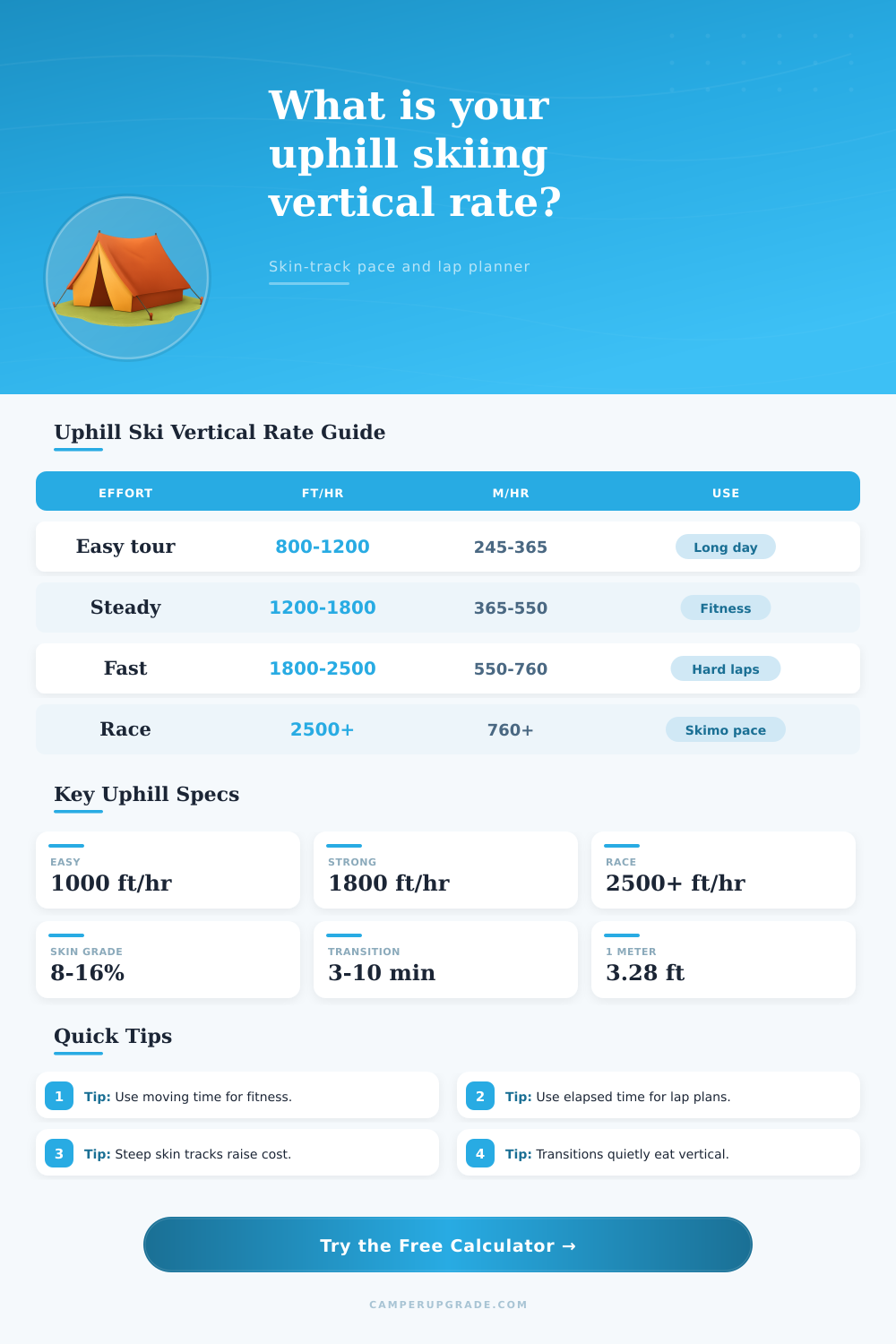
| Easy aerobic tour | 800-1200 | 245-365 | All-day pace | Useful for longer backcountry days with route decisions. |
| Steady fitness pace | 1200-1800 | 365-550 | Purposeful but controlled | Common resort uphill and regular training range. |
| Strong uphill workout | 1800-2500 | 550-760 | Hard breathing, limited talking | Works for tempo laps when transitions stay crisp. |
| Skimo race effort | 2500+ | 760+ | Race-specific intensity | Usually needs light gear, efficient technique, and firm tracks. |
| Condition | Pace effect | Common sign | Planning move |
|---|---|---|---|
| Firm groomed route | Faster | Easy glide and edge hold | Use fitness pace but keep descent time realistic. |
| Packed skin track | Baseline | Predictable grip and stride | Good condition for comparing training days. |
| Soft settled snow | Moderate drag | Shorter glide, deeper pole plants | Add time to each lap before committing. |
| Trail breaking | Major drag | Leader slows and rotates often | Plan fewer laps or more group breaks. |
| Icy skin track | Technique drag | Careful edging and kick turns | Use ski crampons when appropriate. |
| Tour factor | Typical range | Why it matters | Calculator input |
|---|---|---|---|
| Transition time | 3-20 min | Small delays multiply over laps. | Transition minutes |
| Descent time | 5-60 min | Powder, trees, and exits can dominate elapsed pace. | Descent minutes |
| Pack load | Race to heavy | Food, water, camera, rope, and rescue kit reduce rate. | Load setting |
| Altitude | Low to very high | High routes reduce sustainable output. | Altitude setting |
| Lap count | 1-6+ | Fatigue and repeated transitions alter the day plan. | Number of laps |
Your watch tells you it’s three hours until the lifts open or it gets dark. You’re standing on a skin track at the base of fresh powder. The sun is high. One last lap? Or are you ready to get back into your cozy car?
The mountain doesn’t give a damn what you want, however. It doesn’t care about intuition: Physics and fitness matters. When faced with that question, most skiers lets their gut mislead them, either racing the clock in a desperate effort to stay out longer or retreating too soon to their warm cars. This small difference, understanding the distinction between elapsed time and moving time, is the dividing line between an efficient ascent and a casual tour.
How to Plan Your Ski Tour Better
We start counting when we begin to climb and stop when we reach the summit. This gives us a number that is heavily flawed. Most folks don’t consider their descents, transitions, snacking, and photo stops. This calculator do all the math when you input your own variables. You’ll no longer have to guess if you had a slow day because you weren’t fit enough or if you were swapping out too many pieces of gear. It makes you think about the entire lap rather than just how long you took to get up on skins.
Maybe you’re hiking up a hill at eighteen hundred feet per hour, which sounds great. But that’s only true when you subtract the “transition” hours from the clock. If it takes you twenty to get down and ten to go back up then your total ascent come way down. Snow conditions are such a big variable that the tool asks for information more important than pure speed.
If there’s a well-groomed, firm track uphill, you’ll be able to glide efficienty and put out big bursts of energy. However, breaking trail through deeper snow can double your energy cost with no increase in vertical gain. To adjust for the drag, the calculator recognizes that a slow day in fresh snow is often a more accurate reflection of your fitness than a fast day on packed corduroy, something you might otherwise punish yourself over.
Similarly, altitude also plays a role. Less available oxygen means your sustainable output decreases above nine thousand feet. This helps you establish realistic expectations instead of beating yourself up for not performing at the same level as when you’re at sea level.
There are other factors that slow you down, load weight being one. Carrying rescue gear or an overnight pack alters the way you move when you walk and makes each step take more force to raise that additional mass. You may think you’re moving fine but your vertical rate will suffer. The tool’s presets assist with this by helping you simulate different load scenarios prior to heading out the door and seeing the impact various loads has on your pace.
For instance, someone taking their first tour could use the easy tour setting to pace themselves for a long social day while a racer dials in the skimo tempo set to see how much faster they can go with a high intensity effort on paper.
Finally, perhaps the least talked about input is transition time. How fast you change gears makes or breaks lap counts. Each stop take away from your total available time and a five minute transition adds up fast if you’re doing three laps. The table at the top of the page lays it all out and shows how various effort bands correspond to realistic times. It points out that vertical rate moving are the best measure of fitness. However, when determining if there is time for one more run before sunset, the only number that matters is elapsed vertical rate.
With a little planning, you’ll get a better idea of how hard your body can work before it needs a break. You can also separate the climb from the stop and the downhill to manage expectations. The idea is not to go faster to climb but to ski smarter. If you discover your body isn’t ready for the full route or number of laps, shorten it and drop one for safety’s sake. This way, you can still have fun on the day.
That means when you notice the drag off each condition and the price of each stop, you stop fighting the hill and begin to work with it. That clarity will transform the stressful scramble to beat the clock into a controlled ascent where you leave yourself plenty of time to savor the first turn in fresh snow instead of rush to it.
You should of planned ahead.