Climbing Pitch Count Time Calculator
Estimate how long a multi-pitch climb will take from pitch count, average lead time, following time, belay transitions, rope handling, party size, crux pitches, descent, and daylight window.
🧗Climbing time presets
⚙Route, team, and daylight inputs
Formula: route time = pitch count x adjusted lead/follow cycle + transitions + crux extras + queue delay. Total day time adds approach, descent, rappel station handling, and contingency buffer.
Pitch count time results
📊Pitch planning spec grid
📐Reference tables
| Route style | Lead time | Follow time | Transition | Planning note |
|---|---|---|---|---|
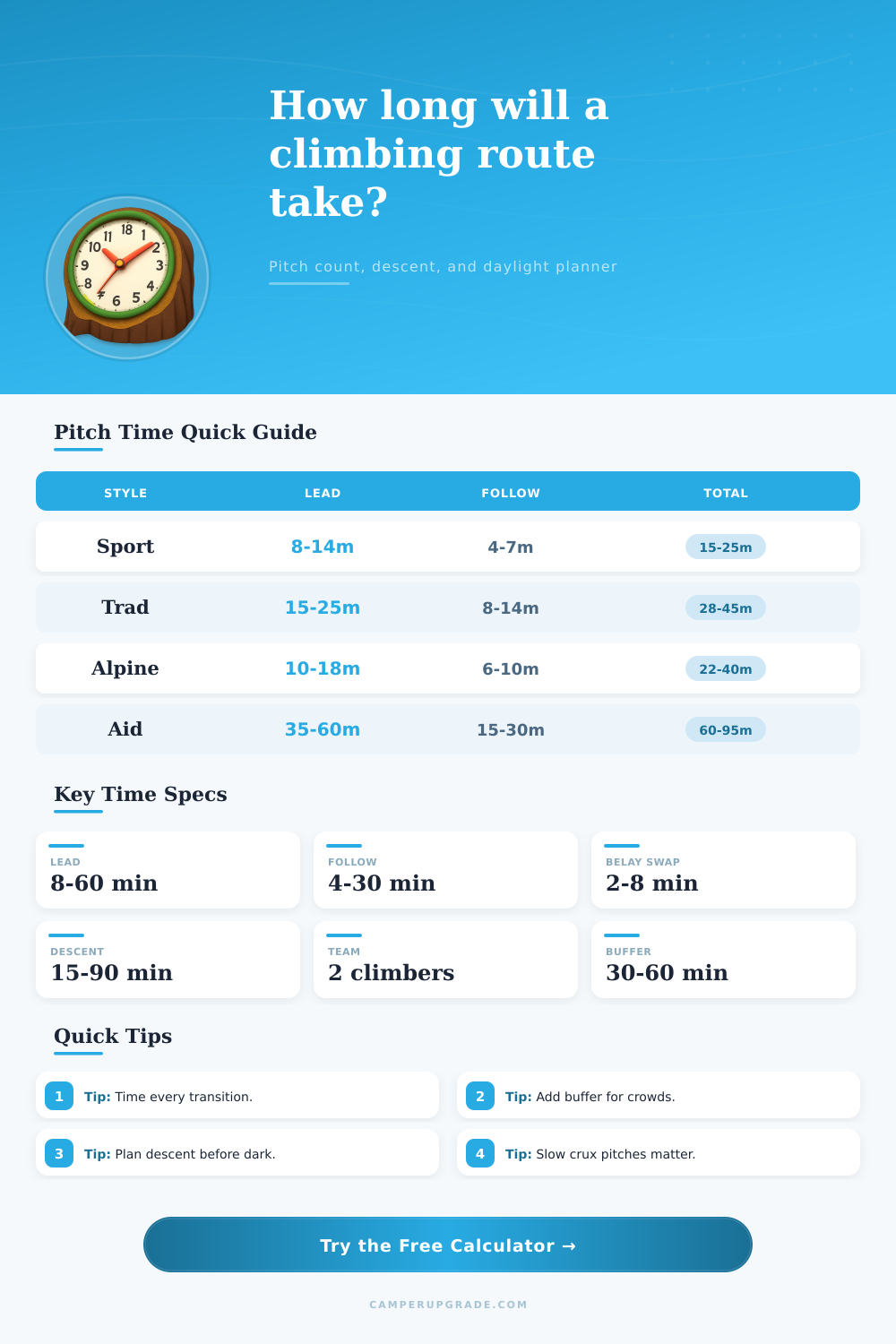
| Bolted sport multi-pitch | 8-14 min | 4-7 min | 2-4 min | Fast anchors and simple cleaning usually keep cycles short. |
| Moderate traditional route | 15-25 min | 8-14 min | 4-7 min | Gear placement, cleaning, and rack sorting add time. |
| Alpine rock route | 10-18 min | 6-10 min | 3-6 min | Easier climbing can be offset by route-finding and terrain changes. |
| Aid or mixed aid pitch | 35-60 min | 15-30 min | 6-10 min | Movement, cleaning, and hauling systems change the pace sharply. |
| Crag training laps | 6-12 min | 4-8 min | 3-6 min | Lower stakes, nearby packs, and repeated systems improve timing. |
| Team system | Lead effect | Follow effect | Transition effect | Use when |
|---|---|---|---|---|
| Swinging leads | Baseline | Baseline | Baseline | Both climbers lead similar difficulty and share the rack. |
| Block leads | No change | No change | 10-20% faster | One climber leads several pitches before swapping. |
| Leader fixes, follower ascends | 15-35% slower | 10-25% faster | Extra system time | Short aid walls or jugging practice days. |
| Simul section included | 25-45% faster | 25-45% faster | Fewer belays | Easy terrain where the team intentionally moves together. |
| Guide style with two followers | 5-10% slower | 20-40% slower | More rope management | A strong leader manages a party of three on broad belays. |
| Descent type | Base time | Rappel add | Delay risk | Calculator setting |
|---|---|---|---|---|
| Simple walkoff | 15-45 min | 0 min | Low unless route-finding is unclear | Enter descent only, 0 rappels. |
| Scramble descent | 30-90 min | 0-10 min | Moderate if tired or in approach shoes | Add buffer if terrain is loose. |
| Two-rope rappel route | 30-120 min | 8-15 min each | High with other parties or stuck ropes | Enter station count and queue delay. |
| Topout plus hike out | 60-180 min | 0-20 min | Moderate from route-finding and darkness | Put all off-route travel into descent. |
| Common route plan | Pitch count | Average cycle | On-route time | Planning read |
|---|---|---|---|---|
| Easy 4-pitch sport outing | 4 | 18-24 min | 1.2-1.8 hr | Good first multi-pitch timing check. |
| Moderate 6-pitch trad climb | 6 | 32-42 min | 3.2-4.5 hr | Transitions often decide the day length. |
| Long 10-pitch alpine route | 10 | 25-38 min | 4.5-6.8 hr | Route-finding and descent margin matter. |
| Short aid wall practice | 3 | 60-95 min | 3.0-4.8 hr | System setup can dominate the actual climbing. |
| Crag lap session | 8 | 16-25 min | 2.1-3.4 hr | Useful for volume goals and partner pacing. |
💡Pitch timing tips
By pitch four, you typicaly overestimate how much it’s going to take until you’re done for the day. You look at your watch with a sinking feeling that you wasted an hour or two. The sun is still high, and you feel good and energized.
Here’s where the rubber meets the road in rock climbing: multi-pitch climbs is not necessarily tests of raw vertical speed; instead, they are a test of time management, patience, and logistical know-how. More times than not, what you think will be “uphill” battle, takes less time then you thought when it comes down to actualy moving up the rock itself. The rest of it devours your daylight hours.
Why Managing Time Matters More Than Speed
The calculator above do that math for you, but knowing why it weighs some of these things differently will change how you pack bag. Lead time is a hot topic for most climber. They think about the exposure. They picture the crux move. The thing is if you’re taking fifteen minutes to lead a pitch and your follower spend ten minutes cleaning gear and eight minutes on anchor transitions, you’re not moving quickly. You’re moving at a slow, efficient pace.
It’s the overall cycle time that matters. How long does it take you to reset your feet? Hand off the rack? Drink a sip of water? Stack the rope? All those little micro-delays adds up quickly over six or ten pitches. Your route style determine your base level of efficiency, but intuition regularily fails to take this into account.
Sport routes with bolts clean fast since you’re removing clips rather than retrieving placed protection. Traditional routes weigh each pitch down considerabley. Two bodies manage hardware at once: the leader gets the rack out and the second cleans placements. A built-in bottleneck form here. Enter aid climbing where setup time overwhelms the clock, though the pace are slow.
You can’t just intuitively know what those numbers will be. You require a structure that consider the specific friction of your preferred style. One thing that many folks overlook is that team size factor into things as well.
A two-person team operate like a well-oiled machine. Bring out the third climber and you have double the wait time between belay. You also have twice the rope management to think about and twice the clean-up time. Because three people don’t travel in a straight line, the following and transition times increases to match in the calculator. They’ll also need to work around each other to negotiate space. Add in novices who need instruction over instinct, and you’re going to slow down even more if you’re teaching or guiding.
To ease some of the lag from block leading, it can help to keep the moving pieces rolling on simple ground. Break your average with crux pitches. The clock stops ticking in linear increments when you get to that section with hard ground or tricky route-finding. Twenty minutes deciding which direction the crack runs? Twenty minutes figuring out how to thread that darned draw?
Throwing in some cushion time on those parts will keep the rest of your plan from falling down when life throws you lemons. This is why the contingency percentage matters. It’s not “padding.” It’s insurance. It is insurance against rock reality and human error.
Most people don’t plan their descent until they realize they have no choice. Rappelling are slower than walking. You have to retrieve rope, uncoil it, manage the rope, set up stations, check your knots, and then do it all again. And if you’re exhausted at the top, that takes even longer. What appears as a short, ten-minute scramble on paper turn into a half-hour of cautious foot placement in the failing light and sore legs.
The calculator makes you put a price tag on that return trip. It also makes sure there’s plenty of daylight left for the most dangerous part of the day. Leave yourself room to screw up, start early and always respect the transition times just as much as you do the climbing. How fast you climb doesn’t determine your finishing time. It’s how well you manage the time in between pitch.