Climbing V Scale To Font Conversion Calculator
Convert bouldering grades between the Hueco V scale and Fontainebleau Font scale, then adjust the estimate for style, setting context, benchmark strictness, and grade range.
Grade conversion results
| V grade | Main Font equivalent | Nearby Font band | Typical use note |
|---|---|---|---|
| V0 | 4 | 3 to 4+ | Intro boulders; gym V0 can cover a wide spread. |
| V1 | 5 | 4+ to 5 | Easy problems with clearer movement and holds. |
| V2 | 5+ | 5 to 5+ | Moderate movement; often first outdoor target grade. |
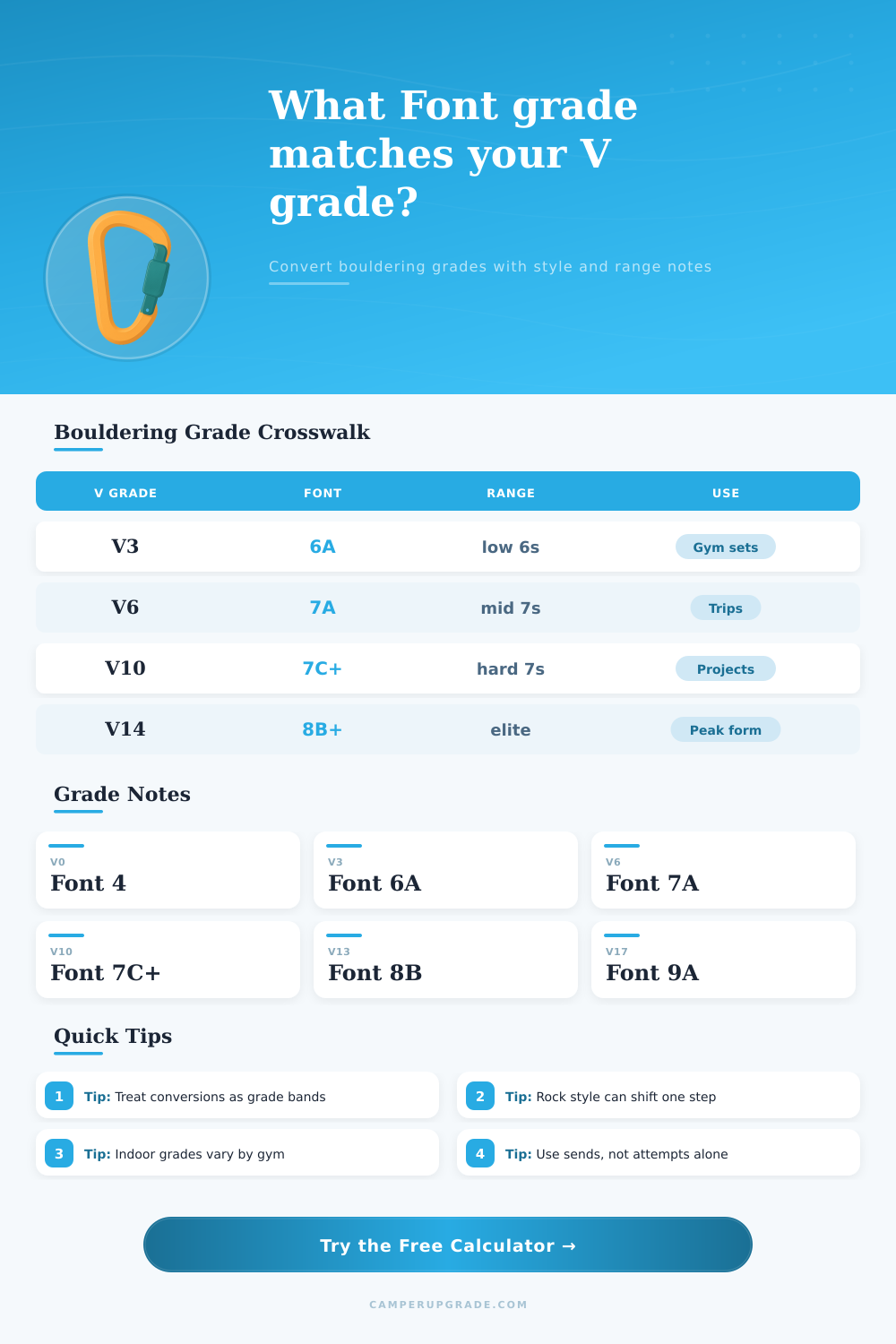
| V3 | 6A | 5+ to 6A+ | First low-6 Font reference in many conversion charts. |
| V4 | 6B | 6A+ to 6B+ | Intermediate grade where style begins to matter more. |
| V5 | 6C | 6B+ to 6C+ | Often a strong recreational benchmark. |
| V6 | 7A | 6C+ to 7A | Common bridge from hard 6s into Font 7s. |
| V7 | 7A+ | 7A to 7B | Advanced movement, smaller margins, and more projecting. |
| V8 | 7B/7B+ | 7B to 7B+ | Often split between 7B and 7B+ depending on source. |
| V9 | 7C | 7B+ to 7C | Hard outdoor bouldering with high style sensitivity. |
| V10 | 7C+ | 7C to 8A | Double-digit V grade near the upper 7 Font boundary. |
| V11 | 8A | 7C+ to 8A | First common 8A reference on many crosswalks. |
| V12 | 8A+ | 8A to 8B | Elite project range for many experienced climbers. |
| V13 | 8B | 8A+ to 8B | High-end difficulty with small consensus differences. |
| V14 | 8B+ | 8B to 8C | World-class benchmark grade in many areas. |
| V15 | 8C | 8B+ to 8C | Very rare difficulty; beta and conditions matter heavily. |
| V16 | 8C+ | 8C to 9A | Top-end modern bouldering grade. |
| V17 | 9A | 8C+ to 9A | Current highest consensus zone in bouldering. |
| Font grade | Estimated V grade | Conversion behavior | Practical interpretation |
|---|---|---|---|
| 4 | V0 | Broad entry band | Use as a low-end outdoor reference rather than a precise gym conversion. |
| 5 to 5+ | V1 to V2 | Two Font steps cover early V grades | Technique, height, and hold familiarity can dominate the grade feel. |
| 6A to 6B+ | V3 to V4/V5 | Intermediate overlap | Expect guidebooks and gyms to differ by a half grade or full grade. |
| 6C to 7A | V5 to V6 | Transition into Font 7s | Outdoor style and skin conditions can move the practical target. |
| 7A+ to 7B+ | V7 to V8/V9 | Advanced overlap | Different charts often split V8 between 7B and 7B+. |
| 7C to 8A | V9 to V11 | Hard bouldering range | Project history and consensus matter more than the raw conversion. |
| 8A+ to 8B+ | V12 to V14 | Elite grade band | Use the result as a range, especially across rock types. |
| 8C to 9A | V15 to V17 | World-class range | Small notation changes represent very large training differences. |
| Adjustment factor | Default effect | When to widen the range | Best use |
|---|---|---|---|
| Commercial gym | May feel softer or more compressed | New gym, reset week, comp-style blocs | Use as a training reference, not a strict outdoor prediction. |
| Training board | Finger and body-tension biased | MoonBoard, spray wall, steep symmetric sets | Compare to similar boards rather than all outdoor boulders. |
| Slab or technical feet | Can feel harder without local skill | Low friction, insecure mantles, tiny footholds | Add range if your pyramid is mostly steep climbing. |
| Steep power | Can feel easier for powerful climbers | Compression, heel hooks, dynamic moves | Read the range against your personal strengths. |
| Known sandbag | Shifts toward the harder side | Old guidebook grades or famous testpieces | Keep the main grade but plan attempts like the upper band. |
| Soft benchmark | Shifts toward the easier side | High-send-volume classics or generous gym sets | Use the lower band when planning outdoor expectations. |
| Scenario | Input grade | Likely conversion | Planning note |
|---|---|---|---|
| First outdoor trip after gym V3s | V3 gym | Font 5+ to 6A | Start below the direct conversion until rock texture and topouts feel familiar. |
| Board climber with V6 benchmarks | V6 board | Font 6C+ to 7A | Expect steep problems to translate better than slabs or rounded compression. |
| Font 7A travel circuit | 7A outdoor | About V6 | Plan warmups in the 6B to 6C zone and projects around 7A to 7A+. |
| Outdoor V8 project search | V8 outdoor | Font 7B/7B+ | Look for both 7B and 7B+ problems because charts split this grade. |
| First Font 8A goal | 8A outdoor | About V11 | Build a pyramid of 7C and 7C+ sends before treating 8A as a reliable target. |
| High-end guidebook comparison | V14 outdoor | Font 8B+ | At this level, consensus history is more useful than a single conversion line. |
Two bouldering grading systems exist: they are just used differently depending on where you climb. In the US we have the V scale with a starting grade of V0, then moving through the teens to reflect the most difficult problem. Most of the rest of the world, including Europe, has the Fontainbleau system (Font) where the grade reflects letters and plus (+) signs that denotes difficulty.
While there’s not a 1-1 swap between the two because they arise from distinct cultures of climbers and kinds of rock, a climber used to climbing outside on V6 may find themself facing something else entirely when faced with same number in a Font graded book. But it’s not math. Even though numbers may be close on paper, the feeling of the problem change based off style, setting and local agreement.
How to Use Boulder Grade Conversion
For example, a powerful climber may find a steep compression problem in a gym easier than a technical slab of similar grade. And there are other variables such as outdoor rock texture, skin conditions and the fact that guidebooks was written decades ago. As a result, most climbers use any given conversion as a starting range but not a fixed target.
When switching from this system to that, it’s useful to think in ranges. In some settings a V8 might be perfectly comfy in Font 7B; in others it feel more like a 7B+. That comes into play when you’re planning a trip and want to know what will keep you warm, compared to what is going to take a lot of work.
Input the benchmark feel of the problem along with the dominant movement style, setting, and direction of conversion. The calculator do those adjustments for you and allows you to preview one or two harder grades. This gives you a chance to construct a realistic pyramid rather than just guess at the next step.
This is something many climbers learn early in their traveling days. They show up and expect to onsight everything one grade higher at home, only to find out the locals are sandbagging it or they reset all those problems while stuck indoors climbing on plastic for months. That’s where the practical range the calculator spits out comes in. It helps you know how to deal with your uncertainty, and not freeze every decision until you’ve gotten up there yourself.
It also helps remind you of what matters. Recent sends at a grade are worth more than a quick flash, when considering if something is realistic. This is also true for training at home. Fingers on boards are often stiffer than they would be outdoors, whereas gym sets can feel soft depending on how much use the setter want.
By making adjustments based on style and context, you can let the output reflect these real differences rather than force everything onto one universal chart. With time, this allows you to know what adjustments is important to your specific strengths and which ones you can largely ignore. And used like this, conversion ceases to be a lookup task.
It’s part of your planning process. You input your known grade and add information about what kind of rock or plastic you’re actualy dealing with up there. Out comes a workable window. It is not exactly precise, but it is typically honest enough to keep moving onward rather than second-guessing each number on the wall.