Bikepacking Bag Volume Calculator
Estimate total bikepacking storage and distribute it across frame, seat, handlebar, fork, cockpit, and accessory bags using trip length, food bulk, water carried in bags, gear volume, compression, packing efficiency, and reserve room.
🚲Choose a bikepacking preset
Your Bikepacking Bag Volume Plan
📦Trip Cargo Inputs
👜Bag Capacity Inputs
Planning note: Labeled bag volume is not the same as useful packed volume. The calculator uses your packability setting to account for curved frame bags, harness gaps, closures, and hard items that leave voids.
📊Common Bikepacking Bag Volumes
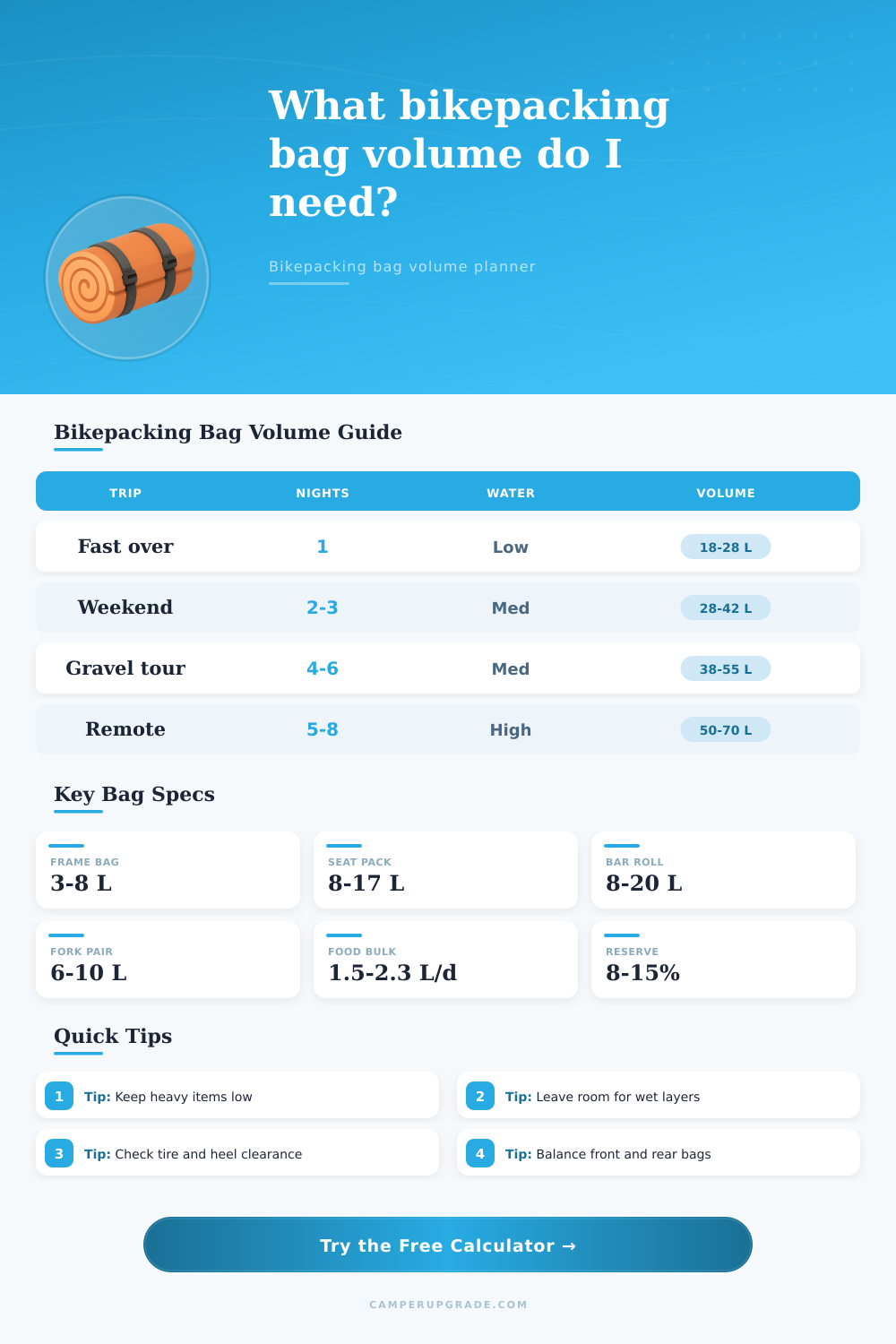
📋Trip Volume Reference
| Trip style | Typical total volume | Bag mix | Planning note |
|---|---|---|---|
| Credit card overnight | 10-20 L | Frame, cockpit, small seat | Minimal sleep gear or lodging replaces camp bulk. |
| Warm weather overnight | 20-32 L | Seat, bar, half frame | Enough for light camp kit and one food carry. |
| Weekend gravel route | 28-42 L | Seat, bar, frame, top tube | Most riders benefit from 10% spare room. |
| Cold or wet weekend | 36-52 L | Larger bar roll, seat, fork | Insulation and dry layers are bulky even when light. |
| Remote desert stretch | 45-65 L | Frame water, fork, rear add-on | Water volume can dominate the plan. |
| Fast race setup | 14-28 L | Frame, top tube, compact seat | Works only with minimal sleep and resupply spacing. |
⚖Load Placement Reference
| Bag zone | Best cargo | Avoid loading | Why it matters |
|---|---|---|---|
| Frame bag | Food, water, tools, spares | Bulky sleep gear | Low center storage improves handling. |
| Seat pack | Clothes, quilt, soft dry items | Heavy dense tools | Too much weight high and rearward can sway. |
| Handlebar roll | Shelter, pad, quilt, light bulk | Hard heavy items | Heavy front rolls affect steering precision. |
| Fork bags | Water, food, stove, compact gear | Very tall loose loads | Keep both sides similar for steering balance. |
| Top tube and feed | Snacks, phone, camera, battery | Fragile loose clutter | Items stay reachable while riding. |
| Accessory rack | Extra food or comfort gear | Unstrapped swinging loads | Useful when volume need exceeds soft bags. |
🧮Conversion And Packing Factors
| Factor | Use in calculator | Typical range | Field check |
|---|---|---|---|
| Liters to cubic inches | 1 L = 61.024 cu in | Exact conversion | Use when bag labels use different units. |
| Bag packability | Available liters used efficiently | 80-92% | Lower it for odd frame shapes or hard gear. |
| Compression gain | Soft cargo volume reduction | 5-20% | Higher only for quilts and clothing-heavy loads. |
| Reserve room | Extra capacity above need | 8-15% | More is helpful for wet morning repacks. |
| Food volume | Daily consumable bulk | 1.4-2.3 L/day | Snack-heavy menus take more room. |
| Water in bags | Bladders or packed soft bottles | 0-6 L | Do not count bottles mounted outside bags. |
💡Bikepacking Volume Tips
Bikepacking setups are all about getting volume just right: Does your frame bag rub the chain? Can’t get that tent bag cinched up? Getting the volume right feels like such a little thing, a minor detail until you realize it’s the difference between a comfortable carry and a constantly shifting load.
What happens after you pack, compress, balance, and add everything up? It can make all the difference between an easy, comfortable carry vs. It is a shifting load where every item matter. A good calculator take the guesswork out of this equation and converts your list into a usable number.
How to Use the Bikepacking Calculator
You will make these decisions in real life. So the inputs will reflect those choices: The number of days between resupplies are nights before resupply. Your food volume per day captures if it’s bulky snacks or dense meals. Water carried inside bags is for bladders that ride in your bag rather than on a cage. Volumes for shelter, clothing, and kitchen is for the bulky stuff that never packs into neat rectangles. The compression and packability percentages accounts for the reality that actualy bags aren’t rectangular boxes. And extra space allow for expanded packaging and wet layers.
These outputs tells you if a bag fits what you want to put in it. If you’ve got all your bags picked out, do they add up? Total capacity is capacity of your frame, plus your accessory bags, plus your cockpit bags, plus your fork bags, plus your seat bags, plus your bar bags.
Reserve capacity: This is a margin built in for unexpected items like wet layers or expanded food packaging. Gap: Is it close enough that you will be comfortable? Are you overpacked by a little or are you short on space? Do you lean toward packing heavier things at the front or the rear? This doesn’t matter unless you compare it to how you realy ride.
Common trip lengths have context in reference tables on the page. When you’re staying at lodges instead of using most of your own sleeping gear, an overnighter with a credit card can stay below twenty liters. Add extra layers, add water, and suddenly a multi-day, no-resupply, remote route is pushing into fifty to seventy liter range. They are not rules. These are starting points. They help you judge if your plan falls inside or outside normal experience.
It’s not just how much, but also where the weight go. To increase stability, heavy stuff should of placed in frame bag, centered and as low in the frame as possible. Other soft bulky stuff like food, clothes, etc., can be carried in bar roll or seat pack without negatively affecting handling. The calculator recommend placing dense cargo low and forward to leave room for snacks or tools while keeping load stable.
Now it’s time to load up your bags and take it for a spin around town on a short loop with the same weight you’ll have on your trip. What the volume numbers don’t account for is the hidden constraint of clearance. Yes, your seat pack may fit the liters but now it sags or swings into your heels on technical sections and rubs your tires. You have fork bags on and they needs to match on each side or your bike doesn’t feel right. The clearance sensitivity setting on the calculator will flag if you’re leaning too hard on bar or seat volume for a smaller frame.
In the end you still has to check in person with everything loaded for clearance around your tires and heels. The more I use it, the better as it becomes part of the routine prior to any ride: “What am I taking?” rather than “I have these big ol’ bags, what fits?” You develop a sense over time for what is realy compressible and what requires extra space (often larger than anticipated). This makes the calculator no longer just a once-in-a-while pre-trip exercise but a log of your kits behavior on road.