Bike Chain Length Calculator
Estimate bicycle chain length from chainstay, chainring, cassette, suspension growth, link rounding, master link choice, and rear derailleur capacity.
1.Bike presets
2.Drivetrain dimensions
Chain sizing result
3.Chain sizing reference
4.Reference tables
| Drivetrain | Usual method | Extra links | Important check |
|---|---|---|---|
| Road 2x | Big ring plus big cog formula | 2 links | Rear derailleur must not over-stretch in big-big. |
| Gravel 1x | Single ring plus largest cassette cog | 2-4 links | Check clutch derailleur angle and chain retention. |
| Full-suspension MTB | Use chainstay at maximum chain growth | 4-6 links | Compress suspension or use maker growth data. |
| Single speed | Use exact center distance and sprockets | 0 links | Dropout adjustment sets final chain tension. |
| Bike style | Chainstay range | Common gears | Typical result |
|---|---|---|---|
| Road race | 15.8-16.3 in | 52/36 and 11-30 | 108-110 links |
| Endurance road | 16.1-16.7 in | 50/34 and 11-34 | 110-112 links |
| Gravel | 16.7-17.4 in | 42T and 10-44 | 112-116 links |
| Trail MTB | 16.9-17.8 in | 32T and 10-52 | 116-122 links |
| Rear derailleur rating | Example capacity | Works well for | Risk sign |
|---|---|---|---|
| Short cage road | 28-35T | Close road cassettes | Pulley cage tight in big-big. |
| Medium cage road | 35-41T | Compact road and light gravel | Slack chain in small-small. |
| Gravel clutch | 38-47T | 1x or subcompact gravel | B-screw maxed out. |
| MTB long cage | 45-52T | 10-50 or 10-52 cassettes | Chain pulls tight at sag. |
| Raw result | Even rounding | Master link | Cut instruction |
|---|---|---|---|
| 109.1 links | 110 links | Included | Leave 110 total links after connector. |
| 110.0 links | 110 links | Included | No rounding needed. |
| 110.2 links | 112 links | Included | Round up, then dry-fit big-big. |
| 115.8 links | 116 links | Included | Use a 116-link chain only if checks pass. |
5.Practical fitting notes
For example: When installing a new bike chain you need to get it to the right length so your drivetrain work correctly. A chain that is too short will bind in big gear. If it is too long, the rear derailleur sags or the chain drop out as the suspension compresses. It’s not complicated math-wise, but there are inputs based off bike geometry and here’s where things can go wrong.
First comes the distance from the crank spindle to the rear axle. That number should accounts for any increase from moving the full-suspension frame through its travel. For instance, the enduro bike might have ten to twenty millimeters added as the suspension lowers to accommodate the rider’s weight; and a rigid or hardtail bike has virtually no change to that distance. Enter your adjusted (longer) chainstay value into calculator and let it do the math, but the important part is understanding why that number changes between bikes in the first place.
How to Find the Right Chain Length
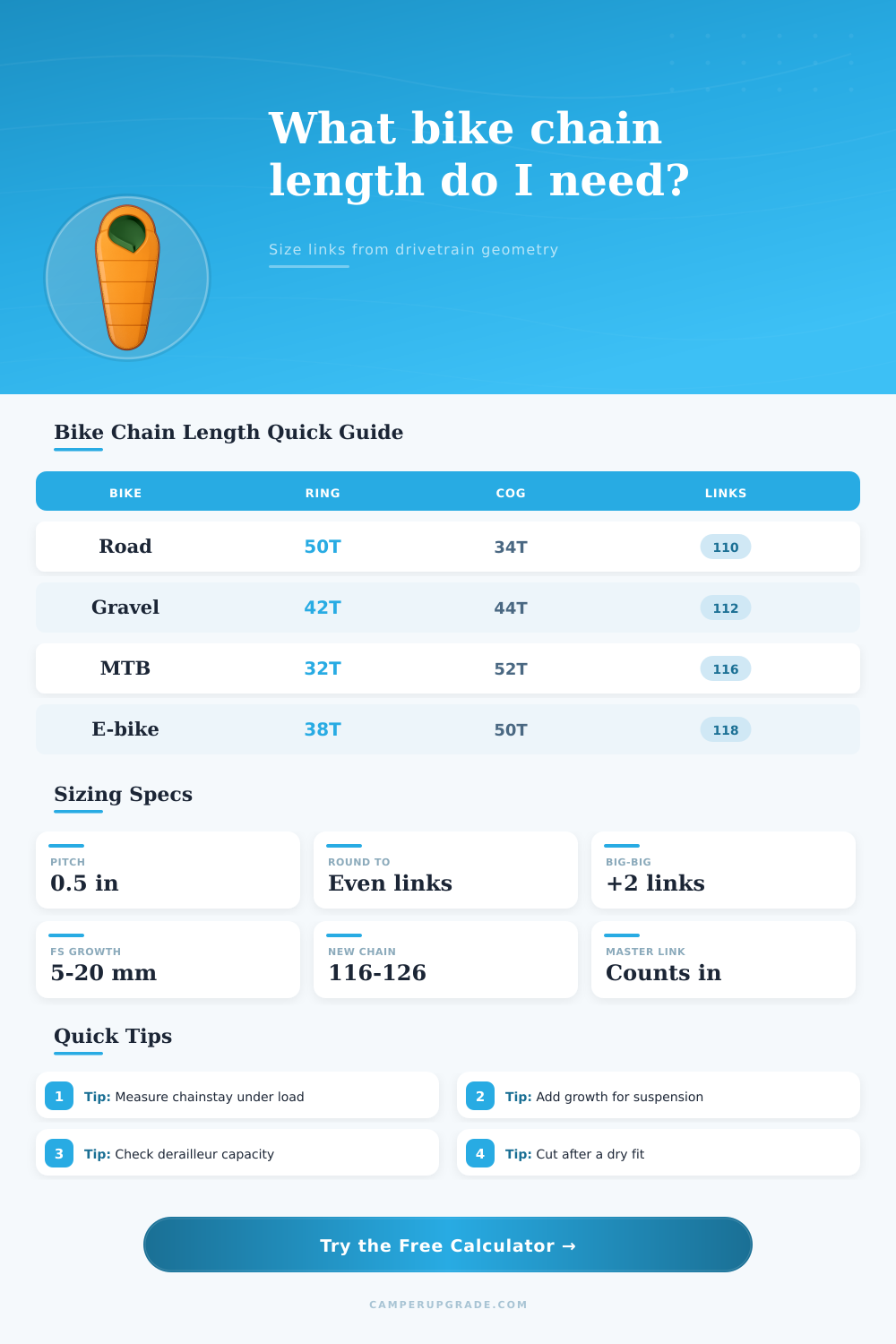
On most suspension designs, the chain arc is tuned such that the rear wheel travel in an arc which stretches the chain at some point(s). If you don’t consider that arc, you’ll end up with a chain that looks right on work stand, but too tight out on the trail. There are two reasons why the size of the front and rear sprockets is important. One is that they dictate how many links of chain you’ll need to wrap around both the largest cog and the largest ring at the same time. Another reason is that it helps define the capacity required by the rear derailleur. For example, a 34-tooth cog and 50-tooth ring require less chain wrap then a 52-tooth cassette and a 32-tooth single ring.
The calculator take the sum of those differences and then checks whether the value is higher than what you entered as the derailleur rating. If so, there won’t be enough room for the chain on either the smallest or the largest end. Alternatively, the derailleur cage may bind when the suspension sags. Most cyclists find this out the hard way… After installing the chain.
Find more information here. Add another allowance for the position of the derailleur cage with a chain stretched out all the way. This depends on the bike: One inner and one outer link will be located within the jockey wheel. A long-travel bike might require four or six additional links to prevent the cage from collapsing under itself at full extension.
Here’s the rounding rule: Does the result fall on an even number of links? If so, most moddern chains go in neatly. And remember: The quick-link connector doesn’t count as an additional component; it’s part of the tally from the start. You then have to try it out on the bike and measure length. Thread the chain around the big cog and around the big ring (without threading through the derailleur). Rotate the rear wheel and ensure the chain doesn’t rub against the derailleur cage or touch the chain stay. Next, shift to the smallest cog and ring to check for excess slack. The derailleur should now be stretched all the way open. If not, there’s still a bit of play left in the chain. If it is, you either have a derailleur with the wrong capacity or the chain are too short for your largest gear combination.
So what’s in the box? How do you know how many links to cut? First off, the printed length of a chain is just a starting point; many road groups comes with 116 links, while wide-range mountain chains often start at 126. Mountain Wide Range starts out around 126. If your chain comes long, there are clear instructions as to just how many links to snip out (calculator). Just don’t make the frequent mistake of cutting up a chain that is actualy too short for the job, you can avoid this.
But really, what we’re talking about here is how chain length affects the frame and drivetrain moving in unison when you’re putting power down. That’s why while the numbers on the page will give you a good place to start, the ultimate test comes once your wheels are on the ground and your suspension works its way through its travel. In this case, they both line up and your chain shifts cleanly, remains quiet and lasts longer than if it were sized only by feel. You should of checked everything before riding.