Trail Uphill Slowdown Calculator
Estimate how much an uphill section will slow your hike or trail run by combining grade, elevation gain, pack load, footing, altitude, weather, fatigue, and planned breaks.
⛰Load a climb preset
📍Route and pace inputs
🎒Load, trail, and conditions
Uphill slowdown estimate
📊Climb diagnostics
🧭Uphill grade planning table
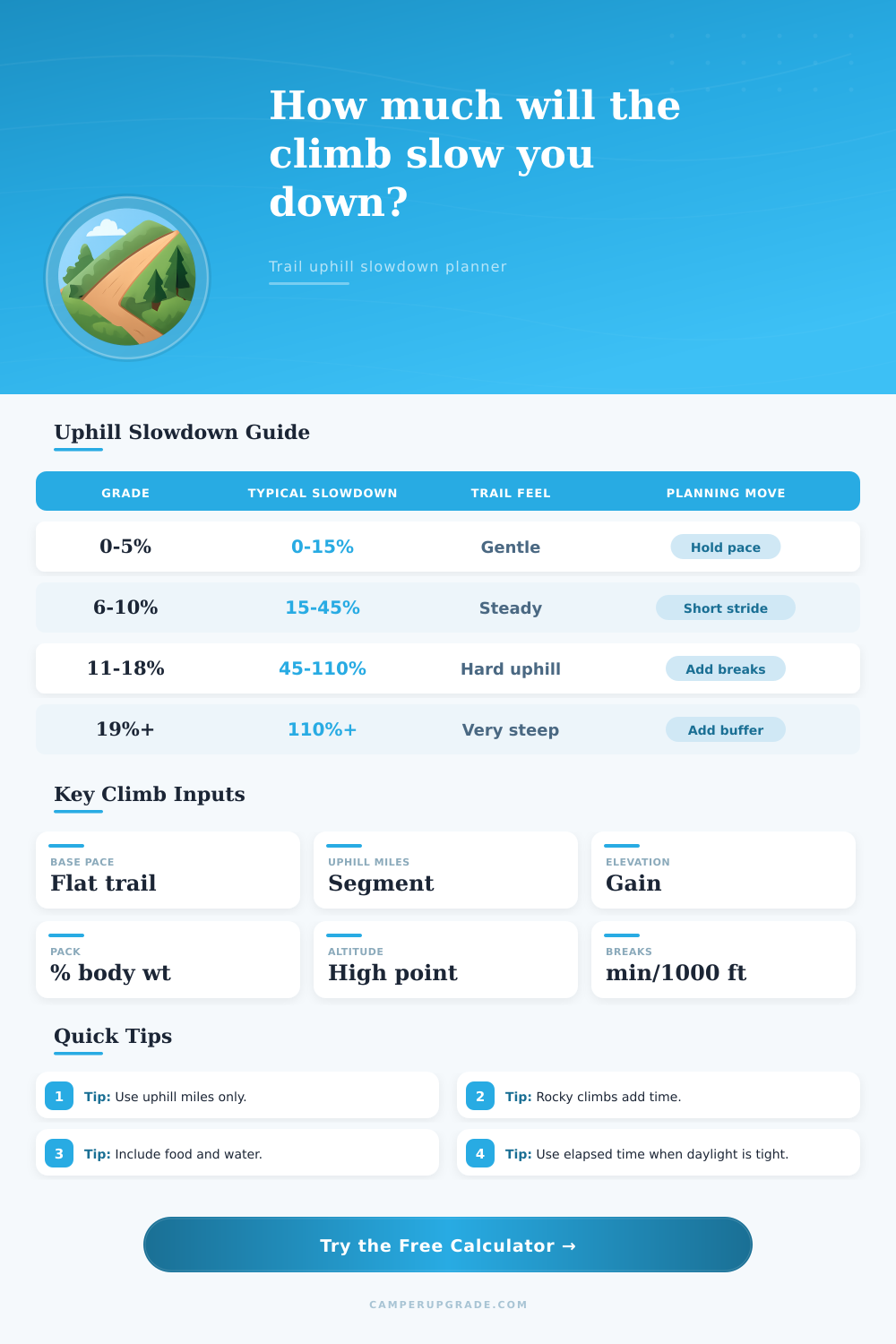
| Average grade | What it usually feels like | Slowdown cue | Break strategy | Planning caution |
|---|---|---|---|---|
| 0-5% | Gentle rise, runnable for many | Flat pace to about 15% slower | Normal snack/water rhythm | Watch heat and exposure more than grade |
| 6-10% | Steady climb, breathing changes | 15-45% slower | Micro-pauses every 20-35 minutes | Heavy packs start to matter |
| 11-18% | Hard sustained ascent | 45-110% slower | Short breaks by elevation blocks | Check daylight and water before committing |
| 19-30% | Very steep trail, stairs, switchbacks | 110-220% slower | Frequent short rests beat one long stop | Footing and descent risk may dominate |
| 31%+ | Scramble-like or route-finding terrain | Highly variable | Use terrain-specific judgement | Do not treat as normal hiking pace |
Your watch will be the second to notice it. Your legs will notice it first. On a climb, the gap between expectation and reality opens, and most of our plans fall apart there: the stretch that seemed doable on the map now stretches out before you in real time. That’s what the uphill slowdown calculator measures. It tracks distance from where you are to what you thought would be, once all the real variables is layered on top of your climb numbers and your flat pace, transforming a pleasant grade into a longer day.
Not all elevation gain are created equal. A steady 8 percent rise feel different than a 15 percent pitch that lasts only a quarter mile. Your pack weight also enters into it: Even if the trail appear the same, a forty five pound overnight load slows you down more then a twenty pound day pack. Once you reach about six thousand feet, altitude add more drag. And then there are temperature fluctuations, which do the rest. Cold below thirty five degrees costs energy, just like heat above eighty degrees does (though in a different way). Instead of guessing which of those affects you the most on any particular climb, the calculator roll them up for you.
How to Use the Uphill Slowdown Calculator
Climb Shape & Footing Matter More Than You Think The smoother the switchback, the better: When a trail is well-maintained, you can maintain your rhythm. When it’s loose gravel or has a direct fall line, you must takes shorter steps and pause more frequently at a micro level. If two climbs has the same gain in elevation, you’ll always hike slower up stairs or talus than you would on dirt, and the calculator accounts for this variation with the shape and footing settings.
Fatigue Timing The same climb beginning fresh will cost you less than same climb when your legs are already fatigued by eight miles. The other variable most hikers don’t realize is breaks. On paper, your hiking speed may appear enough, but by adding in regrouping time at the top of a hill, drinking water, or changing out layers, you can burn through whatever margin you assumed you had.
You can play with the rate to see what works for you prior to setting foot outside the trailhead. After a couple thousand feet of elevation gain, an extra minute per thousand start to add up. For example, if a hike out of town takes me 2 hours at flat hiking speed, I’ll know that when my hike-planner says “4+ hours” for a descent, it will probably be true. Likewise, a hike with 1,000’ of climbing should of be an hour longer than flat pace, give or take a bit depending on your speed.
You can find this kind of information in the reference table on the page. It gives a quick sense of what various grades tend to look/sound/feel like and roughly how much more time they tend to add. It’s no rule book, though: it’s intended to help you make a decision about whether the numbers generated by the calculator are consistent with your experience on similar terrain. For instance, if my hike-planner says “3+ hours” for a 10 mile hike on relatively flat ground, that sounds reasonable. But if it’s saying something more like “5 hours,” the smart play would be to check bailout points and daylight windows before committing.
But that’s where real trails make things complicated for the calculator. A section with an unexpected snowfall? There might be a sudden change in weather. Your group pace spread? Or it could be how you decide which route to take next. That will overrule what the moddern model tells you. It provides a more clear starting estimate than most folks have in their head. But it ultimately is up to the dude on the ground to make the final call.
Set your realistic expectations based off this tool and then adjust as the mountain shows you something you didn’t see in the numbers.