Hiking Water Weight Per Liter Calculator
Convert trail water from liters to pounds, add container weight, and see how much margin you have for the longest dry stretch.
| Assumption | Density used | Weight per liter | Trail note |
|---|---|---|---|
| Cold stream, 4 C / 39 F | 1.0000 kg/L | 2.205 lb/L | Maximum practical density for fresh water. |
| Cool bottle, 10 C / 50 F | 0.9997 kg/L | 2.204 lb/L | Good default for many hikes. |
| Room temperature, 20 C / 68 F | 0.9982 kg/L | 2.201 lb/L | Common indoor filling assumption. |
| Warm bottle, 30 C / 86 F | 0.9957 kg/L | 2.195 lb/L | Slightly lighter per liter, not enough to change packing decisions. |
| Hot camp water, 60 C / 140 F | 0.9832 kg/L | 2.168 lb/L | Useful for camp kitchen or hot-bottle planning. |
| Container style | Typical empty weight | Best planning use | Calculator behavior |
|---|---|---|---|
| Ultralight soft bottles | 35 g each / 1.2 oz | Low pack weight with flexible storage. | Multiplies by number of containers. |
| Thin disposable-style bottles | 38 g each / 1.3 oz | Very light bottle-based carry. | Multiplies by number of containers. |
| Hard hiking bottles | 180 g each / 6.3 oz | Durable carry on rough trips. | Multiplies by number of containers. |
| Hydration bladder with hose | 190 g base / 6.7 oz | Hands-free sipping while moving. | Uses base bladder weight plus small count adjustment. |
| Trail running soft flasks | 55 g each / 1.9 oz | Front-vest carry and frequent sipping. | Multiplies by number of flasks. |
| Collapsible water bag | 80 g each / 2.8 oz | Camp or dry-camp backup water. | Multiplies by number of bags. |
| Mixed bottles plus bladder | 130 g base plus 40 g each | Bladder convenience with bottle backup. | Adds mixed base and bottle count. |
| Carried water | Water weight | With light bottles | Typical hiking role |
|---|---|---|---|
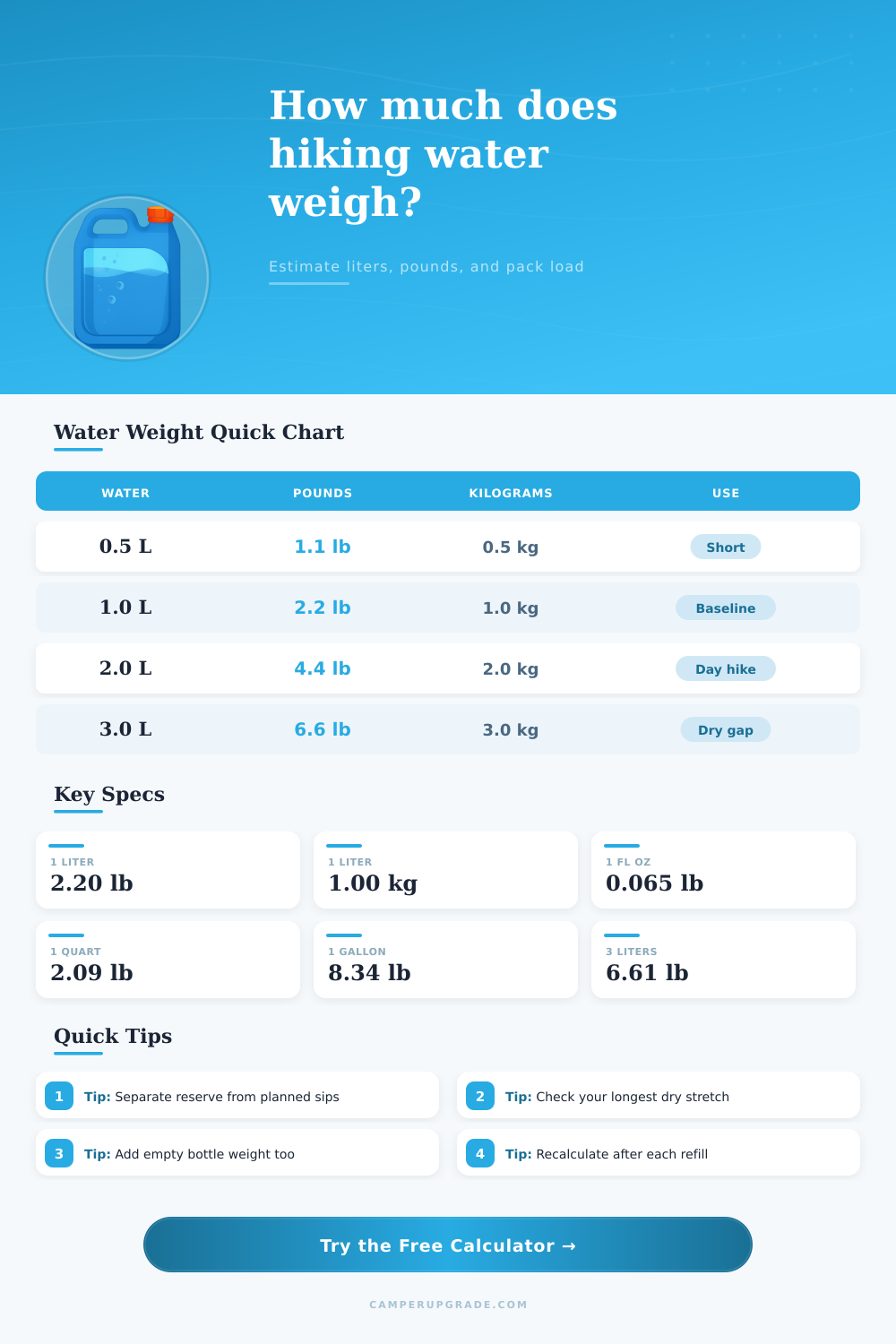
| 0.5 L / 16.9 fl oz | 1.10 lb / 0.50 kg | About 1.19 lb / 0.54 kg | Short refill-to-refill section. |
| 1.0 L / 33.8 fl oz | 2.20 lb / 1.00 kg | About 2.29 lb / 1.04 kg | Baseline day-hike bottle. |
| 1.5 L / 50.7 fl oz | 3.31 lb / 1.50 kg | About 3.48 lb / 1.58 kg | Cool half-day carry. |
| 2.0 L / 67.6 fl oz | 4.41 lb / 2.00 kg | About 4.59 lb / 2.08 kg | Common warm day start. |
| 3.0 L / 101 fl oz | 6.61 lb / 3.00 kg | About 6.86 lb / 3.11 kg | Longer dry stretch or hot climb. |
| 4.0 L / 135 fl oz | 8.82 lb / 4.00 kg | About 9.13 lb / 4.14 kg | Dry-country planning load. |
| 5.0 L / 169 fl oz | 11.02 lb / 5.00 kg | About 11.42 lb / 5.18 kg | Heavy carry for scarce water. |
| 6.0 L / 203 fl oz | 13.23 lb / 6.00 kg | About 13.71 lb / 6.22 kg | Very heavy start; reassess refills. |
| Scenario | Starting liters | Water weight | Planning emphasis |
|---|---|---|---|
| Cool local loop | 1.5 L | 3.3 lb / 1.5 kg | Enough for a short outing with modest reserve. |
| Warm day hike | 2.5 L | 5.5 lb / 2.5 kg | Good balance for moderate heat and distance. |
| Hot exposed ridge | 3.5 L | 7.7 lb / 3.5 kg | Watch how much of the load is water at the start. |
| Dry desert section | 5.0 L | 11.0 lb / 5.0 kg | Plan capacity, refill certainty, and pace together. |
| Trail run vest | 1.0 L | 2.2 lb / 1.0 kg | Small volume, high attention to refill timing. |
| Overnight camp start | 4.0 L | 8.8 lb / 4.0 kg | Separate drinking water from cooking water. |
| Rate | 3 hour stretch | 5 hour stretch | Trail meaning |
|---|---|---|---|
| 0.30 L/hour | 0.9 L plus reserve | 1.5 L plus reserve | Cool conditions or slower sipping. |
| 0.45 L/hour | 1.35 L plus reserve | 2.25 L plus reserve | Moderate day-hike default. |
| 0.60 L/hour | 1.8 L plus reserve | 3.0 L plus reserve | Warm, exposed, or steady climbing. |
| 0.80 L/hour | 2.4 L plus reserve | 4.0 L plus reserve | Hot conditions or heavy exertion. |
When the next sure water source is many miles off trail, there’s that dilemma at the trailhead, how much water do I want to carry? Water is usually heaviest thing in your pack, so it impacts amount of gear you will carry as well as your energy level during hike. You’ll soon discover if you have too little or too much water as you begin ascending.
Before departure, this require some planning. How much do you drink? What’s the distance between water source? What are weights of your empty bottles? Depending off these factors, your load will be manageable or excessive. By removing the guesswork with a simple liter to carried weight converter (with reserve buffer), you’ll avoid common pitfalls of over-packing and running out.
How Much Water to Carry on Your Hike
To use it, though, you has to input certain things. Pace include both planned distance and moving time. How fast will the load go down? The system know this from how much you’re drinking (adjusted by effort and heat). Will you run out before next spring? This determine if you have any margin of safety left.
What percent of your total load is water? Body weight and dry pack weight tells you that and help you determine if you want to carry one more bottle or simply rely on the next spring. Choice of container make a difference too. Before filling your water containers with water, a bladder or hard bottle will weigh more, like a few ounces. A soft bottle is virtualy weightless. The calculator split out those empty weights so you can see true system load instead of just liquid.
Temperature does make a difference, though not as much as one might think. Cold water from the stream is actualy a bit heavier then warm water in your bottles. This become apparent as you tally every last ounce over course of an extended hike.
That’s all there is to it. How much water will be left for your driest spot after you subtract what you plan to drink and what you plan to use from your reserve? If the answer is positive, great, kick back a bit. If not, either speed up on your way into town next time. If you are coming from town, slow down. This way you can ensure you have enough, get some more to carry in, or recognize you’re gonna cut things close.
For most people standing at beginning of their hike, this is all they require. Whether it’s a multi day section through the desert or a quick loop over a few ridges, this make sense. It simply depends on scale of your dry stretch and what level of buffer you consider reasonable. When you have numbers in hand, it ceases to be this vague worry, but instead becomes a straight up decision between caution and comfort.