Hiking Pace by Pack Weight Calculator
Estimate how body weight, starting pack weight, daily consumables, terrain, gain, altitude, heat, and planned stops change your hiking pace and trip time.
1.Trail presets
2.Inputs
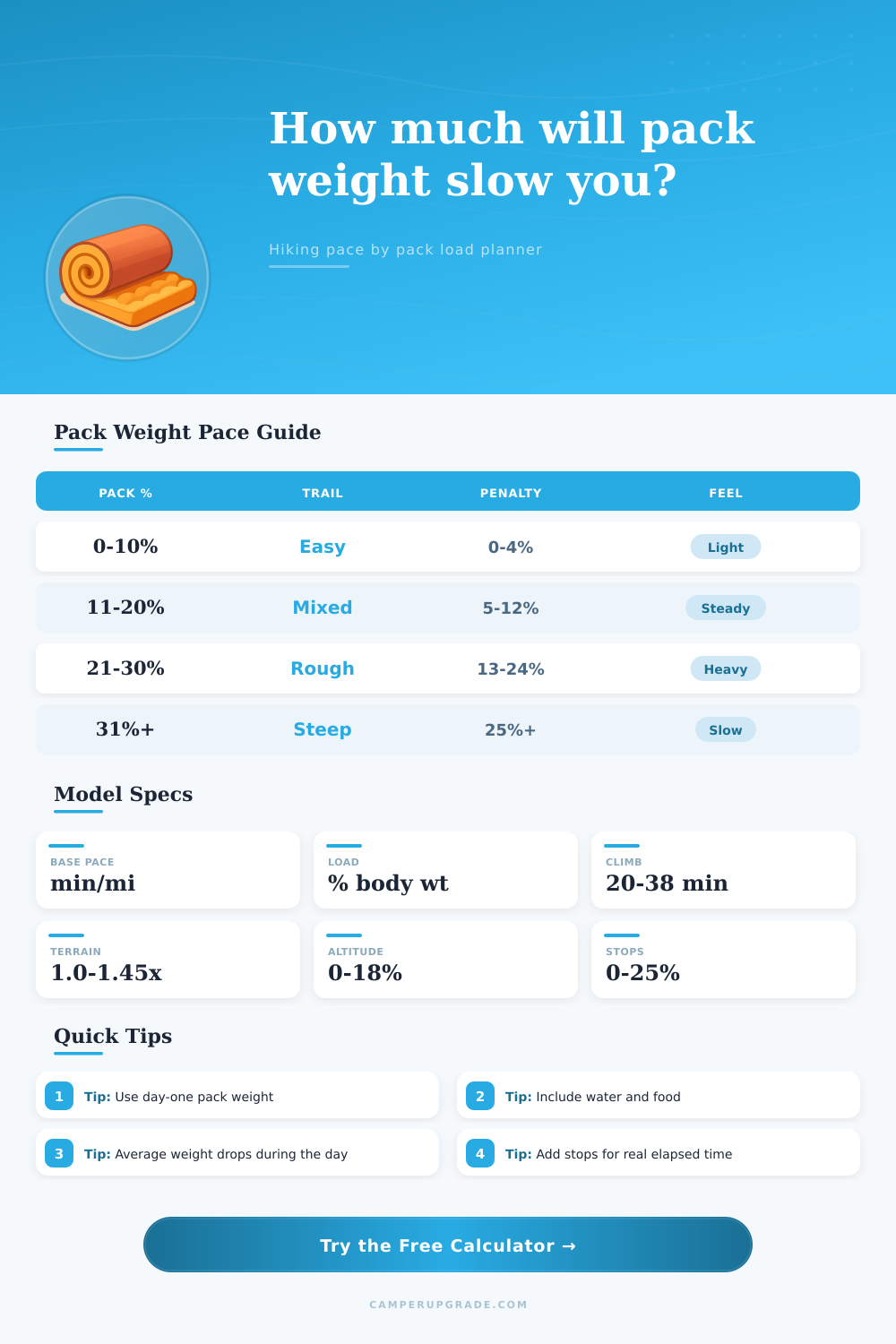
Model note: This planner uses average carried load, a load penalty based on pack percent, Naismith-style climb minutes, descent drag, altitude stress, footing factor, heat factor, and a separate elapsed-time stop buffer.
Pack-adjusted pace estimate
3.Load reference
4.Pack weight pace tables
| Average pack percent | Smooth trail penalty | Rough trail penalty | Planning note |
|---|---|---|---|
| 0-10% of body weight | 0-4% slower | 2-7% slower | Good for faster mileage if footing stays easy. |
| 11-20% of body weight | 5-10% slower | 8-15% slower | Common overnight range; climbing pace starts to change. |
| 21-30% of body weight | 11-18% slower | 16-26% slower | Use shorter days or more stop buffer on steep routes. |
| 31-40% of body weight | 19-30% slower | 28-42% slower | Heavy load; descents can become slower than expected. |
| 40%+ of body weight | 30%+ slower | 45%+ slower | Repack, split group gear, or reduce distance where possible. |
| Route condition | Factor used | Best use | Watch for |
|---|---|---|---|
| Smooth dirt or rail trail | 1.00x | Crushed path, maintained tread, low roots. | Sun exposure can still slow pace. |
| Normal singletrack | 1.08x | Typical forest trail with small obstacles. | Small climbs add up over long distance. |
| Rocky or rooted trail | 1.18x | Uneven trail where foot placement matters. | Heavy packs make balance slower. |
| Loose scree, sand, mud, or snow | 1.30x | Soft or sliding surfaces with wasted steps. | Water and winter loads multiply the penalty. |
| Off-trail bushwhack | 1.45x | Navigation, brush, blowdown, or talus. | Use route segments instead of one whole-route estimate. |
| Example route | Distance | Gain | Typical pack | Planning pace |
|---|---|---|---|---|
| Easy lake loop | 5 mi | 400 ft | 8-12 lb | 18-23 min/mi |
| Weekend ridge hike | 10 mi | 2200 ft | 25-35 lb | 25-34 min/mi |
| High route day | 8 mi | 3200 ft | 22-32 lb | 32-45 min/mi |
| Desert water carry | 14 mi | 1500 ft | 35-50 lb | 27-40 min/mi |
| Fastpacking trail | 18 mi | 2500 ft | 10-18 lb | 15-24 min/mi |
5.Planning tips
You move differenty when carrying pack weight. That fact is obvious at first. And the effect build up silently with time. You may not notice a couple of added pound on a brief stroll, but when you spend hours and miles covering ground, you see them in tired legs, slower ascents, and knee pain on descents.
It’s not a matter of if weight will matter. It’s just a matter of how much it will matter on the route you’re actualy going to walk. Hikers tends to focus on their initial pack weight. But the number that matters more is the one you have when your moving. During the day, you’ll lose food and water which will lighten your pack. The halfway point between your beginning and ending weight are a truer representation of what it’s like to hike. That one change can often account for why certain days were easier then expected (even though the numbers said otherwise).
How to Plan Your Hike Time
The terrain also adds its own multipliers: If you have to pay more attention to place your feet carefuly (e.g., on rocky or rooted trails), the cost increase if your pack is heavy enough to raise your center of gravity. Climbing steep sections increases the time required to get a given number of thousands of feet of gain, and the bigger your pack, the greater the penalty for carrying it up there. Snow and sand waste energy with each step, so the same distance take significantly longer on a soft trail versus one that’s firm.
There’s also altitude and heat. You’ll notice your body does more work at higher elevation for the same amount of effort. You will also notice that sun wears you out with extra dehydration and additional breaks. These things are almost never shown on pace charts but frequently determine if you’re done by sunset or stumbling along in the headlamp for final hour.
But separating elapsed time into moving time is where real planning benefit lies. Enter your distance, elevation change, pack weight, body weight, and anticipated stop buffer, and the calculator do the rest of the math. That’s when it factors in all those pesky things like layer changes, snacks, and photos, things you always do that don’t factor into straight-up moving-pace estimations. Having both numbers give you a better idea about setting realistic turnaround times and figuring out if a longer day might realy be possible.
The most common errors are not accounting for the fact that you move slower downhill, even with heavy pack. Other errors include assuming your pace stay the same regardless of terrain. Finally, people often use a starting pack weight as a constant value. (If a section starts out on smooth trail and finishes in loose scree, it requires two estimates; not an average.)
We’re not aiming for fast. We want our energy and time spending to be in sync with how much time we realy have. A doable day… Rather than one where you feel like you’re racing your own group, happens when those figures align. You should of planned better.